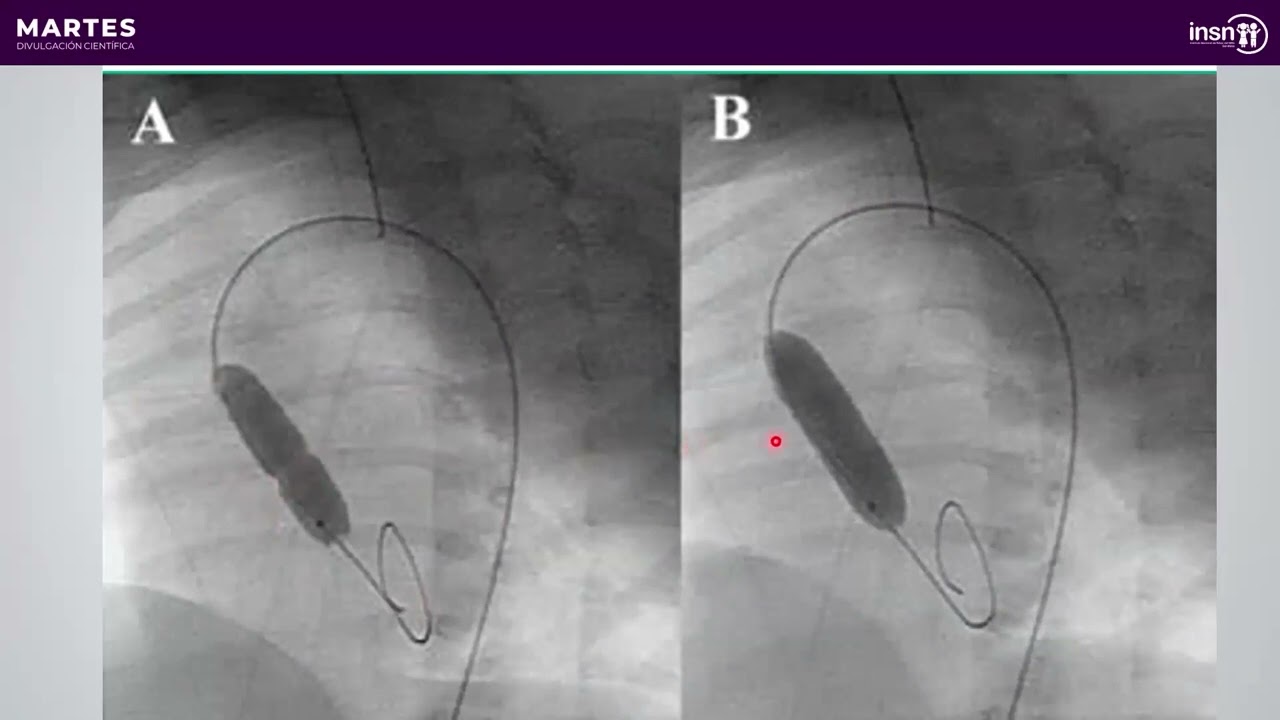
Valvuloplastía aórtica bajo guía ecocardiográfica en un lactante menor en un centro de referencia nacional del Perú: reporte de caso
Keywords
Summary
146 words
Critical Evaluation
Value of the Information & Strength of the Argument
The value of the information lies in its practical demonstration of a complex interventional procedure performed without fluoroscopy, which is particularly relevant in settings with limited access to advanced imaging. The argumentation is based on a single case, which limits the strength of the conclusions. However, the speaker provides a clear rationale for the approach, citing the need to adapt to equipment failure and the potential benefits of reducing radiation and contrast exposure. The discussion of technical details, such as balloon sizing and the use of native heart rate, adds practical value. The speaker acknowledges the limitations and the need for a specialized center, which strengthens the credibility of the presentation.
Scientific Rigor, Source Quality, Title Accuracy
The scientific rigor is moderate: the presentation is a case report, which inherently has lower evidence strength. The speaker does not cite specific literature or references during the talk, but mentions that the case was published. The title accurately reflects the content. The speaker’s credentials and institutional affiliation lend some credibility. The lack of peer-reviewed references and the single-case nature are limitations. The video description does not provide additional sources. The presentation is clear and well-structured, but the absence of a formal literature review or comparison with existing evidence reduces its scientific depth.
219 words
Title / Content Match
The title accurately reflects the content: a case report on aortic valvuloplasty under echocardiographic guidance in an infant.
Quality & Reliability
7/10
The presentation is a clinical case report from a pediatric cardiologist at a national reference center, based on direct clinical experience. The speaker is a specialist with relevant credentials. The case is presented with technical detail, but lacks peer-reviewed publication reference and statistical support. The information is plausible and consistent with medical knowledge, but the single-case nature limits generalizability.
Key Moments
Markers derived by PSI from the transcript: the creator did not define chapters.
- Introduction and speaker presentation
- Background on critical aortic stenosis in infants
- Case presentation: 1-month-old infant with heart failure
- Echocardiographic findings and diagnosis
- Technical aspects of valvuloplasty under echo guidance
- Procedure details and balloon sizing
- Discussion of avoiding radiation and contrast
- Conclusions and follow-up
- Q&A session
Cited Sources
- Case report publication (mentioned but not specified) — The speaker mentions that the case was published, but no specific reference is provided.
Concurring Sources
- Aortic valvuloplasty in children: a review — General literature supports the use of balloon valvuloplasty for congenital aortic stenosis, though typically under fluoroscopy.
Dissenting Sources
- Standard practice guidelines — Standard guidelines recommend fluoroscopic guidance for valvuloplasty; this case deviates by using echocardiography alone, which may be considered less standard.
Contribution & Novelties
The video provides a unique case report of aortic valvuloplasty performed under echocardiographic guidance alone, without fluoroscopy, in a resource-limited setting. This approach minimizes radiation exposure and avoids contrast use, which is particularly beneficial for critically ill infants. The presentation offers practical insights into the feasibility and technical considerations of this technique, potentially guiding other centers facing similar equipment limitations.
Pour aller plus loin :
- Aortic valve stenosis - Wikipedia — Overview of the condition and treatment options.
- Balloon valvuloplasty - Wikipedia — General description of the procedure.
- Echocardiography - Wikipedia — Background on the imaging modality used.
- Congenital heart disease - Wikipedia — Context on congenital heart defects.
109 words
Radar Profile
The radar profile shows moderate scores across all dimensions, with slightly higher quality and reliability scores, reflecting the clinical expertise and practical value, but lower quantity of information due to the single-case nature.