🎥✨ Martes de Divulgación Científica- 18 de noviembre de 2025- Robot social - Cánceres hematológicos
Keywords
Summary
197 words
Critical Evaluation
Value of the Information & Strength of the Argument
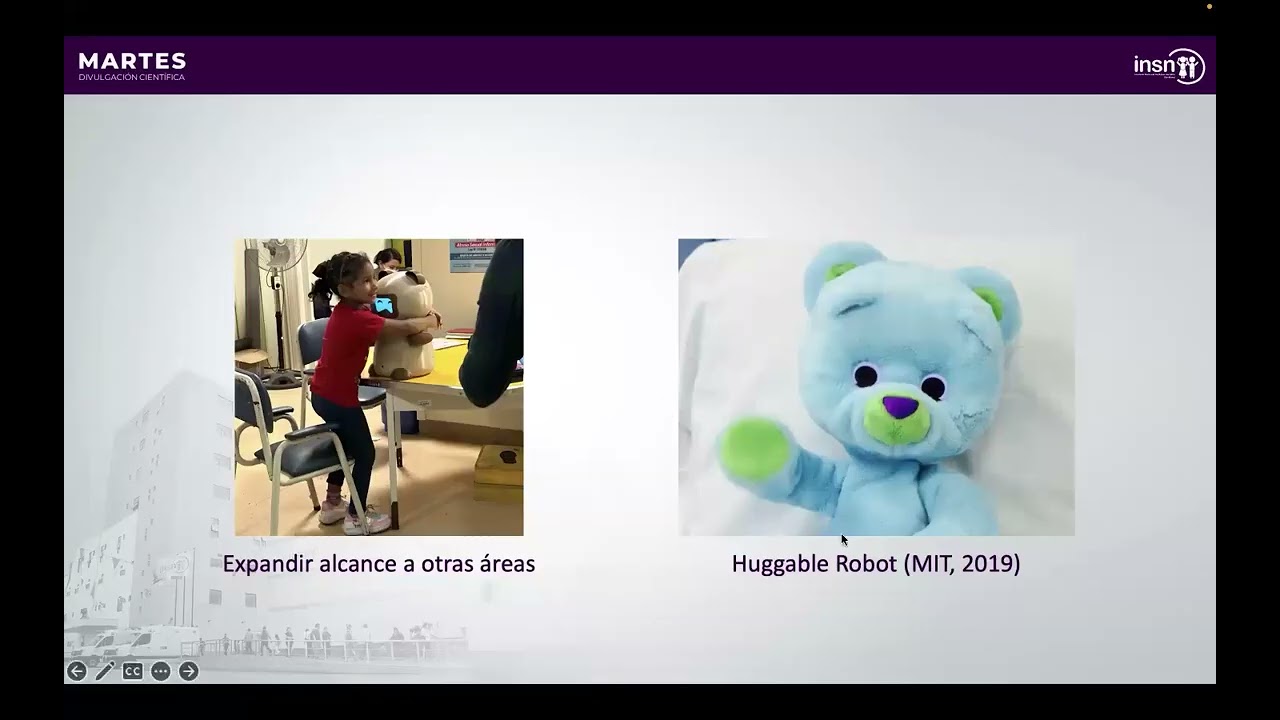
The presentation offers valuable insights into the design and development of a social robot for a specific healthcare context. The speaker provides a clear rationale for the robot’s design choices, based on user feedback and practical considerations. The argumentation is coherent, but relies heavily on anecdotal evidence and personal experience rather than rigorous scientific data. The lack of quantitative results or comparative studies weakens the scientific value. The speaker does mention a related study (Hugit) that supports the effectiveness of interactive robots, but does not provide details or citations.
Scientific Rigor, Source Quality, Title Accuracy
The presentation is scientifically grounded in the field of human-robot interaction, but the speaker does not cite specific academic sources. The project is based on a real need and involves a multidisciplinary team, which adds credibility. However, the lack of published data or references to existing literature limits the scientific rigor. The title accurately reflects the content, as it is a scientific dissemination talk about a social robot for hematological cancer patients. No comments were provided for analysis.
182 words
Title / Content Match
The title accurately reflects the content: a scientific dissemination talk about a social robot for hematological cancer patients.
Quality & Reliability
6/10
The presentation is based on a real project with a multidisciplinary team, but lacks detailed data, peer-reviewed references, and rigorous methodology. The speaker provides anecdotal evidence and personal insights, with limited scientific validation.
Key Moments
Markers derived by PSI from the transcript: the creator did not define chapters.
- Introduction to social robotics and examples like Jibo, Cozmo, and Paro.
- Identification of the problem: high anxiety and depression in pediatric hematology patients.
- User research: focus groups with children to determine robot design preferences.
- Design and prototyping process, including sketches and 3D modeling.
- Development of interaction design: facial expressions and communication flow.
- Technical specifications: hardware components, web platform, and AI integration.
- Current status, future plans, and discussion of scalability and maintenance.
Cited Sources
- No external sources provided in the video description — The video description contains no links to external sources.
Concurring Sources
- No concordant sources provided — No external sources were mentioned in the video.
Dissenting Sources
- No discordant sources provided — No external sources were mentioned in the video.
Contribution & Novelties
The presentation provides a detailed account of the development of a social robot specifically designed for pediatric hematology patients, highlighting the importance of user-centered design and multidisciplinary collaboration. The project is innovative in its context, as it addresses a specific need in a Peruvian hospital and incorporates indigenous languages. The speaker emphasizes the cocreation process with patients and healthcare professionals.
Pour aller plus loin :
- Social robot — Overview of social robots and their applications.
- Human-robot interaction — Field of study on interactions between humans and robots.
- Paro (robot) — Example of a therapeutic robot for emotional support.
- Pediatric oncology — Medical specialty for childhood cancers.
106 words
Radar Profile
The radar profile shows moderate scores across all dimensions, indicating a balanced but not exceptional presentation. The strengths lie in the quantity of information and the technical level, while the reliability and quality of information are slightly lower due to the lack of rigorous scientific evidence.