🎥✨ Martes de Divulgación Científica- 30 de setiembre de 2025 - Papilomatosis laríngea
Keywords
Summary
168 words
Critical Evaluation
Value of the Information & Strength of the Argument
The video provides valuable information on a rare but serious pediatric condition, recurrent respiratory papillomatosis with pulmonary involvement. The case report is well-documented with clinical, imaging, and histopathological findings, and the discussion includes relevant epidemiological data and treatment options. The argumentation is solid, based on a published case report and a review of the literature. The speaker clearly explains the clinical presentation, diagnostic workup, and management, including the use of bevacizumab as an off-label adjuvant therapy. The strengths and limitations of the case are honestly acknowledged, such as the lack of HPV genotyping and long-term follow-up. The presentation is logical and evidence-based, making it a valuable educational resource for healthcare professionals.
Scientific Rigor, Source Quality, Title Accuracy
The scientific rigor is adequate for a case report presentation. The speaker references a publication in the Peruvian Journal of Experimental Medicine and Public Health, which is a peer-reviewed journal. The case is presented with detailed clinical data and imaging, and the discussion includes relevant epidemiological statistics. However, the presentation does not provide specific citations for all claims, and the lack of genotyping is a limitation. The title accurately reflects the content, as it is a scientific dissemination talk about laryngeal papillomatosis. The video includes a brief Q&A session, but no comments are provided for analysis.
222 words
Title / Content Match
The title accurately reflects the content, which is a scientific dissemination talk about laryngeal papillomatosis, specifically a case report.
Quality & Reliability
7/10
The video presents a clinical case report from a peer-reviewed journal, with clear methodology, imaging, and follow-up. However, it lacks genotyping and long-term endoscopic follow-up, and the presentation is primarily descriptive.
Key Moments
Markers derived by PSI from the transcript: the creator did not define chapters.
- Introduction and presentation of the topic: recurrent laryngeal papillomatosis.
- Definition, etiology, and epidemiology of recurrent respiratory papillomatosis.
- Clinical presentation and treatment options, including surgical excision and bevacizumab.
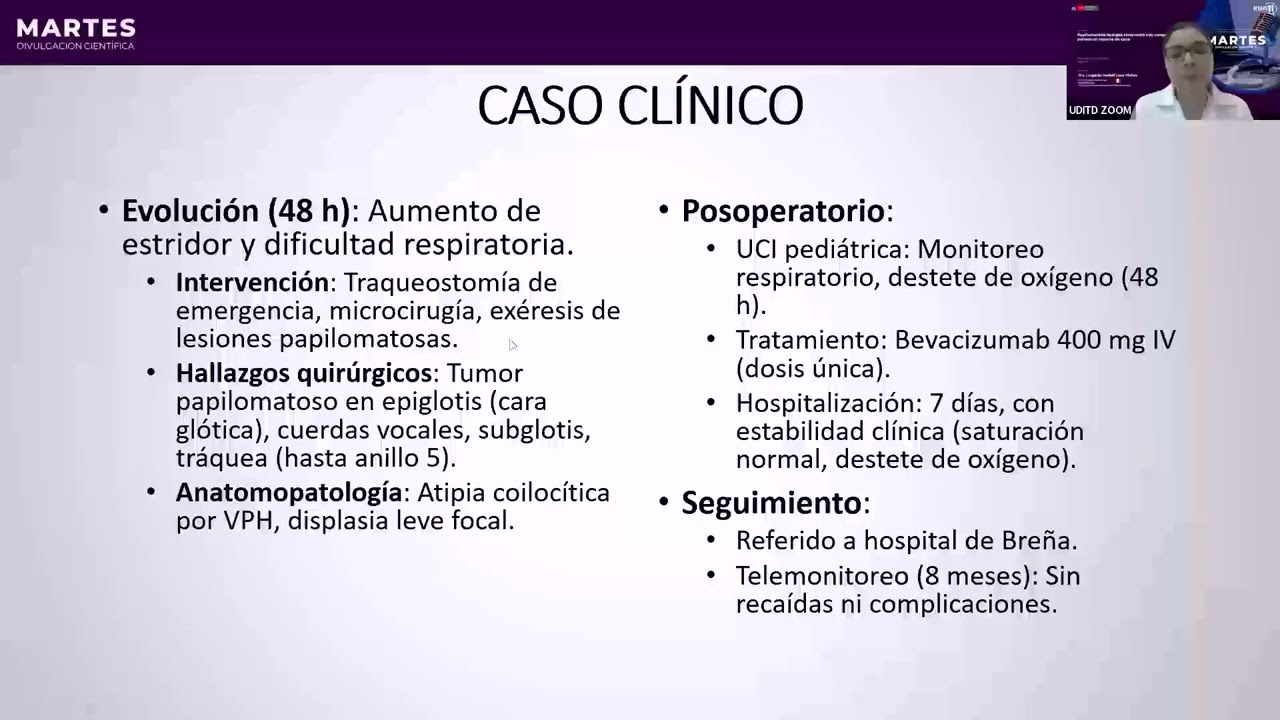
- Presentation of the clinical case: 13-year-old male from Cusco with history of papillomatosis since age 2.
- Imaging findings: chest X-ray and CT showing cystic lesions and tracheal stenosis.
- Emergency tracheostomy and microsurgery; histopathology results.
- Postoperative management with bevacizumab and clinical improvement.
- Discussion of case strengths, limitations, and conclusions.
- Q&A session: risk factors, including maternal genital HPV infection.
Cited Sources
- Peruvian Journal of Experimental Medicine and Public Health — The case report was published in this journal in 2023.
Concurring Sources
- Recurrent respiratory papillomatosis: A review — Review article on RRP, supporting the epidemiology and treatment discussed.
Contribution & Novelties
The video presents a rare case of recurrent respiratory papillomatosis with pulmonary involvement, highlighting the severity in pediatric patients and the potential benefit of bevacizumab as adjuvant therapy. It underscores the importance of early diagnosis and multidisciplinary management. The case report adds to the limited literature on this condition, especially in the Peruvian context.
Pour aller plus loin :
- Recurrent respiratory papillomatosis - Wikipedia — Overview of the disease, its etiology, and management.
- Human papillomavirus infection - Wikipedia — Background on HPV, including types 6 and 11.
- Bevacizumab - Wikipedia — Information on the monoclonal antibody used in this case.
- Peruvian Journal of Experimental Medicine and Public Health — The journal where the case report was published.
117 words
Radar Profile
The radar profile shows balanced scores across information quantity, quality, technical level, and reliability, indicating a well-rounded presentation. The slightly lower technical level suggests it is accessible to a broader medical audience, while the reliability is supported by the peer-reviewed publication.