🎥✨ Martes de Divulgación Científica - 24 de marzo 2026 - Biobancos
Keywords
Summary
163 words
Critical Evaluation
Value of the Information & Strength of the Argument
The value of the information lies in its practical, experience-based insights into biobank governance and ethics, particularly from a Latin American perspective. The speaker provides concrete examples and legal considerations, making it useful for researchers and ethics committee members. The argumentation is coherent and structured, building from historical cases to current challenges. However, it relies heavily on anecdotal evidence and personal opinion, with limited reference to specific regulations or studies. The ethical dilemmas are well articulated, but the discussion could benefit from more empirical data or comparative analysis.
Scientific Rigor, Source Quality, Title Accuracy
The scientific rigor is moderate: the speaker cites well-known cases (HeLa, Havasupai, Yanomami) and mentions institutional biobanks, but does not provide specific references or citations. The quality of sources is therefore limited to general knowledge. The title accurately reflects the content, which is a scientific dissemination talk on biobanks. No comments were provided, so no analysis of public trends is possible.
164 words
Title / Content Match
The title indicates a scientific dissemination talk on biobanks, and the content matches this, focusing on challenges and opportunities in research.
Quality & Reliability
7/10
The speaker is a legal expert (Abog.) with institutional affiliation, providing a detailed and structured overview of biobanking ethics and governance. The content is based on established cases and legal frameworks, but lacks citations to specific sources or peer-reviewed literature. The presentation is largely opinion and experience-based, with some factual references (e.g., HeLa cells, specific cases).
Key Moments
Markers derived by PSI from the transcript: the creator did not define chapters.
- Introduction and overview of the talk's topics.
- Story of Henrietta Lacks and the HeLa cells.
- Definition of biobanks and types.
- Ethical challenges: group harm cases (Arizona, Brazil).
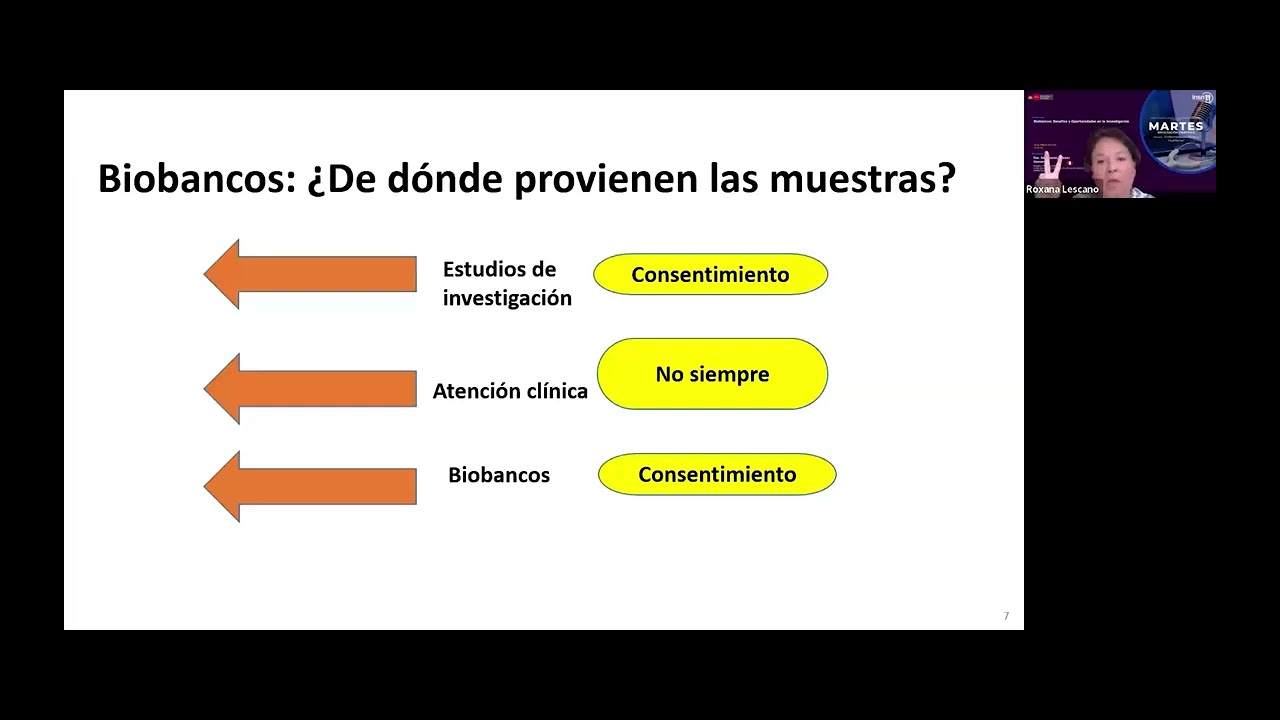
- Consent issues and broad consent.
- Technical challenges: governance, infrastructure, transfer agreements.
- Role of ethics committees and conclusion.
Cited Sources
- HeLa cells — Mentioned as the source of the HeLa cell line, used in research.
- Havasupai tribe case — Mentioned as an example of group harm from genetic research.
- Yanomami case — Mentioned as an example of group harm from research.
Concurring Sources
- Biobank — Provides general information on biobanks, consistent with the talk's definition.
- Informed consent — Relevant to the ethical discussions on consent.
Contribution & Novelties
The talk provides a practical, legal perspective on biobank governance, emphasizing the need for ethics committee involvement and the challenges in developing countries. It highlights the importance of broad consent and the donor’s right to withdraw, and discusses the concept of custodianship. The novelty lies in its focus on the Peruvian context and the integration of legal and ethical aspects.
Pour aller plus loin :
- Biobank — General overview of biobanks.
- Informed consent — Ethical and legal aspects.
- Material transfer agreement — Legal framework for sharing samples.
87 words
Radar Profile
The radar profile shows high scores in quantity of information and fiabilité, with moderate technical level. This indicates a comprehensive and reliable overview, but with a practical rather than deeply technical focus.