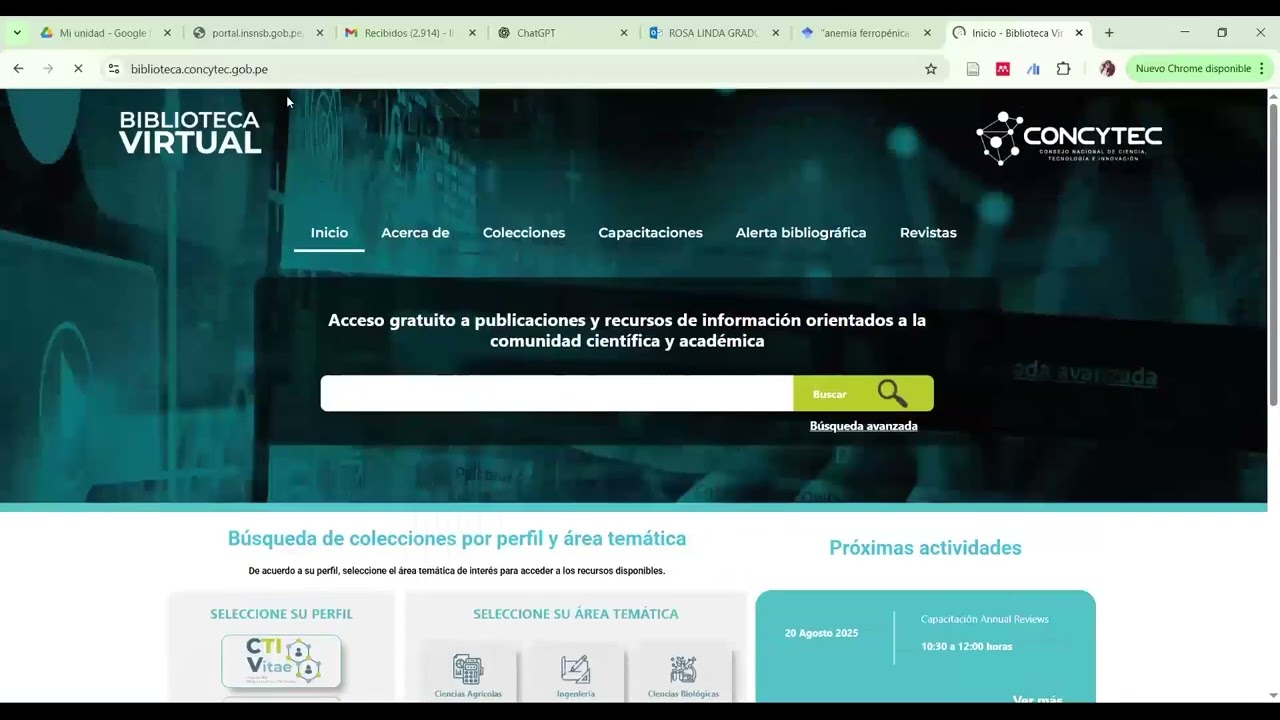
🎥✨ Martes de Divulgación Científica -22 de julio 2025- Evidencia en salud -Bases de datos biomédicas
Keywords
Summary
176 words
Critical Evaluation
Value of the Information & Strength of the Argument
The video provides valuable practical information on searching biomedical databases, with clear demonstrations and tips. The presenter’s argumentation is based on her professional experience as a librarian, which adds credibility. She emphasizes the importance of critical evaluation of sources and provides concrete examples of how to use each platform. However, the argumentation is not deeply analytical, as it focuses more on ‘how to’ rather than ‘why’ certain databases are better. The value lies in the actionable advice for clinicians and researchers.
Scientific Rigor, Source Quality, Title Accuracy
The scientific rigor is moderate. The presenter mentions several databases and platforms but does not provide detailed comparisons or evidence of their reliability. She correctly warns about predatory journals and the need for critical reading, but the sources cited are mostly the databases themselves. The title accurately reflects the content, which is a tutorial on searching biomedical databases. The video does not include a formal review of literature or meta-analysis, but it is a practical guide based on the presenter’s expertise.
177 words
Title / Content Match
The title accurately reflects the content, which is a scientific outreach session on evidence in health and biomedical databases.
Quality & Reliability
7/10
The video provides a practical tutorial on searching biomedical databases, with clear explanations and demonstrations. The speaker is a librarian with expertise in the field. However, the content is largely based on personal experience and institutional resources, with limited critical evaluation of the databases themselves. The video is informative but not deeply analytical.
Key Moments
Markers derived by PSI from the transcript: the creator did not define chapters.
- Introduction to the session and mention of the certificate for the series.
- Explanation of the importance of identifying information needs and using keywords.
- Demonstration of Google Scholar and caution about non-indexed journals.
- Introduction to the CONCYTEC virtual library and its resources.
- Detailed demonstration of Dynamed, including search strategies and levels of evidence.
- Comparison between Dynamed and UpToDate, highlighting the GRADE system.
- Demonstration of UpToDate and its features, including patient information.
- Conclusion and reminder of the next session.
Cited Sources
- Google Scholar — Mentioned as a platform for searching scientific literature, with caution about non-indexed journals.
- Dynamed — Demonstrated as a point-of-care tool for evidence-based clinical decisions.
- UpToDate — Presented as a similar platform to Dynamed, with the GRADE system for evidence evaluation.
- CONCYTEC Virtual Library — Shown as a portal providing access to various biomedical databases.
Concurring Sources
- PubMed — Referenced as the underlying database for PubMed, which is a standard resource for biomedical literature.
Contribution & Novelties
The video offers a practical, step-by-step guide to searching biomedical databases, which is particularly useful for healthcare professionals and students. It highlights the importance of critical evaluation of sources and provides specific tips for using platforms like Dynamed and UpToDate. The presenter’s emphasis on using pre-built search strategies in Dynamed is a novel approach that can save time for clinicians.
Pour aller plus loin :
- PubMed — The primary search engine for biomedical literature, often used in conjunction with the databases mentioned.
- GRADE system — The framework used in UpToDate for rating evidence quality and recommendation strength.
- Levels of Evidence — The Oxford CEBM levels, which are commonly referenced in evidence-based medicine.
112 words
Radar Profile
The radar profile shows a balanced performance across all dimensions, with slightly higher scores in information quantity and quality, reflecting the tutorial's practical nature. The technical level is moderate, suitable for a general healthcare audience. The overall reliability is good, but the lack of critical analysis of the databases themselves prevents a higher score.
💬 Sur les 0 commentaires analysés, aucune tendance n'est disponible.