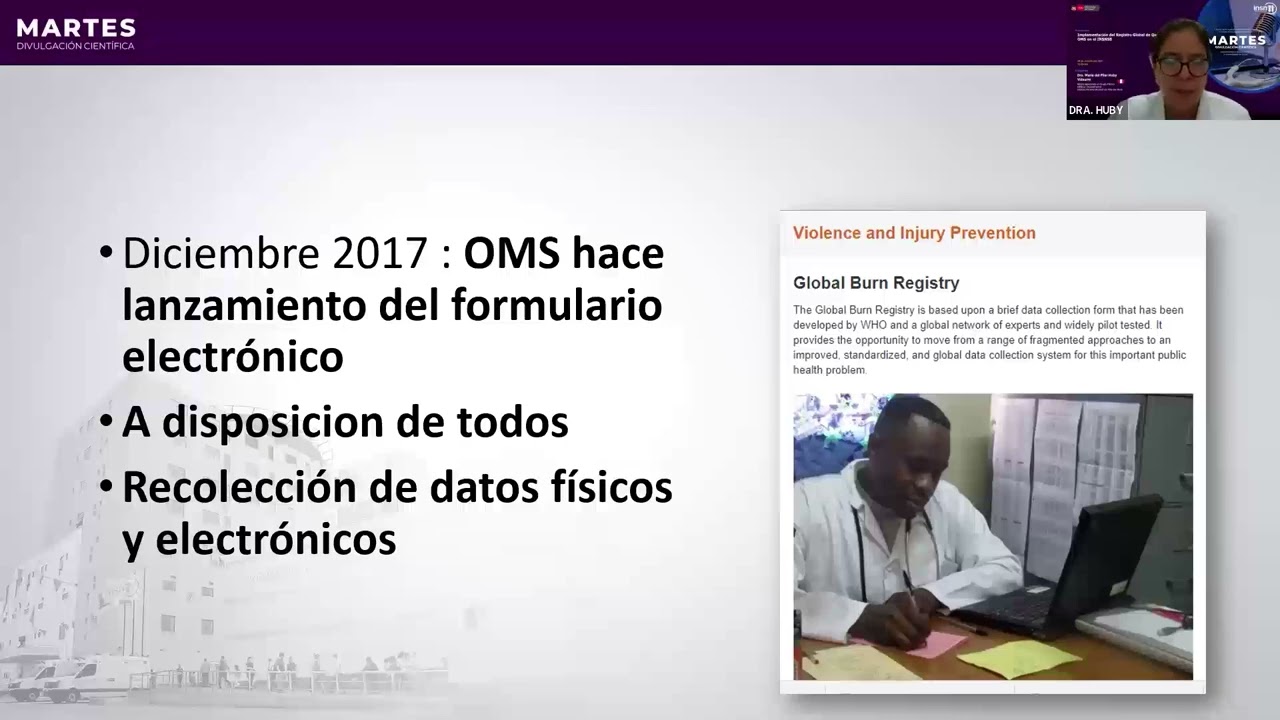
🎥✨ Martes de Divulgación Científica - 28 de octubre 2025 - Registro Global de Quemados OMS -INSNSB
Keywords
Summary
239 words
Critical Evaluation
Value of the Information & Strength of the Argument
The value of the information lies in its practical insights into implementing a global health registry in a resource-limited setting. The speaker provides a detailed account of the adaptation process, including specific modifications made to the WHO form to suit local needs, which is valuable for other institutions considering similar implementations. The argumentation is solid, based on a real project with clear methodology (pilot study, focus groups) and honest reporting of challenges and outcomes. However, the presentation is largely descriptive and lacks deeper statistical analysis or comparison with other registries. The speaker’s expertise as a plastic surgeon and head of the burn unit adds credibility, but the evidence is limited to a single-center experience.
Scientific Rigor, Source Quality, Title Accuracy
The presentation demonstrates scientific rigor by referencing the WHO Global Burn Registry and the International Society for Burn Injuries, and by describing the ethical approval and institutional authorization. The quality of sources is adequate, though no specific publications are cited. The title accurately reflects the content, and the presentation is well-structured. The speaker declares no conflicts of interest. However, the lack of external references and the small sample size in the pilot study limit the generalizability of the findings. The adaptation process is well-documented, but the sustainability of the registry is questioned due to lack of dedicated personnel.
227 words
Title / Content Match
The title accurately reflects the content: a scientific dissemination session on the implementation of the WHO Global Burn Registry at the National Institute of Child Health San Borja.
Quality & Reliability
7/10
The presentation is based on a real implementation project at a national institute, with clear methodology and results. However, it is a single-center experience with limited data (only 40 forms in pilot), and no external validation or peer review is mentioned.
Key Moments
Markers derived by PSI from the transcript: the creator did not define chapters.
- Introduction and speaker credentials
- Burden of burns and lack of data in Peru
- Need for a burn registry and examples from other countries
- WHO Global Burn Registry launch and collaboration
- Description of the WHO form and its data fields
- Pilot study methodology and focus groups
- Modifications made to the WHO form
- Results of the pilot study and challenges
- Sustainability issues and prevention campaigns
Cited Sources
- WHO Global Burn Registry — Mentioned as the global registry implemented at the institute.
- International Society for Burn Injuries — Collaborated with WHO to create the registry.
Concurring Sources
- WHO Global Burn Registry — The registry is endorsed by WHO and used globally.
Contribution & Novelties
The presentation provides a unique case study of adapting a global health registry to a local context, highlighting practical challenges and solutions. It contributes to the literature on burn registries in low- and middle-income countries, emphasizing the need for dedicated personnel and sustainable funding.
Pour aller plus loin :
- WHO Global Burn Registry — Official WHO page on burns and the registry.
- Lund-Browder chart — Reference for burn extent calculation in children.
- American Burn Association Repository — Example of a national burn registry.
83 words
Radar Profile
The radar profile shows balanced scores across all dimensions, with slightly lower technical level due to the practical nature of the presentation. The high scores in information quantity and quality reflect the detailed account of the implementation process, while the moderate technical level indicates accessibility to a broader audience.