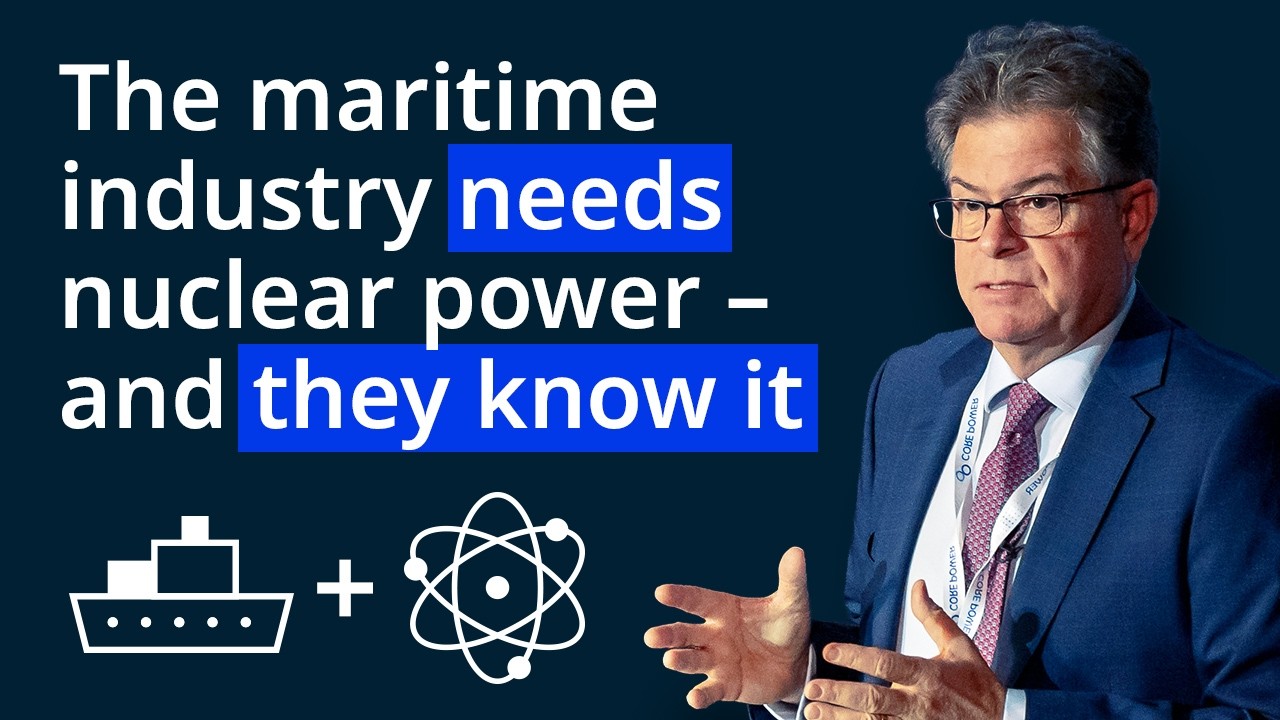
The strategy behind maritime nuclear
Keywords
Summary
175 words
Critical Evaluation
Value of the Information & Strength of the Argument
The talk provides valuable insights into the strategic motivations behind maritime nuclear propulsion, particularly the competitive pressure from China and the potential for industrial renewal. The argumentation is coherent, linking historical precedents of maritime innovation to the current opportunity for nuclear technology. However, the claims are largely qualitative and lack empirical evidence or detailed technical analysis. The speaker’s position as CEO of CORE POWER introduces a promotional bias, and the argumentation would benefit from more concrete data on costs, timelines, and feasibility.
Scientific Rigor, Source Quality, Title Accuracy
The talk does not cite specific sources or provide references. The speaker references general historical facts and current industry trends but does not substantiate them with data. The title accurately reflects the content, which is a strategic overview rather than a technical deep dive. The lack of sources and reliance on anecdotal evidence reduces the scientific rigor. The talk is more of an expert opinion and industry advocacy than a rigorous scientific presentation.
170 words
Title / Content Match
The title accurately reflects the content, which focuses on the strategic rationale and industrial approach for maritime nuclear propulsion.
Quality & Reliability
6/10
The speaker is the CEO of CORE POWER, providing an industry insider perspective. The talk is strategic and promotional, with no detailed technical data or peer-reviewed references. Claims about Chinese programs and cost reductions are not substantiated with sources.
Key Moments
Markers derived by PSI from the transcript: the creator did not define chapters.
- Introduction and framing of the summit
- Discussion of maritime powers and China's dominance
- Historical role of maritime in industrializing technologies
- Current slow steaming and economic rationale for nuclear propulsion
- Introduction of CORE POWER's Liberty program and ecosystem approach
- Announcement of business split and call for public-private partnership
Contribution & Novelties
The talk offers a strategic perspective on maritime nuclear propulsion, emphasizing competitiveness and industrial renewal over environmental concerns. It introduces CORE POWER’s approach to building an industrial ecosystem and the Liberty program for standards. The announcement of the business split into Propulsion and Generation is a notable development.
Pour aller plus loin :
- Small Modular Reactors — Overview of SMR technology and its potential applications.
- Nuclear marine propulsion — Historical and technical background on nuclear-powered ships.
- China’s floating nuclear power plants — Context on China’s developments in floating nuclear technology.
90 words
Radar Profile
The radar profile shows moderate scores across all dimensions, with slightly higher scores in quantity of information and technical level, but lower in quality and reliability. This reflects a talk that provides a broad strategic overview but lacks depth and rigorous sourcing.