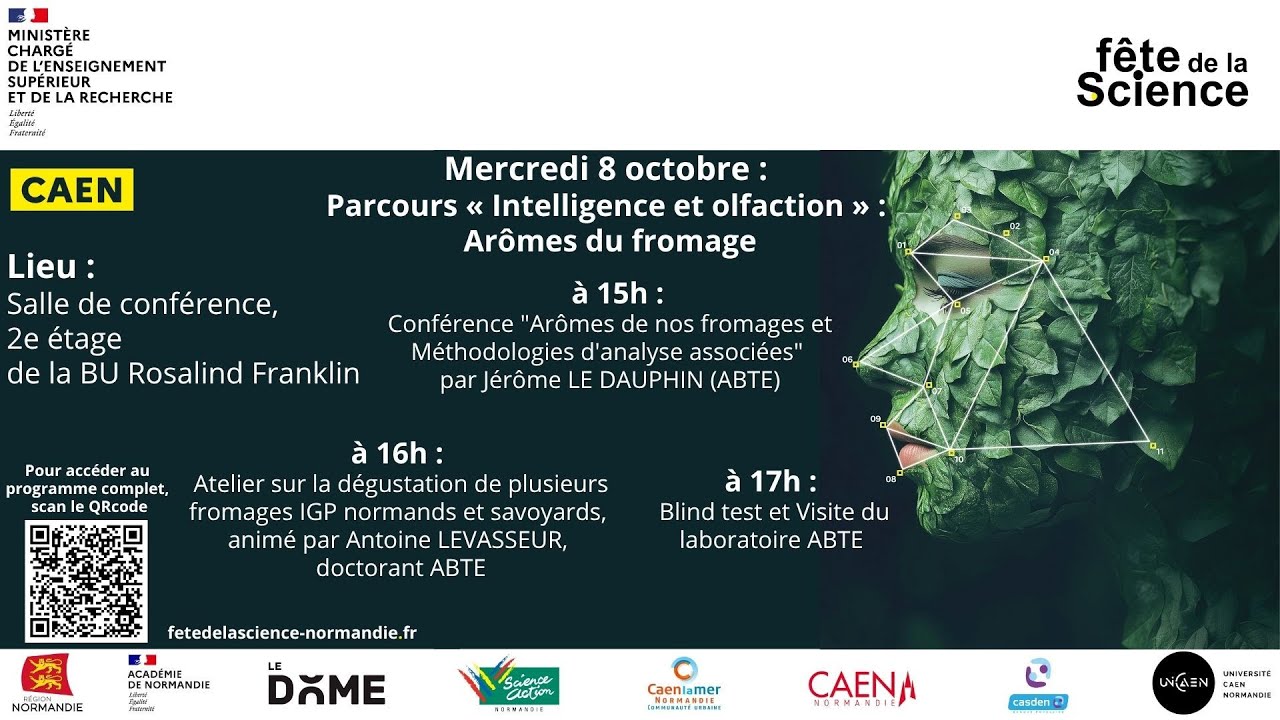
Arômes de nos fromages et méthodologies d'analyse associées
Keywords
Summary
242 words
Critical Evaluation
Value of the Information & Strength of the Argument
The value of the information lies in its clear and structured presentation of the scientific basis of cheese aroma, from perception to chemical analysis. The speakers effectively explain complex concepts such as the olfactory system and volatile compound analysis in an accessible manner. The argumentation is solid, grounded in established scientific literature (e.g., Jaubert, Noble, Edwards, Berrier) and their own research projects. They also highlight the practical applications for cheese producers, such as selecting autochthonous strains to enhance aroma. However, the talk is more descriptive than critical; it does not delve into the limitations of the methods or the controversies in aroma research. The argumentation is coherent and logical, but it could benefit from more concrete examples or data from their studies.
Scientific Rigor, Source Quality, Title Accuracy
The scientific rigor is generally good: the speakers are researchers in the field, and they reference several key publications (Jaubert, Noble, Edwards, Berrier). They also mention their own research projects (SODIF, CANOPÉ) which are funded and collaborative. However, they do not provide specific citations for all claims, and the talk is more of an overview than a detailed scientific presentation. The title accurately reflects the content, which covers both the aroma compounds and the analytical methods. The sources cited are relevant and credible, but the lack of explicit references in the video description limits the ability to verify them. The adequacy between title and content is high, as the talk indeed covers both aspects.
251 words
Title / Content Match
The title accurately reflects the content, which covers both the aroma compounds in cheeses and the analytical methods used.
Quality & Reliability
7/10
Presentation by researchers from ABTE laboratory, with references to scientific literature (Jaubert, Noble, Edwards, Berrier) and ongoing research projects (SODIF, CANOPÉ). However, no detailed methodology or data shown, and some statements are general.
Key Moments
Markers derived by PSI from the transcript: the creator did not define chapters.
- Introduction and presentation of speakers and research projects (SODIF, CANOPÉ).
- Explanation of aroma perception: orthonasal and retronasal pathways, olfactory epithelium.
- Historical classification of odors: Jaubert's odor field (1984, 1987), odor wheels by Noble and Edwards.
- Specific odor wheel for cheeses by Berrier et al. (1997).
- Main chemical families of cheese odorants: acids, esters, alcohols, ketones, sulfur compounds, aromatic compounds.
- Analytical techniques: HS-SPME and GC-MS, description of the autosampler and GC-MS system.
- Discussion on the complexity of cheese aroma and the importance of subtle differences.
- Conclusion and Q&A session.
Cited Sources
- Jaubert, J.N. (1984) - Champ des odeurs — Mentioned as a classification system for odors.
- Noble, A.C. (1987) - Wine aroma wheel — Mentioned as a classification system used in oenology.
- Edwards, M. (2012) - Fragrance wheel — Mentioned as a classification system used in perfumery.
- Berrier, F. et al. (1997) - Guide d'évaluation olfacto-gustative des fromages à pâte dure et semi-dure — Mentioned as a specific classification for cheeses.
Concurring Sources
- Jaubert, J.N. (1984) - Champ des odeurs — Referenced as a foundational classification of odors.
- Noble, A.C. (1987) - Wine aroma wheel — Referenced as a widely used classification in oenology.
- Berrier, F. et al. (1997) - Guide d'évaluation olfacto-gustative des fromages — Referenced as a specific classification for cheeses.
Contribution & Novelties
The talk provides an accessible overview of cheese aroma science, linking sensory perception to chemical analysis. It highlights the ongoing research projects (SODIF, CANOPÉ) that aim to connect microbial communities and ecosystem services to cheese aroma, which is a novel interdisciplinary approach. The presentation also emphasizes the practical applications for cheese producers, such as selecting autochthonous strains to enhance aroma.
Pour aller plus loin :
- Solid-phase microextraction (SPME) — Technique used for sample preparation in volatile analysis.
- Gas chromatography–mass spectrometry (GC-MS) — Analytical method used to identify volatile compounds.
- Olfactory receptor — Proteins involved in odor detection.
- Terroir — Concept linking environmental factors to food characteristics, relevant to AOP cheeses.
110 words
Radar Profile
The radar profile shows balanced scores across all dimensions, with slightly lower technical level compared to information quantity and quality. This indicates a well-rounded presentation that is informative and reliable, but not overly technical, making it accessible to a general audience.
💬 Sur les 0 commentaires analysés, aucune tendance n'est observable.