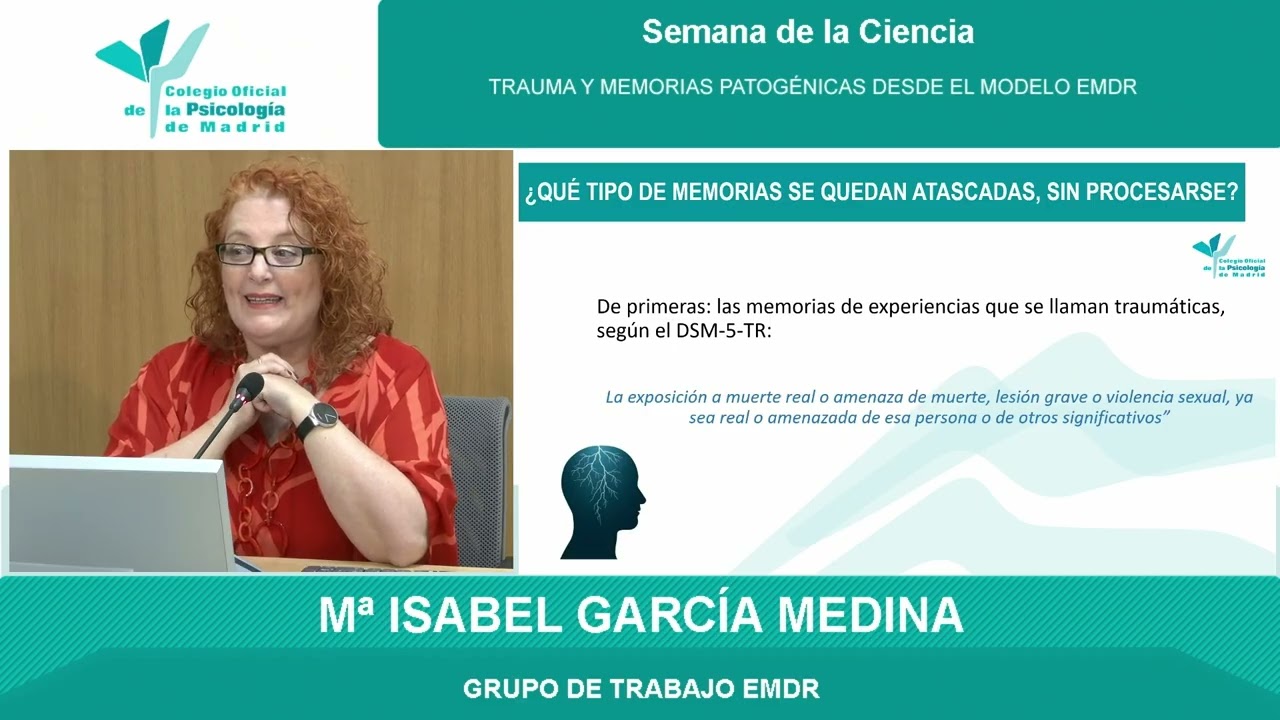
SEMANA DE LA CIENCIA 2025. 22. Conferencia: Trauma y Memorias Patogénicas desde el modelo EMDR.
Keywords
Summary
247 words
Critical Evaluation
Value of the Information & Strength of the Argument
The talk provides a clear and accessible explanation of the EMDR model and the concept of pathogenic memories. It offers valuable insights into how unprocessed experiences can lead to psychological symptoms, emphasizing the role of subjective experience and developmental factors. The argumentation is coherent and grounded in clinical practice, with references to established theories (AIP, DSM-5) and authors like Francine Shapiro. However, it lacks empirical data or case studies to support some claims, and the presentation is more descriptive than analytical.
Scientific Rigor, Source Quality, Title Accuracy
The talk demonstrates a good understanding of the EMDR framework and references relevant theoretical foundations. However, it does not provide specific citations or sources for many claims, and the mention of ‘Antonieta Contré’ and ‘developmental windows’ is not elaborated with references. The title accurately reflects the content, and the presentation is consistent with the stated topic. No comments were provided for analysis.
158 words
Title / Content Match
The title accurately reflects the content: a conference on trauma and pathogenic memories from the EMDR model.
Quality & Reliability
7/10
The talk is given by two professionals (directors of EMDR centers) and is based on established EMDR theory and clinical practice. It references DSM-5 criteria and mentions authors like Francine Shapiro and Antonieta Contré. However, it is a conference presentation without peer-reviewed citations or empirical data, and some claims (e.g., developmental windows) are presented without detailed evidence.
Key Moments
Markers derived by PSI from the transcript: the creator did not define chapters.
- Introduction of speakers and topic: trauma and pathogenic memories from EMDR model.
- Explanation of the Adaptive Information Processing (AIP) model and the mind's tendency toward health.
- Video showing neurons connecting, illustrating neural networks and memory storage.
- Discussion of memories that do not heal and the concept of 'stuck' memories.
- Definition of traumatic memories according to DSM-5 criteria.
- Introduction of non-traumatic pathogenic memories (e.g., relational experiences, bullying, neglect).
- Explanation of the role of helplessness and lack of resources in creating pathogenic memories.
- Discussion of positive valence pathogenic memories (e.g., feeling seen, drug-induced calm).
- Emphasis on the importance of subjective and developmental factors in memory processing.
- Conclusion: the impact of an event depends on resources and state, not just the event itself.
Cited Sources
- DSM-5 — Referenced for criteria of traumatic experiences.
- Francine Shapiro — Mentioned as the originator of the AIP model and EMDR.
- Antonieta Contré — Mentioned for the concept of subjective and developmental moments.
Concurring Sources
- EMDR Institute — Official EMDR site supporting the model described.
- Wikipedia: Eye movement desensitization and reprocessing — General overview consistent with the talk's content.
Contribution & Novelties
The talk provides a clear synthesis of the EMDR model and the concept of pathogenic memories, emphasizing that not only traumatic events but also non-traumatic experiences can lead to pathology if not processed. It highlights the role of subjective experience, developmental windows, and available resources. The presentation is valuable for clinicians and the public interested in understanding trauma from an EMDR perspective.
Pour aller plus loin :
- EMDR Institute — Official site for EMDR therapy information.
- Adaptive Information Processing model — Overview of EMDR and AIP.
- DSM-5 — Official DSM-5 page for diagnostic criteria.
- Developmental windows and trauma — Article on sensitive periods in brain development.
106 words
Radar Profile
The radar profile shows high scores in information quantity and quality, with moderate technical level and reliability. This indicates a well-structured and informative presentation, but with room for more rigorous scientific backing.