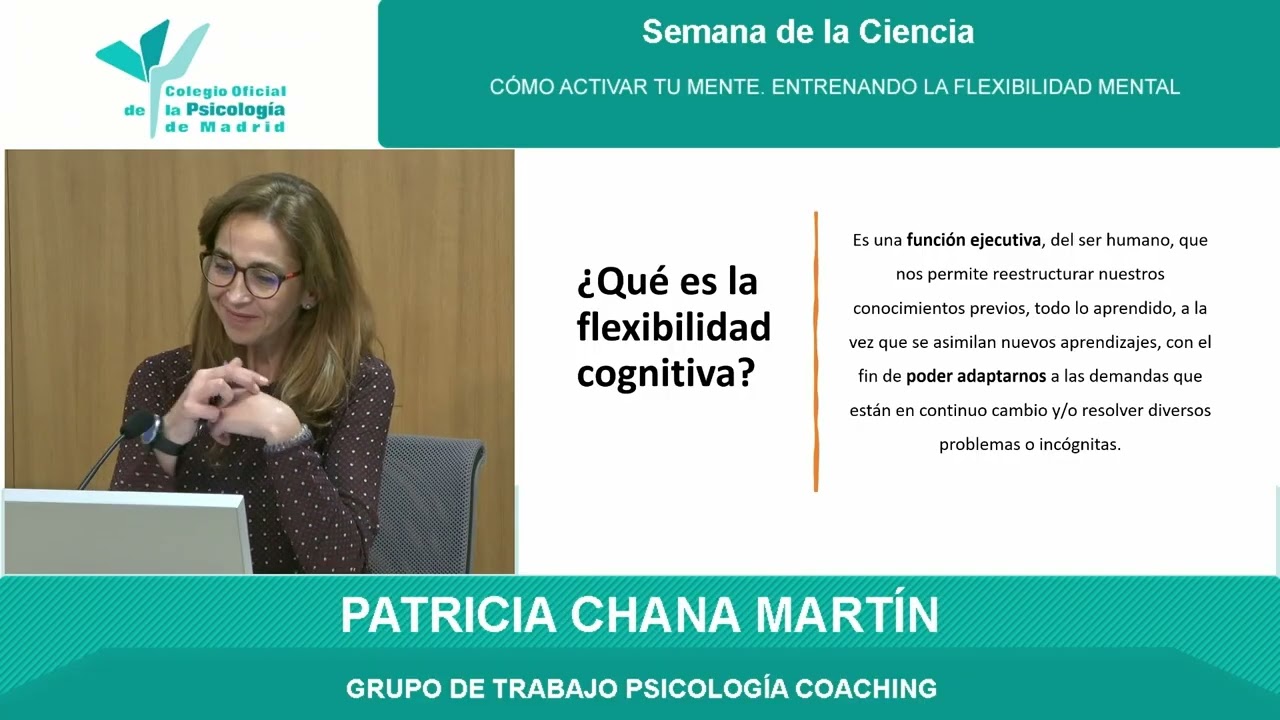
SEMANA DE LA CIENCIA 2025. 5. Conferencia: Cómo activar tu mente: Entrenando la flexibilidad mental.
Keywords
Summary
162 words
Critical Evaluation
Value of the Information & Strength of the Argument
The talk provides a valuable overview of cognitive flexibility and its neural basis, integrating historical and contemporary research. The argumentation is coherent, moving from theoretical foundations to practical applications. However, it relies heavily on anecdotal examples and lacks critical discussion of the limitations of the cited tests and models. The speaker’s expertise in coaching adds practical value, but the scientific rigor is moderate, as specific studies are not cited in detail.
Scientific Rigor, Source Quality, Title Accuracy
The talk references established researchers (Guilford, Torrance, Dietrich) and concepts (neuroplasticity, default mode network) without providing specific citations or URLs. The title accurately reflects the content. The description mentions the organizing group (Psychology Coaching Work Group) but no external sources. The talk is a popular science presentation, not a peer-reviewed study, so the scientific rigor is acceptable for its purpose but not exhaustive.
149 words
Title / Content Match
The title accurately reflects the content: the conference focuses on training mental flexibility, combining theoretical concepts with practical coaching techniques.
Quality & Reliability
7/10
The talk is grounded in established psychological concepts (cognitive flexibility, divergent thinking, neuroplasticity) and references key researchers (Guilford, Torrance, Dietrich). However, it is a popular science presentation with limited depth, no direct citation of specific studies, and relies on anecdotal examples. The speaker is a psychologist and coach, lending credibility, but the content is not peer-reviewed.
Key Moments
Markers derived by PSI from the transcript: the creator did not define chapters.
- Introduction by José Manuel, presenting Patricia Chana and the topic.
- Patricia Chana introduces the talk's structure and the concept of mental flexibility.
- Explanation of what happens in the brain when having a new idea: activation of prefrontal cortex, hippocampus, and limbic system.
- Definition of cognitive flexibility and its components: perspective change, adaptation, creative thinking.
- Historical overview: Guilford's model of intelligence and divergent production.
- Torrance's creativity tests and their longitudinal validity.
- Dietrich's model of creativity: four types based on cognitive/emotional and deliberate/spontaneous dimensions.
- Neuroplasticity and its role in training mental flexibility.
- Coaching techniques: reframing (content, context, positive, humorous, relativity) and their benefits.
- Conclusion and final remarks.
Cited Sources
- No external sources provided in the video description. — The video description does not include any links or references.
Concurring Sources
- Cognitive flexibility — Provides a general overview of cognitive flexibility as an executive function.
- Divergent thinking — Explains divergent thinking, a key component of creativity discussed in the talk.
Contribution & Novelties
The talk offers a practical integration of cognitive flexibility concepts with coaching techniques, providing a bridge between neuroscience and applied psychology. It emphasizes that mental flexibility is trainable, which is empowering for the audience. The use of a case study (Ana) makes the content relatable.
Pour aller plus loin :
- Cognitive flexibility — Wikipedia overview of the concept.
- Divergent thinking — Wikipedia article on divergent thinking.
- Neuroplasticity — Wikipedia article on neuroplasticity.
- Default mode network — Wikipedia article on the default mode network.
- Torrance Tests of Creative Thinking — Wikipedia article on the Torrance tests.
95 words
Radar Profile
The radar profile shows balanced scores across information quantity, quality, technical level, and reliability, with a slight emphasis on practical application. This indicates a well-rounded presentation suitable for a general audience interested in psychology and coaching.
💬 No comments were provided for analysis.