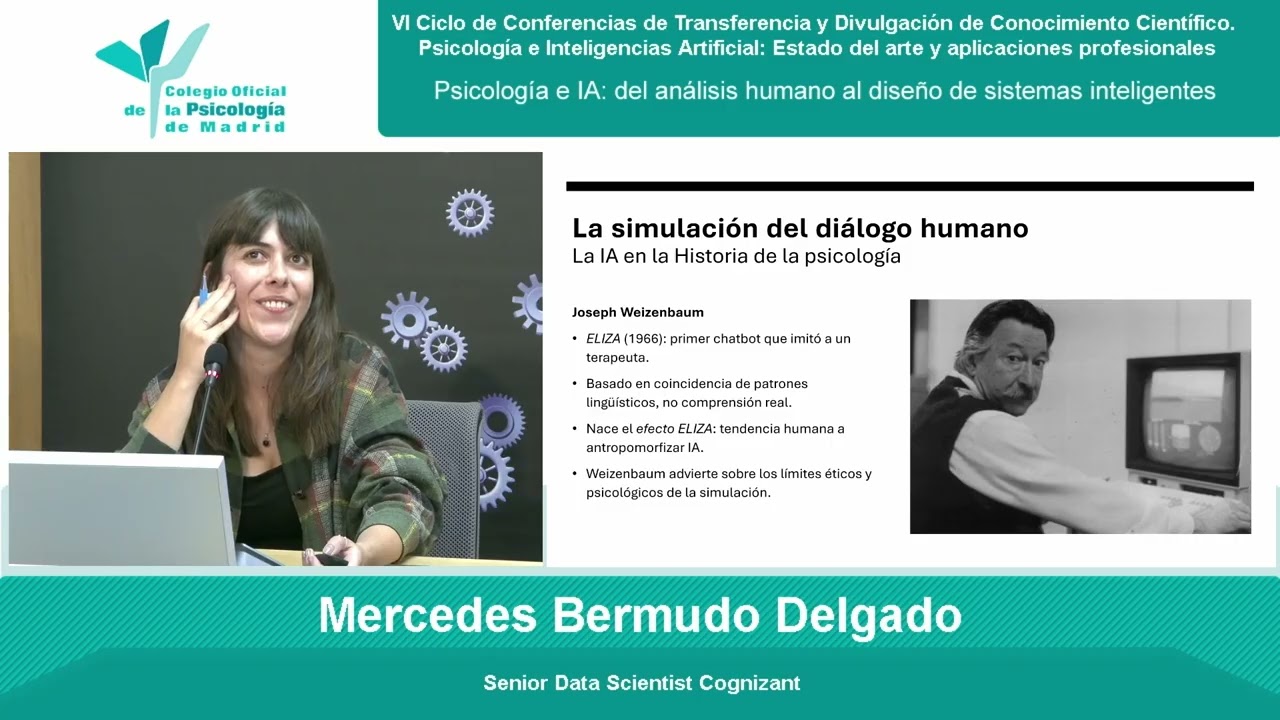
VI Ciclo de Conferencias de Transferencia y Divulgación de Conocimiento Científico 20-10-25
Keywords
Summary
148 words
Critical Evaluation
Value of the Information & Strength of the Argument
The video provides valuable insights into the synergy between psychology and AI, arguing that psychological principles are foundational to AI development. The argumentation is coherent and draws on historical and contemporary examples, such as the ELIZA effect and the work of current researchers. However, the depth is limited, and the claims are not backed by specific studies or data, relying more on personal experience and general knowledge. The speakers effectively communicate the potential for psychologists to contribute to AI, but the argumentation could be strengthened with more concrete evidence and case studies.
Scientific Rigor, Source Quality, Title Accuracy
The scientific rigor is moderate: the speakers are credible, but they do not cite specific sources during the talk. The video description mentions the organizing institutions but no references. The title accurately reflects the content, though it is broad. The content is more of an expert opinion and overview than a rigorous scientific presentation. No comments were provided, so public reception cannot be assessed.
171 words
Title / Content Match
The title accurately reflects the content, which is a conference cycle on psychology and AI, though it is generic and does not specify the subtopics covered.
Quality & Reliability
7/10
The video features two expert speakers with relevant academic and professional backgrounds, providing a credible overview of the intersection of psychology and AI. However, it is a conference recording with limited depth and no formal citations or peer-reviewed references, and the content is largely anecdotal and introductory.
Key Moments
Markers derived by PSI from the transcript: the creator did not define chapters.
- Introduction by Guillermo, framing the conference on psychology and conversational agents.
- Mercedes Bermudo begins her talk, sharing her background as a psychologist in AI.
- Discussion of historical contributions: Simon and Newell, Miller, and the 1956 moment.
- Mention of Weizenbaum's ELIZA and the ELIZA effect.
- Introduction of current researchers: Kosinski, Goldstone, Oswald, and Gopnik.
- Explanation of AI capabilities: reasoning models, context, and RAG systems.
- Discussion of benchmarks for evaluating AI models, including ARC.
- Mention of Moravec's paradox and the limits of AI compared to human cognition.
Cited Sources
- The Spanish Journal of Psychology — Mentioned in the description as the organizing journal.
- Colegio Oficial de la Psicología de Madrid — Organizing institution.
Concurring Sources
- The Spanish Journal of Psychology — The journal is associated with the conference and likely publishes related research.
Contribution & Novelties
The video offers a unique perspective on the role of psychologists in AI development, emphasizing the historical and ongoing contributions of psychology to the field. It provides a bridge between psychological theory and practical AI applications, particularly in conversational agents. The speakers advocate for formalizing conversational strategies and highlight the importance of psychological insights in improving AI models.
Pour aller plus loin :
- ELIZA effect — Relevant to the discussion of human-AI interaction and attribution of intelligence.
- Moravec’s paradox — Directly mentioned in the talk, explaining why AI excels at logical tasks but struggles with sensorimotor skills.
- Retrieval-Augmented Generation (RAG) — Key technique discussed for enhancing LLM context management.
109 words
Radar Profile
The radar profile shows moderate scores across all dimensions, with slightly higher quality and reliability compared to quantity and technical depth. This indicates a balanced but not deeply technical presentation, suitable for a general audience interested in the intersection of psychology and AI.