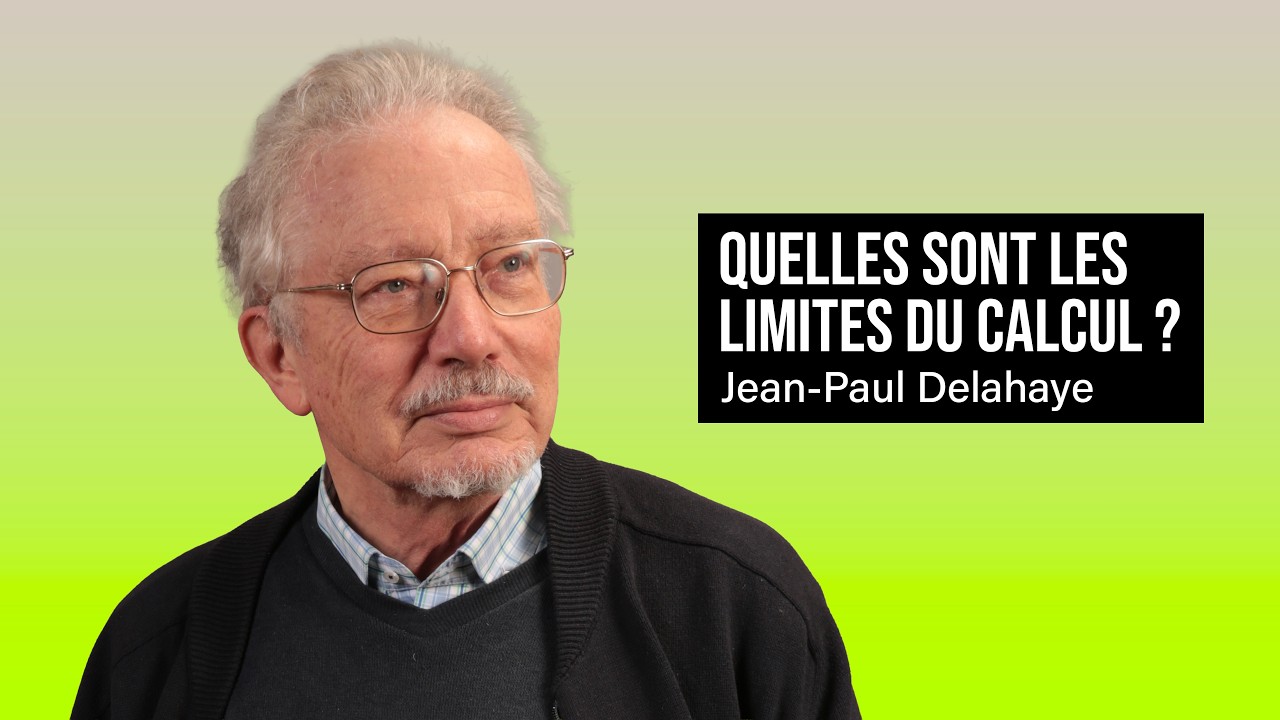
QUELLES SONT LES LIMITES DU CALCUL ?
Keywords
Summary
148 words
Critical Evaluation
The talk provides a comprehensive overview of Landauer’s principle and its significance for the future of computing. Delahaye, a respected computer scientist, presents the material with clarity and authority. He explains complex concepts such as logical irreversibility and the connection to thermodynamics in an accessible manner, without oversimplifying. The argumentation is solid, building from the principle’s formulation to its experimental validation and practical implications. He appropriately notes that experimental evidence supports but does not prove the principle, maintaining scientific rigor. The sources cited are primarily the experiments and theoretical work mentioned, though he does not provide specific references. The talk is well-structured, moving from the problem of heat in microprocessors to the principle itself, its experimental tests, and its implications. The title accurately reflects the content. The only minor weakness is that the talk is a general overview rather than a deep dive, but it serves its purpose as an introduction to the topic. Overall, the content is highly reliable and informative, making it a valuable resource for understanding the physical limits of computation.
174 words
Title / Content Match
The title accurately reflects the content, which explores the physical limits of computation, primarily through Landauer's principle.
Quality & Reliability
8/10
The speaker is a renowned computer scientist and mathematician, and the content is based on established principles (Landauer's principle) and recent experiments. The presentation is clear and rigorous, though it is a conference talk rather than a peer-reviewed publication.
Key Moments
Markers derived by PSI from the transcript: the creator did not define chapters.
- Introduction: The question of physical limits of computation and the energy cost of computing.
- Discussion of Moore's law and Koomey's law, and the trend of increasing energy efficiency.
- Introduction of Landauer's principle: irreversible operations dissipate heat.
- Explanation of the formula for Landauer's limit and its magnitude.
- Connection to Maxwell's demon and Bennett's solution using Landauer's principle.
- Current technological status: energy per operation approaching the Landauer limit by 2035.
- Experimental tests of Landauer's principle: first in 2012 with lasers, then in 2016 with magnetic memory.
- Discussion of logical irreversibility: examples of AND and OR gates.
- Implications for reversible computing and the future of computation.
- Conclusion: The principle is now widely accepted, but not proven; future challenges.
Cited Sources
- Ideas in Science — The channel hosting the video and providing additional resources.
- TimeWorld Event — The conference where the talk was recorded.
- Le temps selon Jean-Paul Delahaye — Related talk by the same speaker on the concept of time.
- Le hasard décrypté par Jean-Paul Delahaye — Related talk by the same speaker on randomness.
- Playlist Mathématiques — Playlist of mathematics-related talks.
- Playlist Physique Quantique — Playlist of quantum physics-related talks.
Concurring Sources
- Landauer's principle - Wikipedia — Confirms the principle and its experimental validation.
- Reversible computing - Wikipedia — Supports the discussion on reversible computing as a solution.
External References
Contribution & Novelties
The talk provides a clear and up-to-date synthesis of Landauer’s principle and its implications for computing, making it accessible to a broad audience. It highlights the recent experimental confirmations and the practical timeline for reaching the limit. The discussion of reversible computing as a potential solution is particularly valuable.
Pour aller plus loin :
- Landauer’s principle - Wikipedia — Provides a detailed overview of the principle and its history.
- Reversible computing - Wikipedia — Explores the concept of reversible computation and its potential.
- Maxwell’s demon - Wikipedia — Discusses the thought experiment and its resolution via information theory.
98 words
Radar Profile
The radar profile shows high scores in quality and reliability, with slightly lower but still strong scores in quantity and technical level. This indicates a well-balanced, authoritative presentation that is both informative and accessible.