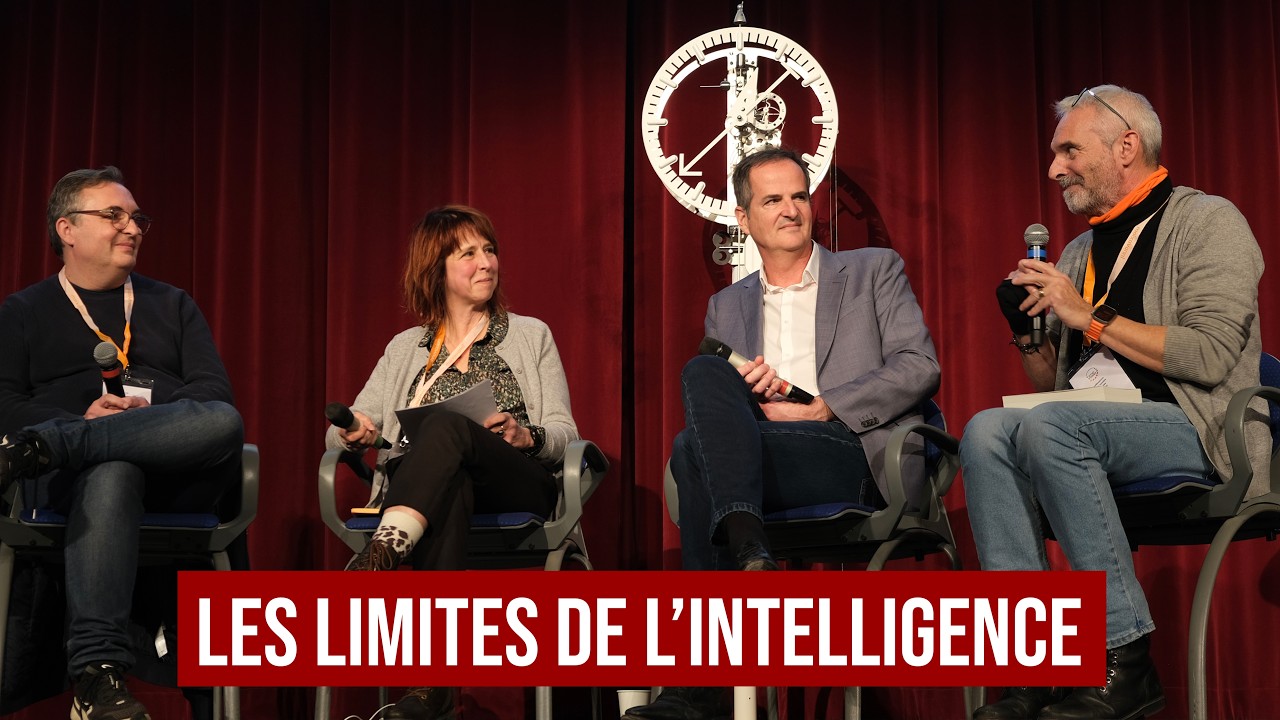
OÙ SE SITUENT LES LIMITES DE L’INTELLIGENCE ET L’INTELLIGENCE DES LIMITES ?
Keywords
Summary
145 words
Critical Evaluation
The roundtable offers a rich interdisciplinary perspective on the concept of limits in relation to intelligence. The speakers are highly credible: Cédric Villani is a Fields Medalist, Ludovic Dickel is a professor of ethology, Alain Riazuelo is an astrophysicist at IAP, and Grégory Ninot is a professor in health sciences. Their contributions are grounded in their respective fields, providing a solid scientific basis. The discussion is well-structured, moving from human intelligence (mathematics) to animal intelligence and then to the limits of the body and cosmic scales. The argumentation is generally rigorous, though the conversational format sometimes lacks depth. For instance, Villani’s segment is insightful but brief, touching on the limits of mathematical proof and the potential role of AI, but not delving into technical details. Dickel’s points about cephalopod intelligence are fascinating and supported by recent research, but specific studies are not cited. Riazuelo’s discussion of the infinite is thought-provoking, but it remains at a conceptual level. The moderation is effective, keeping the conversation focused. The main weakness is the lack of explicit references to scientific literature, which would enhance the verifiability of the claims. Additionally, the video includes a brief sponsorship segment, but it does not detract from the content. Overall, the video provides a valuable overview of the topic, suitable for a general audience interested in science and philosophy.
221 words
Title / Content Match
The title accurately reflects the content, which explores the limits of intelligence across human, animal, and cosmic scales.
Quality & Reliability
8/10
The roundtable features recognized experts (a mathematician, an ethologist, an astrophysicist, and a health researcher) discussing limits of intelligence from multiple scientific perspectives. The content is largely based on expert opinion and scientific knowledge, but lacks detailed citations or references to specific studies during the discussion. The video is a filmed event with high production quality, and the speakers are credible. However, the absence of explicit sources and the conversational format slightly reduce the verifiability.
Key Moments
Markers derived by PSI from the transcript: the creator did not define chapters.
- Introduction by moderator Olivia Recasens, presenting the theme and speakers.
- Cédric Villani's pre-recorded message on the limits of mathematical knowledge and the role of proofs.
- Discussion on the limits of the human body with Grégory Ninot, focusing on performance and resilience.
- Ludovic Dickel discusses animal intelligence, particularly cephalopods, and how they challenge our categories.
- Alain Riazuelo explores the limits of human cognition when thinking about the infinite and the cosmos.
- Panel discussion on whether limits are obstacles or catalysts for intelligence.
- Q&A session with the audience, addressing questions about AI and the future of intelligence.
- Concluding remarks and thanks to the speakers.
Cited Sources
- Ideas in Science - Official Website — The channel's website, providing access to a library of scientific conferences.
- Ideas in Science - Donation Page — Page for supporting the channel.
- TimeWorld Playlist — Playlist containing related TimeWorld events.
Concurring Sources
- Cédric Villani - Wikipedia — Provides background on Villani's work and achievements, supporting his credibility.
- Cephalopod intelligence - Wikipedia — Supports Dickel's claims about the cognitive abilities of cephalopods.
Dissenting Sources
- No discordant sources found — The video does not present conflicting viewpoints; the speakers generally agree on the importance of limits.
Contribution & Novelties
The video provides a unique interdisciplinary synthesis on the limits of intelligence, bringing together mathematics, ethology, health sciences, and astrophysics. It offers diverse perspectives and highlights the dynamic nature of limits, whether they are mathematical frontiers, biological constraints, or cognitive boundaries. The discussion encourages reflection on whether to push or accept limits, and it underscores the role of collective intelligence and technological tools in expanding our understanding.
Pour aller plus loin :
- Cédric Villani - Wikipedia — Background on the mathematician and his contributions.
- AlphaFold - DeepMind — AI system that predicts protein structures, relevant to the discussion on AI’s impact on science.
- Cephalopod intelligence - Wikipedia — Overview of the cognitive abilities of cephalopods, relevant to Ludovic Dickel’s points.
- The Four Color Theorem - Wikipedia — Example of computer-assisted proof mentioned by Villani.
- Optimal Transport - Wikipedia — Topic of Villani’s book, illustrating the limits and progress in mathematics.
150 words
Radar Profile
The radar profile shows high scores in quantity and quality of information, reflecting the diverse expert contributions. The technical level is moderate, making it accessible to a general audience. The overall reliability is high due to the credibility of the speakers, though the lack of explicit citations slightly reduces the score.
💬 No comments were provided for analysis.