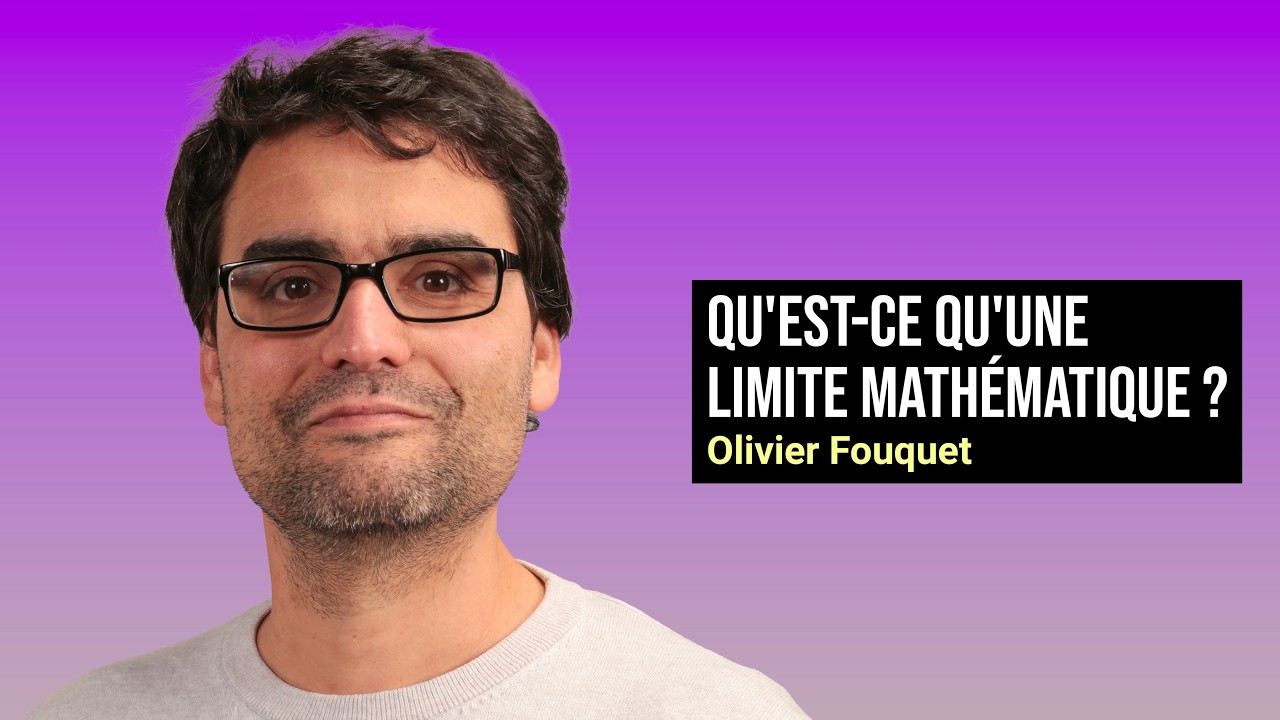
PEUT-ON COMPRENDRE MATHÉMATIQUEMENT CE QU'IL SE PASSE À LA LIMITE ?
Keywords
Summary
151 words
Critical Evaluation
The conference provides a solid introduction to the concept of mathematical limits, using historical paradoxes and practical examples to illustrate the ideas. Olivier Fouquet, a professor of mathematics, demonstrates a clear and rigorous approach, explaining the resolution of Zeno’s paradox through the calculation of an infinite geometric series. The argument is logically sound and well-presented, with a step-by-step derivation that shows the sum equals 1. The transition to the number e via compound interest is effective, showing how limits arise naturally in real-world scenarios. The talk is scientifically accurate, with no apparent errors or misleading statements. The sources cited are minimal, but the content is based on well-established mathematical knowledge. The title accurately reflects the content, which is a conceptual exploration of limits. The presentation is engaging and accessible, making it valuable for a general audience. However, it does not delve into advanced topics or provide extensive references, which might limit its depth for experts. Overall, the conference is a high-quality educational piece that effectively communicates the essence of limits.
170 words
Title / Content Match
The title accurately reflects the content, which explores the mathematical concept of limits through historical paradoxes and modern applications.
Quality & Reliability
8/10
The talk is given by a university professor specializing in arithmetic geometry, providing a rigorous mathematical exposition of the concept of limits. The reasoning is clear and well-structured, with historical context and illustrative examples. The content is accurate and aligns with standard mathematical knowledge, though it is presented at an accessible level.
Key Moments
Markers derived by PSI from the transcript: the creator did not define chapters.
- Introduction to Zeno's paradox of the arrow.
- Demonstration that the infinite sum 1/2 + 1/4 + 1/8 + ... equals 1.
- Definition of a mathematical limit.
- Introduction to the compound interest example.
- Explanation of the number e as a limit.
- Discussion of the philosophical implications of limits.
- Conclusion and summary of key points.
Cited Sources
- Ideas in Science — The channel's website, providing access to a library of scientific lectures.
- TimeWorld Playlist — Playlist of the TimeWorld conference series, where this talk was given.
Concurring Sources
- Limit (mathematics) — Standard mathematical definition of limits, consistent with the talk.
Contribution & Novelties
The talk provides a clear and accessible explanation of the concept of limits, using historical paradoxes and practical examples. It emphasizes the rigorous definition of limits and their role in constructing new numbers like e. The presentation is original in its pedagogical approach, making complex ideas understandable to a general audience.
Pour aller plus loin :
- Zeno’s paradoxes — Background on the ancient paradoxes that motivate the concept of limits.
- Limit (mathematics) — Formal definition and properties of limits in calculus.
- e (mathematical constant) — Detailed information about the number e and its applications.
94 words
Radar Profile
The radar profile shows high scores in quality and reliability, with moderate scores in quantity and technical level. This indicates a well-structured and accurate presentation that is accessible to a broad audience, though it may not delve deeply into advanced technical details.