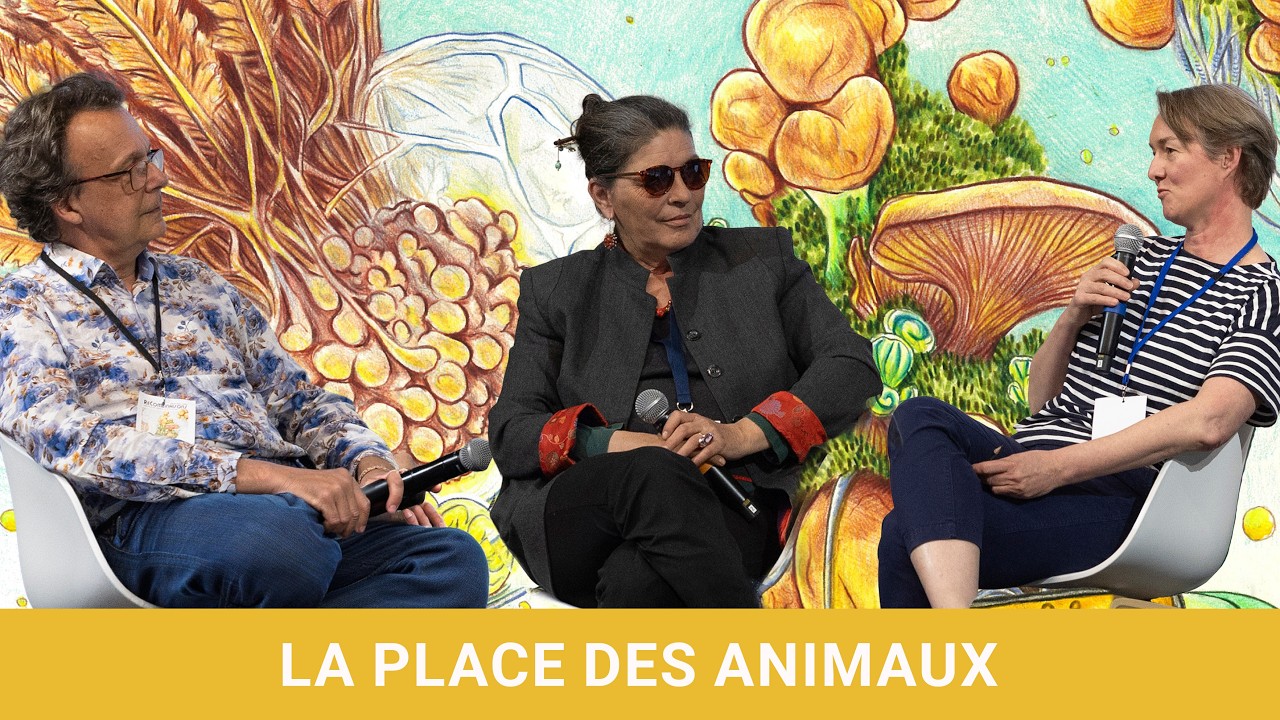
LA PLACE DES ANIMAUX
Keywords
Summary
161 words
Critical Evaluation
The roundtable offers a rich and nuanced exploration of the place of animals, drawing on the diverse expertise of the speakers. Marion Bérard provides a scientific perspective grounded in veterinary medicine and animal welfare, highlighting the evolution of ethical standards in animal research and the importance of considering animal sentience. Jeanne-A Debats brings a literary and personal viewpoint, using science fiction to imagine alternative futures and challenging anthropocentric narratives. François Bontems contributes philosophical insights, questioning the boundaries between human and animal and the ethical implications of our interactions.
The discussion is well-structured, moving from personal experiences to broader ethical and literary considerations. The speakers engage in a genuine dialogue, building on each other’s points and offering complementary perspectives. The scientific content is accurate and up-to-date, referencing the National Reference Centre for Animal Welfare and the ethical frameworks governing animal experimentation. The literary analysis is insightful, drawing on classic and contemporary science fiction to illustrate different models of human-animal relations.
However, the discussion is largely exploratory and does not delve deeply into specific scientific studies or data. Some claims are anecdotal, and the ethical arguments, while compelling, are not systematically developed. The roundtable format limits the depth of analysis, and the conversation occasionally meanders. The absence of a moderator to synthesize or challenge points is noticeable.
The title accurately reflects the content, and the video is well-produced with clear audio and visuals. The description provides useful context and links for further exploration. Overall, this is a valuable contribution to the public understanding of animal ethics, offering a thoughtful and accessible discussion that encourages reflection on our relationships with other species.
269 words
Title / Content Match
The title accurately reflects the content, which explores the role and place of animals in human societies, utopias, and scientific research.
Quality & Reliability
8/10
The roundtable features experts in veterinary science, ethics, and science fiction, providing a multidisciplinary perspective. The discussion is grounded in scientific knowledge (animal welfare, ethics of animal experimentation) and literary analysis. The source is a reputable science communication channel (Ideas in Science) with a focus on academic content. However, the video is a debate, not a peer-reviewed source, and some claims are anecdotal.
Key Moments
Markers derived by PSI from the transcript: the creator did not define chapters.
- Introduction of the roundtable and speakers.
- Personal relationships with animals: Marion Bérard and Jeanne-A Debats share their experiences.
- Discussion on animal welfare and the evolution of ethical standards.
- Animals in utopian literature: Trantor, Anarres, and The Ministry for the Future.
- Communication with animals and the concept of 'becoming animal'.
- Ethics of animal experimentation and the role of ethics committees.
- Multispecies cohabitation and the need for a new ethical framework.
- Q&A session with the audience.
- Concluding remarks and final thoughts.
Cited Sources
- Ideas in Science — Main website of the channel, providing access to over 3000 scientific lectures.
- Support Ideas in Science — Donation page to support the free scientific video library.
- ReCombinaisons Playlist — Playlist of the ReCombinaisons event, where this roundtable was recorded.
Concurring Sources
- National Reference Centre for Animal Welfare — Mentioned by Marion Bérard as a key resource for animal welfare standards in France.
Contribution & Novelties
The video provides a unique interdisciplinary discussion on the place of animals, combining veterinary science, science fiction, and philosophy. It highlights the absence of animals in classic utopias and the need for a multispecies perspective in imagining future societies. The discussion also emphasizes the evolution of animal welfare standards and the ethical responsibilities of humans.
Pour aller plus loin :
- Animal welfare science — Overview of the scientific study of animal welfare.
- Sentience — Concept of sentience and its ethical implications.
- The Ministry for the Future — Kim Stanley Robinson’s novel that integrates animals into ecological restoration.
- Ursula K. Le Guin — Author of The Dispossessed, a utopian novel without animals.
111 words
Radar Profile
The radar profile shows high scores in quantity and quality of information, reflecting the rich and diverse content. The technical level is moderate, making it accessible to a general audience. The overall reliability is high due to the expertise of the speakers and the reputable platform.
💬 No comments were provided for analysis.