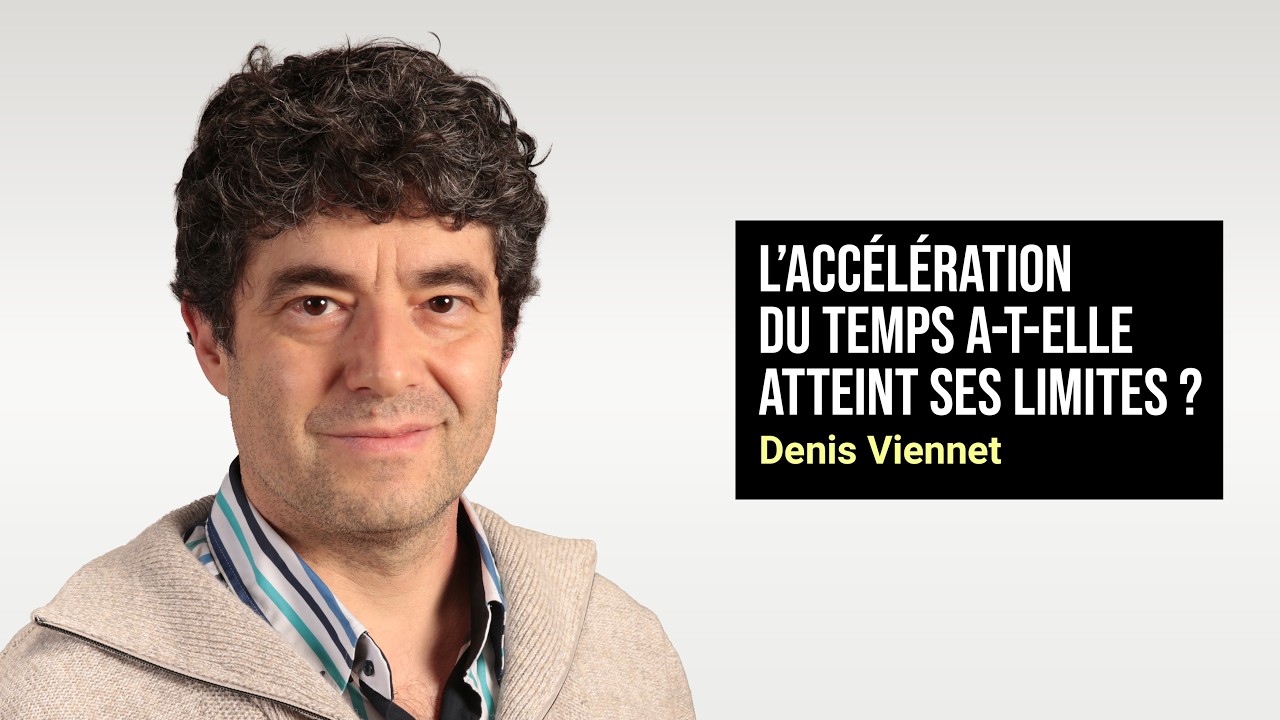
L'accélération du temps a-t-elle atteint ses limites ?
Keywords
Summary
139 words
Critical Evaluation
The conference offers a thought-provoking philosophical analysis of the phenomenon of time acceleration in contemporary societies. The speaker, Denis Viennet, demonstrates a solid command of the relevant philosophical and sociological literature, referencing key thinkers such as Hartmut Rosa, Walter Benjamin, Paul Virilio, and Jean-François Lyotard. His argument is coherent and well-structured, moving from a definition of acceleration to its systemic effects and potential limits. The use of concepts like ’lived time’ and ‘resonance’ provides a valuable framework for understanding the subjective experience of time. However, the presentation is largely theoretical and lacks empirical data or specific case studies to substantiate the claims. While the speaker mentions sociological studies, he does not cite them directly, which weakens the scientific rigor. The argumentation is persuasive but relies heavily on authority and philosophical reasoning rather than concrete evidence. The title’s question is directly addressed, and the speaker’s affirmative answer is justified within his framework. The talk’s strength lies in its synthesis of diverse ideas and its call for a more reflective approach to time. Nevertheless, for a scientific audience, the lack of citations and empirical grounding may be a limitation. Overall, the conference is intellectually stimulating and offers a valuable perspective on a pressing societal issue, but it would benefit from more rigorous scientific support.
212 words
Title / Content Match
The title accurately reflects the central question addressed, and the speaker provides a clear affirmative answer with philosophical and sociological arguments.
Quality & Reliability
7/10
The speaker is a doctor of philosophy and lecturer, and the talk references established sociologists and philosophers (Hartmut Rosa, Walter Benjamin, Paul Virilio, etc.). However, the presentation is largely theoretical and lacks empirical data or direct citations of specific studies, which limits its scientific rigor.
Key Moments
Markers derived by PSI from the transcript: the creator did not define chapters.
- Introduction and thesis statement: acceleration has reached its limits.
- Definition of lived time and phenomenology.
- Discussion of modernity and autonomy, referencing Hartmut Rosa.
- Impact of acceleration on mental health and creativity.
- Concept of resonance as a remedy.
- Role of arts and creativity in resisting acceleration.
- Conclusion and call for a new relationship to time.
Cited Sources
- Ideas in Science — Main website of the channel hosting the conference.
- Support Ideas in Science — Donation page for the channel.
- TimeWorld Playlist — Playlist of related conferences from the TimeWorld event.
Concurring Sources
- Hartmut Rosa - Social Acceleration — Rosa's theory of social acceleration aligns with the talk's thesis.
Dissenting Sources
- Critique of Accelerationism — Some thinkers argue that acceleration can be harnessed for positive change, contrasting with the talk's critical stance.
Contribution & Novelties
The talk offers a philosophical perspective on time acceleration, synthesizing ideas from sociology and phenomenology. It introduces the concept of ‘resonance’ as a potential counterforce to alienation. The speaker emphasizes the importance of artistic practices in resisting dehumanization.
Pour aller plus loin :
- Hartmut Rosa - Resonance — Key theorist on acceleration and resonance.
- Phenomenology — Philosophical approach used in the talk.
- Paul Virilio - Dromology — Concept of speed and acceleration.
72 words
Radar Profile
The radar profile shows high scores in information quantity and quality, reflecting the rich philosophical content. The technical level is moderate, indicating accessibility to a general audience. Reliability is good but not excellent due to lack of empirical citations.
💬 No comments were provided for analysis.