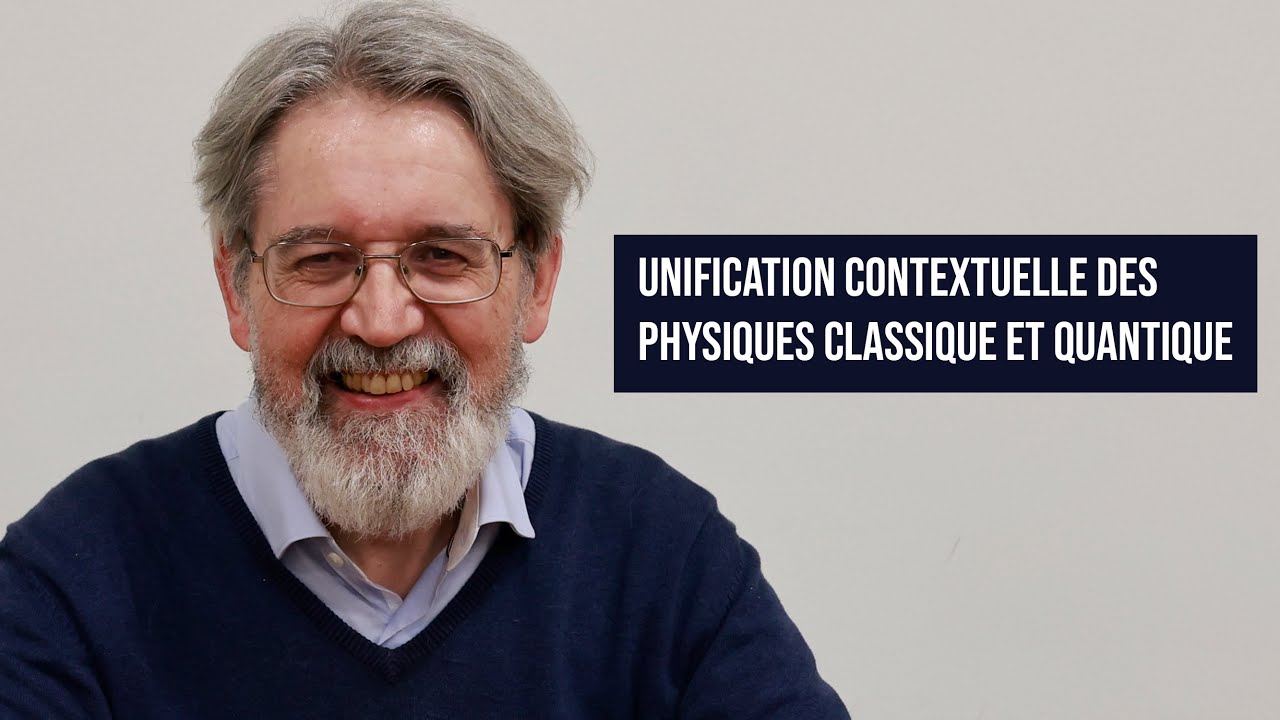
UNIFICATION CONTEXTUELLE DES PHYSIQUES CLASSIQUE ET QUANTIQUE | PHILIPPE GRANGIER
Keywords
Summary
128 words
Critical Evaluation
The talk presents a coherent and original interpretation of quantum mechanics, grounded in the speaker’s extensive experience in quantum optics. Grangier’s argumentation is rigorous, and he clearly explains the conceptual steps from Bell inequalities to his contextual framework. He emphasizes the importance of the ‘context’ in defining physical properties, which is a well-known aspect of quantum mechanics but is here elevated to a central role. The proposal to replace the notion of ‘state’ with ‘modality’ (system + context) is thought-provoking and aligns with some recent developments in quantum foundations, such as QBism and relational quantum mechanics, though Grangier distinguishes his approach from these. The talk is not a literature review but a presentation of the speaker’s own research, which is appropriate for a colloquium. The sources cited are mostly his own publications and collaborations, which is acceptable but limits the breadth of external validation. The discussion with the audience, particularly with Hervé Zwirn, adds depth and clarifies potential objections. The title accurately reflects the content. Overall, the talk is of high scientific quality, though it represents a specific viewpoint that is not universally accepted. The main weakness is the lack of detailed mathematical derivations, but this is understandable given the format. The speaker’s credibility is high, and the ideas are presented with clarity and intellectual honesty.
216 words
Title / Content Match
The title accurately reflects the content: the talk presents a contextual unification of classical and quantum physics, as developed by Philippe Grangier.
Quality & Reliability
8/10
The speaker is a recognized physicist (Institut d'Optique, École Polytechnique) with a long career in quantum optics. The talk is a formal presentation of his own research program, based on published articles and collaborations. The argumentation is rigorous, but it is an expert opinion rather than a peer-reviewed meta-analysis.
Key Moments
Markers derived by PSI from the transcript: the creator did not define chapters.
- Introduction and background: Grangier explains his 20-year research program on quantum foundations.
- Discussion of Bell inequalities and their experimental violation, leading to the rejection of local realism.
- Presentation of the concept of 'modality' as system + context, and the importance of context in quantum measurements.
- Introduction of axioms to reconstruct quantum mechanics, including the postulate of a unique macroscopic world.
- Discussion with Hervé Zwirn on the nature of reality and the existence of the macroscopic world independent of observers.
- Comparison with other interpretations: rejection of universal wavefunction and multiple worlds.
- Further elaboration on the role of context and the classical-quantum boundary.
- Conclusion and outlook: potential implications for quantum technologies and future research.
Cited Sources
- Contextual unification of classical and quantum physics — Grangier's recent paper presenting the contextual unification framework.
- Completing the quantum formalism in a contextually objective framework — Paper by Grangier and collaborators on the contextual objective framework.
- Contextual objectivity: a realistic interpretation of quantum mechanics — Earlier paper by Grangier introducing the concept of contextual objectivity.
Concurring Sources
- Contextual objectivity: a realistic interpretation of quantum mechanics — Grangier's own paper that aligns with the talk's content.
- Completing the quantum formalism in a contextually objective framework — Collaborative paper supporting the framework.
Dissenting Sources
Contribution & Novelties
The talk presents a novel interpretation of quantum mechanics that emphasizes the role of context in defining physical reality. Grangier proposes to replace the notion of ‘state’ with ‘modality’ (system + context), which allows a realist description without invoking a universal wavefunction. This approach offers a potential resolution to the measurement problem and provides a clear criterion for the classical-quantum boundary. The framework is supported by published papers and ongoing collaborations.
Pour aller plus loin :
- Contextual objectivity: a realistic interpretation of quantum mechanics — Key paper by Grangier introducing the concept.
- Completing the quantum formalism in a contextually objective framework — Further development of the framework.
- Contextual unification of classical and quantum physics — Recent paper summarizing the approach.
- Relational quantum mechanics — Related interpretation that also emphasizes context and relations.
- QBism — Another interpretation that treats quantum states as subjective, but with a different emphasis on context.
149 words
Radar Profile
The radar profile shows high scores in information quantity, quality, technical level, and reliability, indicating a dense and rigorous scientific talk. The speaker's expertise and the structured presentation contribute to a strong overall assessment.
💬 No comments were provided for analysis.