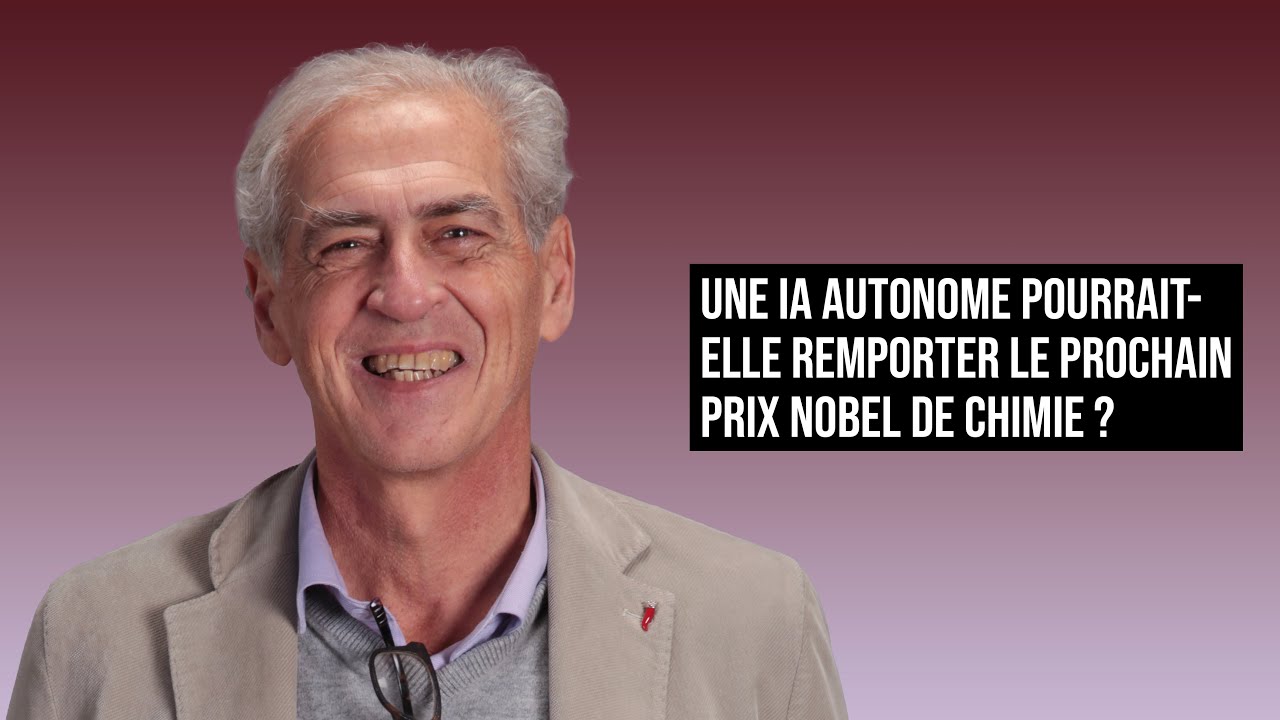
UNE IA AUTONOME POURRAIT-ELLE REMPORTER LE PROCHAIN PRIX NOBEL DE CHIMIE ?
Keywords
Summary
149 words
Critical Evaluation
Hugues Bersini delivers a thought-provoking and intellectually stimulating talk on the intersection of AI and scientific discovery. His credentials as a professor and director of an AI lab lend authority to his commentary. The talk is well-structured, moving from recent AI achievements to the fundamental differences between symbolic and neural AI, and finally to the epistemological implications. Bersini’s use of concrete examples, such as AlphaFold and his students’ Transformer experiments, makes complex concepts accessible. He also provides a balanced view, acknowledging the contributions of human scientists and the data they have compiled. However, the talk is primarily an opinion piece rather than a rigorous scientific analysis. While Bersini mentions key figures and concepts, he does not provide detailed citations or references to specific papers, which limits the verifiability of his claims. The discussion of a ‘sixth revolution’ in science is intriguing but remains speculative. The title’s question is addressed, but the answer is nuanced: while AI has made significant contributions, full autonomy in scientific discovery remains questionable. Overall, the talk offers valuable insights into the current state of AI and its potential impact on science, but it would benefit from more concrete evidence and references.
195 words
Title / Content Match
The title is engaging and directly addressed in the talk, which explores the possibility of autonomous AI winning a future Nobel Prize in Chemistry, using recent examples.
Quality & Reliability
8/10
The speaker is a recognized AI professor and researcher, providing a well-structured argument based on his expertise and citing specific examples (AlphaFold, Nobel Prizes). However, the talk is largely opinion and lacks detailed citations or peer-reviewed references.
Key Moments
Markers derived by PSI from the transcript: the creator did not define chapters.
- Introduction to the question and overview of AI's recent Nobel Prizes.
- Discussion on the shift from symbolic to neural AI.
- Explanation of AlphaFold and its significance in chemistry.
- Demonstration of Transformer networks generating Shakespeare-like text.
- Comparison between Chomsky's symbolic approach and neural networks.
- Epistemological discussion on data-driven science and the potential sixth revolution.
- Reflections on the role of human data and knowledge in AI achievements.
- Conclusion and final thoughts on the future of AI in scientific discovery.
Cited Sources
- TimeWorld Event — The conference was part of the TimeWorld scientific congresses, and this link provides information about the event.
Concurring Sources
- AlphaFold — The talk discusses AlphaFold's Nobel Prize, and this source provides details on its development and impact.
Dissenting Sources
- Noam Chomsky's critique of deep learning — Chomsky has argued that deep learning lacks the symbolic understanding necessary for true intelligence, which contrasts with the talk's emphasis on neural networks' capabilities.
Contribution & Novelties
The talk provides a unique perspective on the potential of AI in scientific discovery, particularly in chemistry, by analyzing the recent Nobel Prizes and the shift towards neural AI. It raises important epistemological questions about the nature of scientific method in the age of AI.
Pour aller plus loin :
- AlphaFold — Overview of the AI system that predicts protein structures.
- Deep learning — Background on the neural network approach.
- Scientific method — Discussion on the traditional scientific approach and its evolution.
82 words
Radar Profile
The radar profile shows high scores in quality of information and reliability, reflecting the speaker's expertise and coherent argumentation. The quantity of information is moderate, and the technical level is high, indicating a talk suited for an informed audience.
💬 No comments were provided for analysis.