Impacts of climate change on forests
Keywords
Summary
213 words
Critical Evaluation
Value of the Information & Strength of the Argument
The lecture provides valuable insights into the economic implications of climate change on forests, combining ecological modeling with economic valuation. The argumentation is solid, based on peer-reviewed research and empirical data. The speaker clearly explains the methodology and acknowledges uncertainties. The use of concrete examples (e.g., bark beetle damage) strengthens the argument. However, some parts are presented as a summary, and the audience may need to refer to the original papers for full details.
Scientific Rigor, Source Quality, Title Accuracy
The speaker cites several of his own publications, including a Nature Climate Change paper (2013) and a Science Advances paper, which are high-quality sources. He also mentions a research training group and a project with green investment funds. The title accurately reflects the content. The lecture is well-structured and the speaker is transparent about model assumptions and limitations. No comments were provided for analysis.
153 words
Title / Content Match
The title accurately reflects the content, which covers various impacts of climate change on forests in Europe and Central America.
Quality & Reliability
8/10
The lecture is based on peer-reviewed research, including a Nature Climate Change paper and a Science Advances paper, and uses extensive empirical data (European forest plots, tropical plantation data). The speaker is a professor at the University of Freiburg and coordinates international projects. However, the presentation is a summary and some details are simplified.
Key Moments
Markers derived by PSI from the transcript: the creator did not define chapters.
- Introduction and overview of the lecture structure
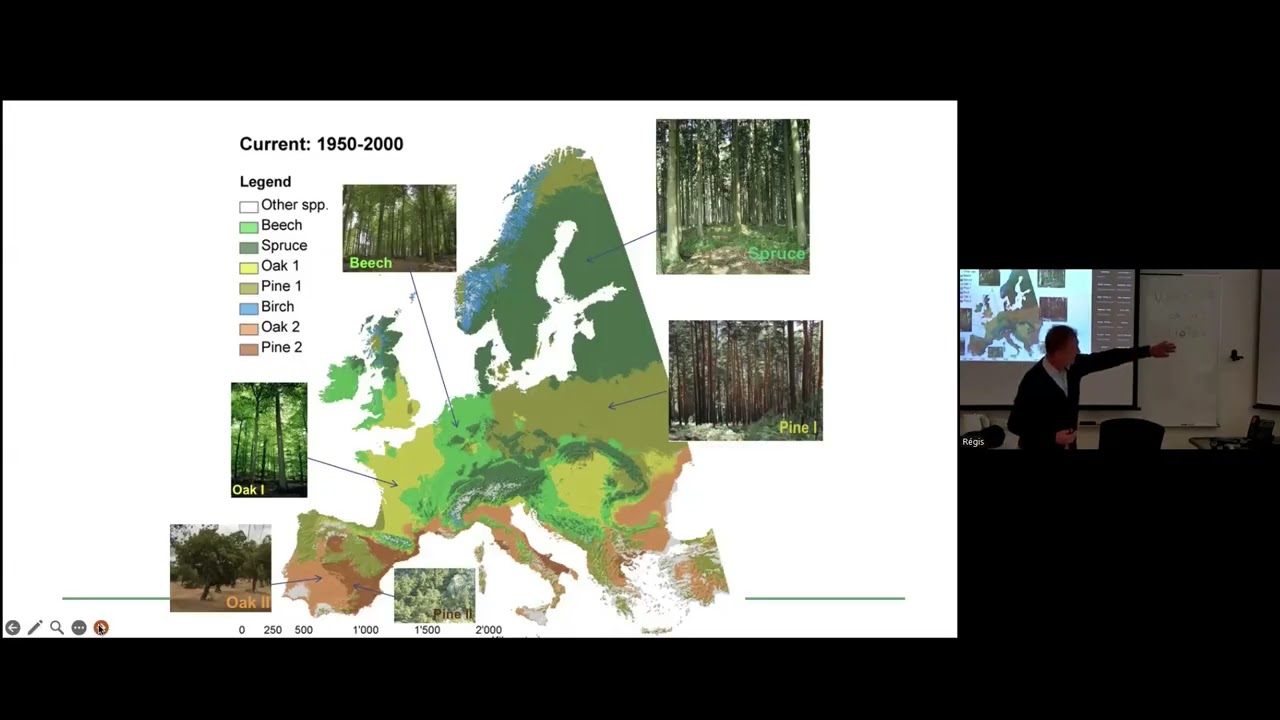
- European forest plot system and species distribution models
- Projected shifts in tree species distributions under climate scenarios
- Economic valuation of forest production losses (100-300 billion euros)
- Recent drought damages in Germany as validation
- Conservation of forest biodiversity: research training group and ecosystem services
- Uncertainty analysis and robust conservation decisions
- Central American tropical plantations and 3PG model calibration
- Temperature threshold and productivity decline in tropical forests
- Upcoming international research training group with Canadian partners
Cited Sources
- Hanewinkel et al. (2013) Nature Climate Change - 'Climate change may cause severe loss in the economic value of European forest land' — Cited as the source for the 100-300 billion euros loss estimate.
- Science Advances paper on tropical plantation productivity — Mentioned as the source for the temperature threshold finding in tropical plantations.
Concurring Sources
- IPCC reports on climate change impacts on forests — General support for climate change impacts on ecosystems.
Contribution & Novelties
The lecture synthesizes several research projects, providing a comprehensive view of climate change impacts on forests from an economic perspective. It highlights the importance of combining species distribution models with economic valuation, and the need for robust decision-making under uncertainty. The Central American case study adds a tropical perspective, showing that even high-growth forests are vulnerable to temperature thresholds.
Pour aller plus loin :
- Species distribution modeling — Overview of the method used to project species ranges.
- Land expectation value — Economic concept used to value forest land.
- 3-PG model — Process-based growth model used for plantations.
97 words
Radar Profile
The radar profile shows high scores in information quantity, quality, and reliability, with a slightly lower technical level. This indicates a well-substantiated lecture that is accessible to a broad audience while maintaining scientific rigor.