Adaptation des forêts aux changements climatiques en présence de cervidés : défis et perspectives
Keywords
Summary
213 words
Critical Evaluation
Value of the Information & Strength of the Argument
The presentation provides valuable insights into the practical implementation of assisted migration, a key adaptation strategy. The speaker presents original data from a well-designed experiment, offering concrete evidence on survival, growth, and damage. The argumentation is solid, based on systematic literature review and rigorous statistical analyses. The speaker acknowledges limitations, such as ongoing analyses and the complexity of interactions, which enhances credibility. The discussion of challenges, such as seed sourcing and operational constraints, adds practical value.
Scientific Rigor, Source Quality, Title Accuracy
The scientific rigor is high, with a clear experimental design and use of statistical models. The speaker cites relevant literature and mentions the DREAM network, but specific sources are not explicitly listed in the video. The title accurately reflects the content, focusing on forest adaptation to climate change in the presence of cervids. The presentation is well-structured and evidence-based, though some methodological details are omitted.
156 words
Title / Content Match
The title accurately reflects the content, focusing on forest adaptation to climate change in the presence of cervids, with a detailed case study on assisted migration.
Quality & Reliability
8/10
The presentation is based on a systematic literature review and original data from the DREAM network, with rigorous experimental design and statistical analyses. The speaker is a researcher at the Direction de la recherche forestière du Québec, with relevant expertise. Some limitations include ongoing analyses and lack of detailed methodological explanations.
Key Moments
Markers derived by PSI from the transcript: the creator did not define chapters.
- Introduction by Rebecca, presenting Émilie Champagne and her expertise.
- Émilie starts her talk, explaining the context of ecosystem-based management and climate change.
- Introduction to assisted migration and its types.
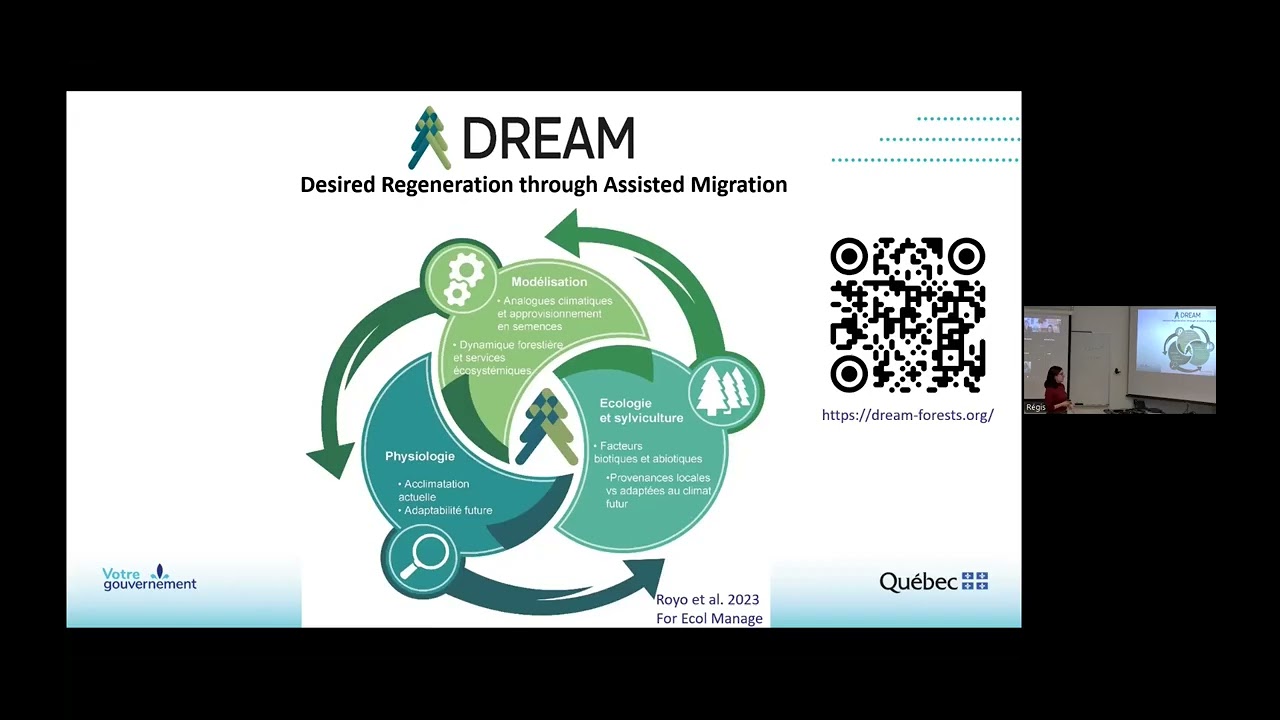
- Presentation of the DREAM network and its objectives.
- Description of the Lac des Amanites experimental design.
- Overview of tree species and climate analogues.
- Survival results after five years.
- Growth results and effects of treatments.
- Discussion of damage types and their impact on survival.
- Conclusion and perspectives for integrating browsing into assisted migration.
Cited Sources
- DREAM network website — Mentioned as the network's website with information on graduate opportunities.
Concurring Sources
- DREAM network website — Provides context on the network's objectives and sites.
Contribution & Novelties
The presentation offers original data from a long-term assisted migration experiment, providing insights into survival, growth, and damage patterns. It highlights the importance of considering cervid browsing in adaptation strategies, a relatively underexplored aspect. The integration of climate analogues and ecophysiological measurements adds novelty.
Pour aller plus loin :
- Assisted migration — Overview of the concept and its applications.
- Climate analogue — Explanation of climate analogue methods.
- DREAM network — Official site with details on the research network.
78 words
Radar Profile
The radar profile shows high scores in information quantity, quality, and reliability, with a slightly lower technical level. This indicates a well-supported and informative presentation, though some technical details are simplified for a general audience.