Frédéric Pitre 26 mars 2025
Keywords
Summary
149 words
Critical Evaluation
Value of the Information & Strength of the Argument
The lecture provides valuable insights into the practical applications of phytoremediation, supported by concrete examples from the speaker’s own research projects. The argumentation is solid, based on experimental data and field observations. The speaker effectively communicates the challenges and benefits of using plants for environmental cleanup, and he addresses potential concerns such as the use of non-native species and the safety of public access to contaminated sites. The presentation is well-structured, moving from general concepts to specific case studies, and it includes a forward-looking perspective on emerging applications like space agriculture.
Scientific Rigor, Source Quality, Title Accuracy
The scientific rigor is high, as the speaker is a recognized researcher and presents data from funded projects (e.g., Genome Canada). He references specific studies and methodologies, such as transcriptomics and metabolomics. The sources are primarily his own and his collaborators’ work, which is appropriate for a lecture. The title is not descriptive, but the description provides context. The content aligns well with the stated topic of a sustainable platform for bioproduct production based on environmental rehabilitation.
183 words
Title / Content Match
The title is generic (just the speaker's name and date), but the description clearly indicates the topic. The content matches the described conference.
Quality & Reliability
8/10
The speaker is a professor and researcher in plant biology, presenting his own and collaborative research, with references to specific projects and funding. The content is technical and appears scientifically sound, though not peer-reviewed in this format.
Key Moments
Markers derived by PSI from the transcript: the creator did not define chapters.
- Introduction and background of the speaker
- Overview of contaminated soil problem in Quebec
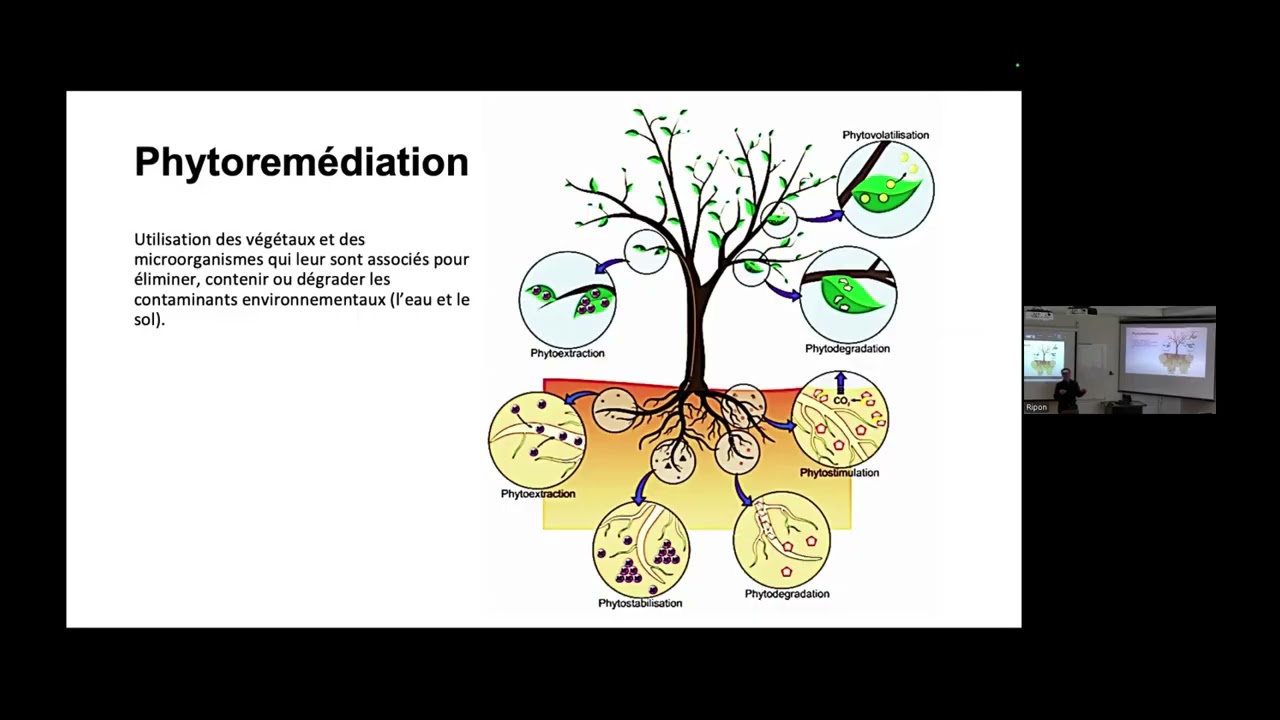
- Explanation of phytoremediation strategies
- Case study: community garden in Montreal
- Case study: vinyl chloride site and deep planting
- Genorem project: large-scale genomics study
- Transcriptomic analysis of rhizosphere
- Revitalization of former refinery sites
- Metabolomics for bioproduct discovery
- Space agriculture projects with Canadian Space Agency
Cited Sources
- Genorem project — Mentioned as a large-scale genomics project funded by Genome Canada.
Concurring Sources
- Phytoremediation: An Overview — General reference supporting the mechanisms and applications discussed.
Contribution & Novelties
The lecture provides an original perspective on integrating phytoremediation with bioproduct production, emphasizing the role of rhizosphere microbiomes. It showcases recent research findings, such as the differential gene expression between plants and microbes in contaminated soils. The speaker also introduces novel applications like using willows for phytovolatilization and space agriculture.
Pour aller plus loin :
- Phytoremediation — Overview of the technology and its mechanisms.
- Rhizosphere — The soil zone influenced by plant roots, crucial for microbial interactions.
- Metabolomics — The study of metabolites, relevant to bioproduct discovery.
- Willow — The genus Salix, commonly used in phytoremediation.
- Canadian Space Agency — Agency involved in space agriculture research.
106 words
Radar Profile
The radar profile shows high scores in information quantity, quality, and reliability, with a slightly lower technical level, indicating a well-balanced and accessible presentation for a scientific audience.