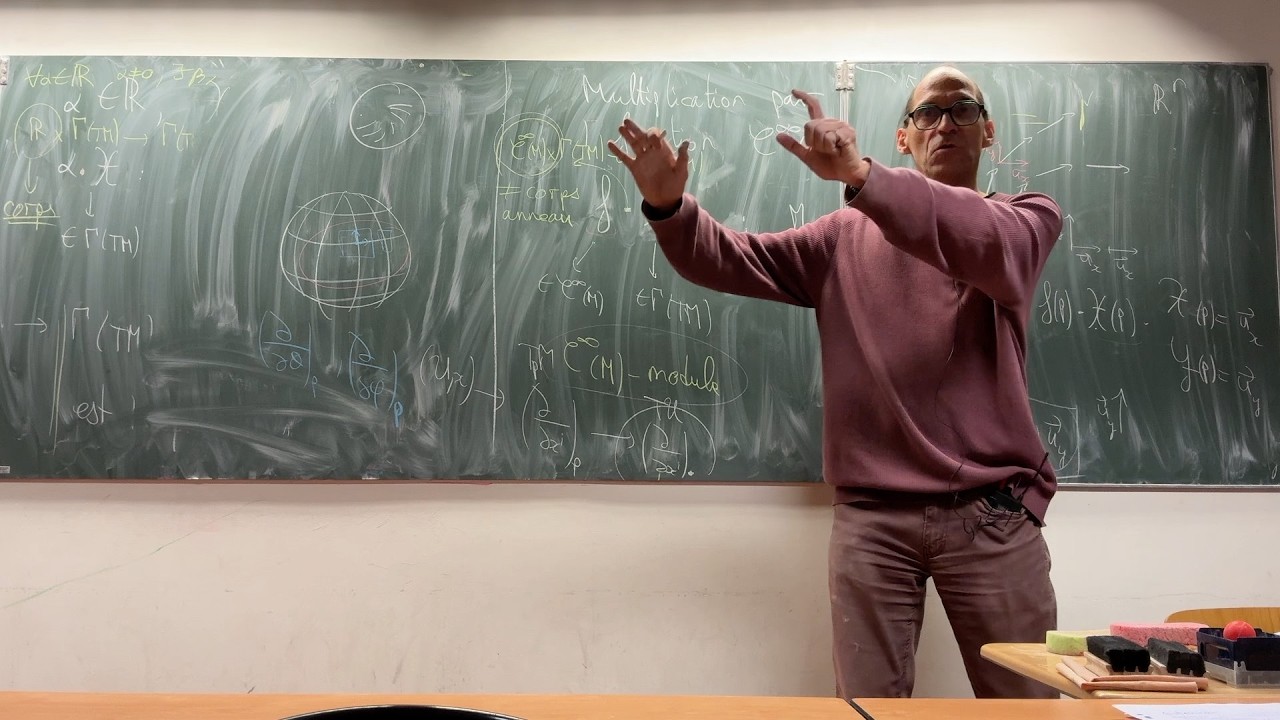
Relativité Générale (2026) – Séance 6a
Keywords
Summary
197 words
Critical Evaluation
Value of the Information & Strength of the Argument
The lecture provides a high value for students of general relativity, offering a clear conceptual bridge from Newtonian mechanics to the geometric framework of general relativity. The argumentation is solid, building logically from the limitations of Newton’s law to the necessity of a geometric description. The professor carefully explains the conceptual shifts, such as the role of proper time and the replacement of a global affine structure with a local metric field. The mathematical exposition is rigorous, with attention to definitions and the motivation behind each concept. The lecture is well-structured, with a clear introduction and a focused development of the tangent bundle and covariant derivative.
Scientific Rigor, Source Quality, Title Accuracy
The scientific rigor is high, as the lecture is part of a university course and adheres to standard mathematical physics. The professor does not cite external sources, but the content is based on established textbooks and the general framework of differential geometry. The title accurately reflects the content, as it is indeed the sixth session covering the specified topics. The lecture is self-contained, with no reliance on unverified claims. The presentation is clear and precise, with appropriate mathematical notation. The only minor issue is the lack of explicit references, but this is typical for a lecture and does not detract from the overall quality.
225 words
Title / Content Match
The title accurately reflects the content: it is the sixth session (6a) of a course on General Relativity, covering the tangent bundle, tensor fields, and covariant derivative.
Quality & Reliability
8/10
The lecture is part of a university Master's course, delivered by a professor (Etienne Parizot) at Université Paris Cité. The content is mathematically rigorous, building on established physics concepts. The presentation is clear and pedagogical, with careful explanations. However, as a lecture, it is not peer-reviewed and may contain minor simplifications or personal interpretations.
Key Moments
Markers derived by PSI from the transcript: the creator did not define chapters.
- Introduction: Newton's law in Newtonian physics, special relativity, and general relativity.
- Discussion of the problems with Newton's law: the notion of Galilean reference frames and the impossibility of force-free bodies.
- Special relativity: spacetime as an absolute structure, proper time as the length along a worldline.
- General relativity: gravity as geometry, the loss of affine structure, and the need for a metric field on the tangent space.
- Introduction to the tangent bundle: definition and canonical manifold structure.
- Detailed explanation of the tangent bundle and its differential structure.
- Discussion of vector fields and tensor fields as sections of the tangent bundle.
- Introduction to the covariant derivative and its role in general relativity.
- Further elaboration on the covariant derivative and its properties.
- Conclusion and summary of the key concepts covered in the session.
Contribution & Novelties
This lecture provides a clear and rigorous introduction to the mathematical foundations of general relativity, specifically the tangent bundle and covariant derivative. It bridges the conceptual gap between Newtonian mechanics and the geometric view of gravity. The lecture is valuable for students seeking a deep understanding of the subject.
Pour aller plus loin :
- Introduction to differentiable manifolds — Provides background on the concept of manifolds.
- Tangent bundle — Detailed explanation of the tangent bundle.
- Covariant derivative — Overview of the covariant derivative in differential geometry.
- General relativity — Overview of the theory.
93 words
Radar Profile
The radar profile shows high scores in technical level and information quality, indicating a rigorous and detailed lecture. The moderate scores in quantity and reliability suggest that while the content is dense, it is based on established physics and delivered by an expert. The overall profile is typical for an advanced university lecture.