Initiation à l'Astrophysique (2026) – Séance 3
Keywords
Summary
166 words
Critical Evaluation
Value of the Information & Strength of the Argument
The lecture provides valuable insights into the historical development of astrophysics, showing how fundamental constants and masses were measured. The argumentation is solid, with clear logical progression from geometric observations to physical laws and their applications. The lecturer emphasizes the importance of understanding derivations, such as the constant in Kepler’s third law, and provides intuitive explanations for complex concepts.
Scientific Rigor, Source Quality, Title Accuracy
The scientific rigor is high, with accurate historical references and correct physics. The sources mentioned are historical figures and their works, which are well-known and reliable. The title accurately reflects the content, which is an introductory astrophysics lecture. No external sources are cited in the video description, but the content is based on established scientific knowledge.
130 words
Title / Content Match
The title accurately reflects the content, which is an introductory astrophysics lecture covering masses, distances, and galaxies.
Quality & Reliability
8/10
The lecture is given by a university professor, presents historical and scientific content accurately, and includes quantitative derivations. The information is reliable, though it is a lecture and not peer-reviewed.
Key Moments
Markers derived by PSI from the transcript: the creator did not define chapters.
- Introduction and recap of previous session on geometric astronomy
- Explanation of why phases of Venus disprove geocentric model
- Introduction to Kepler's laws and their historical context
- Derivation of Kepler's third law constant using Newton's law
- Discussion of measuring G: Maskelyne and Hutton's mountain experiment
- Cavendish experiment and determination of Earth's mass
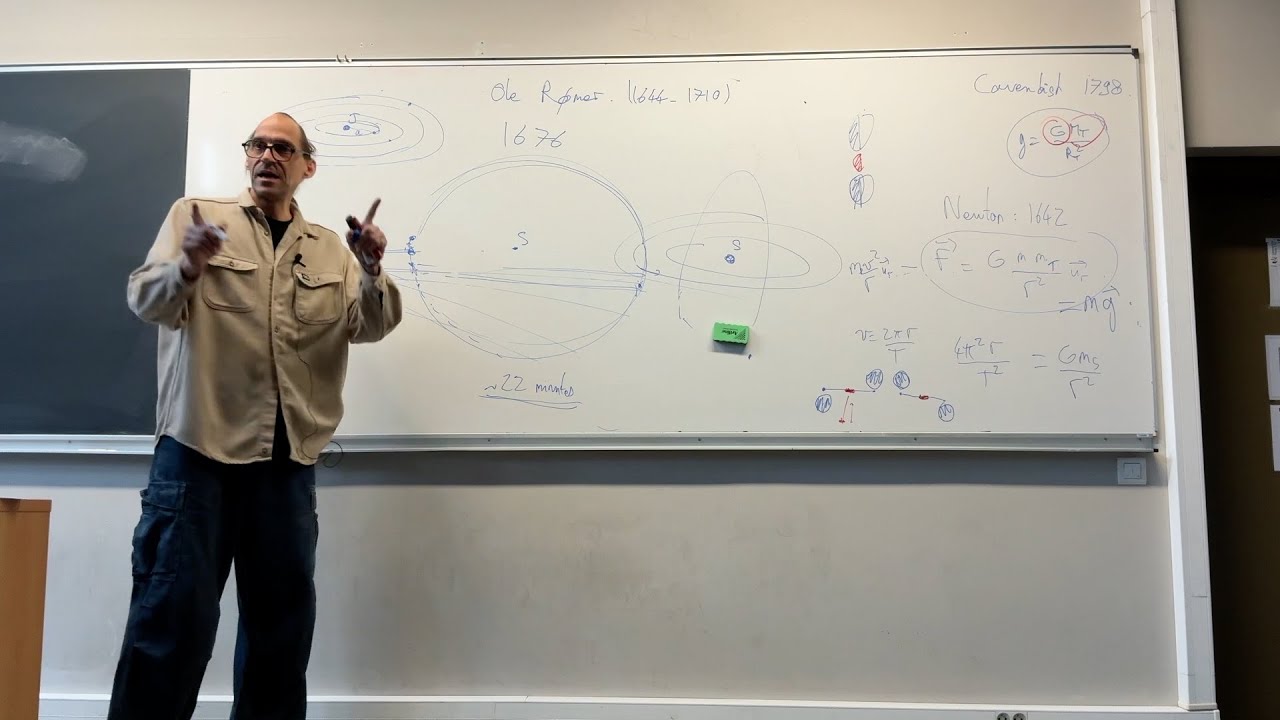
- Measurement of speed of light by Rømer using Io's eclipses
- Stellar parallax and Bessel's measurements
- Cepheid variables and Leavitt's period-luminosity relation
- The Great Debate and discovery of other galaxies
Cited Sources
- Kepler's laws of planetary motion — Mentioned as the foundation for understanding planetary motion.
- Newton's law of universal gravitation — Used to explain Kepler's laws and derive the constant.
- Cavendish experiment — Discussed as the first direct measurement of G.
- Schiehallion experiment — Mentioned as the astronomical method to measure Earth's density.
- Cepheid variable — Used by Leavitt to measure distances to galaxies.
Concurring Sources
- Kepler's laws — The lecture's presentation of Kepler's laws aligns with standard scientific understanding.
- Newton's law of gravitation — The derivation of Kepler's third law constant is consistent with Newtonian mechanics.
- Cavendish experiment — The description of the experiment matches historical accounts.
Contribution & Novelties
The lecture provides a comprehensive historical narrative of how physics enabled the measurement of cosmic quantities, emphasizing the interplay between observation and theory. It clarifies common misconceptions, such as the role of Venus’s phases in disproving geocentrism. The lecturer’s pedagogical approach of deriving key formulas from first principles adds educational value.
Pour aller plus loin :
- Kepler’s laws — Essential for understanding orbital mechanics.
- Newton’s law of universal gravitation — Fundamental to the lecture’s derivations.
- Cavendish experiment — Details on measuring G.
- Schiehallion experiment — The mountain experiment for Earth’s density.
- Cepheid variable — Key to measuring cosmic distances.
99 words
Radar Profile
The radar profile shows high scores in information quantity, quality, and technical level, with a slightly lower but still strong reliability score. This indicates a well-structured, informative lecture with solid scientific content, suitable for an introductory university course.