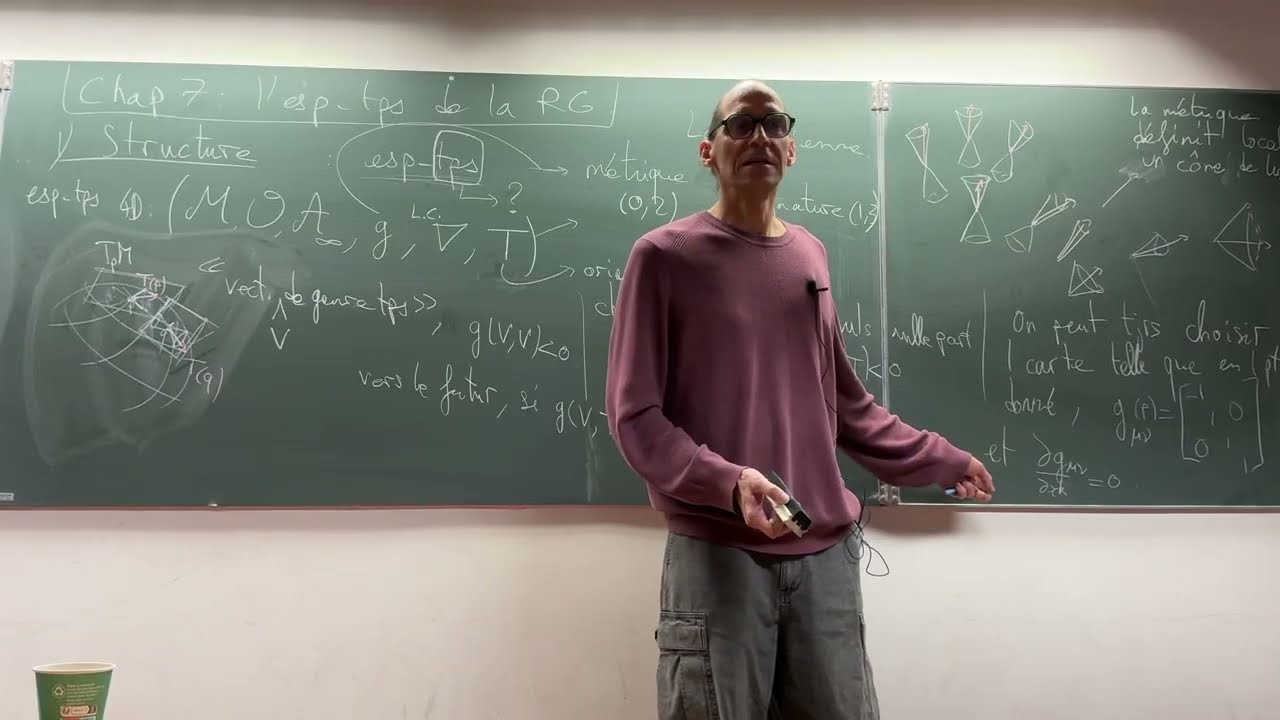
Relativité Générale (2026) – Séance 11a
Keywords
Summary
179 words
Critical Evaluation
Value of the Information & Strength of the Argument
The lecture provides a high-value, rigorous exposition of the geometric foundations of general relativity. The instructor carefully builds the concepts from the manifold structure to the definition of observers, ensuring mathematical precision. The argumentation is solid, as he consistently ties abstract definitions to physical intuition, such as explaining why a time orientation is an extra structure not dictated by the field equations. He also clarifies common misconceptions, like the meaning of light cones in tangent spaces. The presentation is well-structured, though the informal style and occasional digressions may require the viewer to maintain focus.
Scientific Rigor, Source Quality, Title Accuracy
The scientific rigor is high, as the content aligns with standard graduate-level treatments of general relativity. The instructor is a professor at a reputable university, and the lecture is part of an official course. However, no specific sources are cited within the video, and the description only provides the course context. The title accurately reflects the content, being the 11th session of a series on General Relativity. The adequacy between title and content is excellent, as the lecture indeed covers the geometric framework of spacetime as announced.
196 words
Title / Content Match
The title accurately reflects the content: it is the 11th session of a course on General Relativity, covering the geometric framework of spacetime.
Quality & Reliability
8/10
The lecture is part of a university Master's course by a professor at Université Paris Cité, providing a rigorous mathematical treatment of general relativity. The content is consistent with standard textbooks and the instructor demonstrates deep expertise. However, the video is a raw lecture recording without editing, and the transcription contains some informal asides and repetitions.
Key Moments
Markers derived by PSI from the transcript: the creator did not define chapters.
- Introduction to the lecture and the geometric framework of general relativity.
- Discussion on the structure of spacetime: differentiable manifold, Lorentzian metric, and time orientation.
- Explanation of light cones in tangent spaces and the role of the metric.
- Definition of worldlines for massive and massless particles.
- Introduction of observers as worldlines with a tetrad basis.
- Discussion on the significance of the tetrad and local inertial frames.
- Philosophical considerations on time and causality in relativity.
Contribution & Novelties
This lecture provides a clear and rigorous exposition of the geometric framework of general relativity, particularly focusing on the definition of observers via tetrads. It clarifies the distinction between coordinate transformations and changes of reference frame, which is often confusing for students. The philosophical discussion on the nature of time and causality adds depth, encouraging critical thinking about the foundations of the theory.
Pour aller plus loin :
- General relativity — Overview of the theory.
- Lorentzian manifold — Mathematical structure of spacetime.
- Tetrad formalism — Technique used to define observers.
- Proper time — Time measured by an observer along its worldline.
101 words
Radar Profile
The radar profile shows high scores in information quality, technical level, and reliability, with a slightly lower score in information quantity due to the lecture's focus on a specific topic. This indicates a dense, expert-level content that is highly reliable but may not cover a broad range of topics.