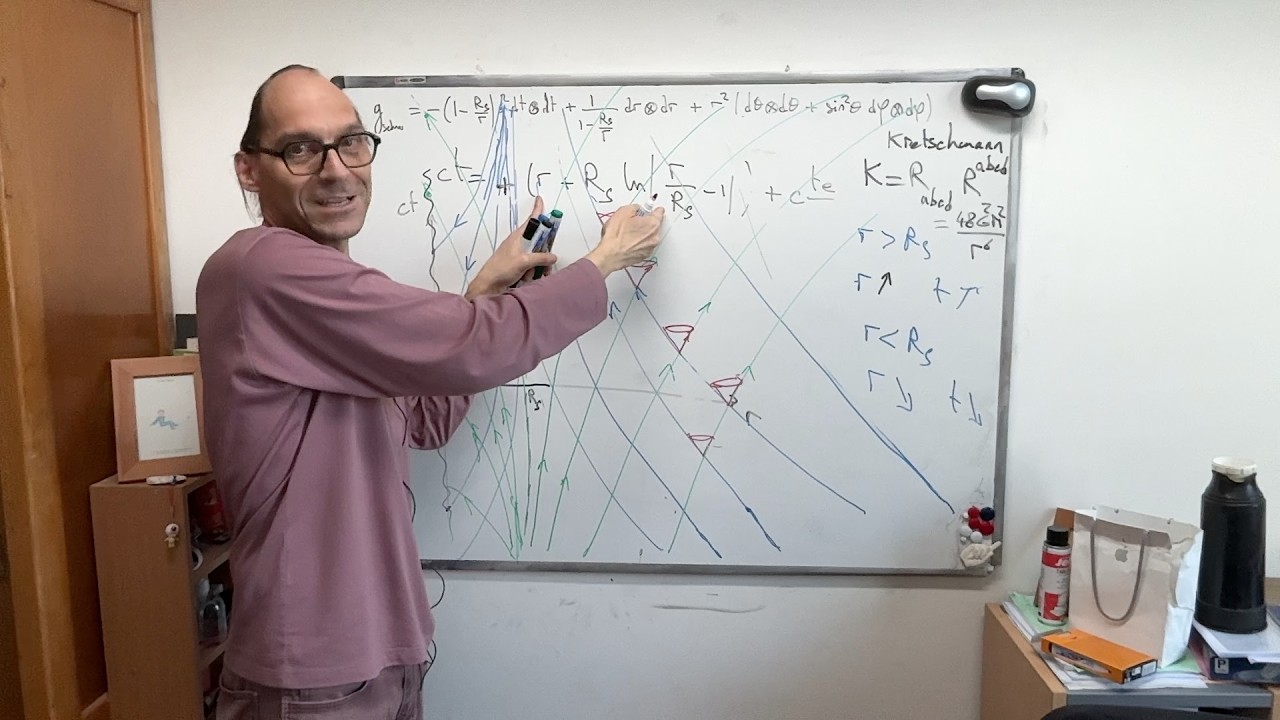
Relativité Générale (2026) – Séance 15 : MÉTRIQUE DE SCHWARZSCHILD : COMPLÉMENTS
Keywords
Summary
127 words
Critical Evaluation
Value of the Information & Strength of the Argument
The lecture provides a deep and rigorous exploration of the Schwarzschild metric, offering valuable insights into the structure of spacetime around a spherically symmetric mass. The argumentation is solid, built on mathematical derivations and physical reasoning. The professor carefully explains the limitations of coordinate charts and uses geodesics to probe the global structure. The introduction of Eddington-Finkelstein and Kruskal-Szekeres coordinates is well-motivated and clearly presented, enhancing the understanding of black hole physics.
Scientific Rigor, Source Quality, Title Accuracy
The scientific rigor is high, with precise mathematical treatments and references to standard results in general relativity. The sources are not explicitly cited in the video, but the content aligns with established literature. The title accurately reflects the content, which is a continuation of the Schwarzschild metric discussion. The lecture is well-structured and pedagogically effective.
142 words
Title / Content Match
The title accurately reflects the content, which focuses on complementary aspects of the Schwarzschild metric.
Quality & Reliability
9/10
The lecture is delivered by a university professor, based on established general relativity theory, with rigorous mathematical derivations and references to standard concepts (Schwarzschild metric, Eddington-Finkelstein coordinates, Kruskal-Szekeres coordinates). The content is consistent with current scientific knowledge.
Key Moments
Markers derived by PSI from the transcript: the creator did not define chapters.
- Introduction and recap of the Schwarzschild metric
- Discussion of coordinate charts and the distinction between chart and manifold
- Derivation of radial null geodesics
- Introduction of Eddington-Finkelstein coordinates
- Introduction of Kruskal-Szekeres coordinates
- Analysis of light cones and horizon
- Discussion of maximal extension and white holes
- Conclusion and summary
Concurring Sources
- Schwarzschild metric — Standard reference for the Schwarzschild solution.
- Eddington–Finkelstein coordinates — Coordinates used to extend the Schwarzschild chart.
- Kruskal–Szekeres coordinates — Coordinates for the maximal extension.
Contribution & Novelties
This lecture provides a comprehensive and accessible explanation of the Schwarzschild metric’s global structure, emphasizing the importance of coordinate choices and the physical interpretation of the horizon and singularity. It bridges the gap between introductory treatments and advanced topics like maximal extensions.
Pour aller plus loin :
- Schwarzschild metric — Overview of the metric and its properties.
- Eddington–Finkelstein coordinates — Explanation of these coordinates and their role in extending the chart.
- Kruskal–Szekeres coordinates — Details on the maximal extension of the Schwarzschild solution.
83 words
Radar Profile
The radar profile shows high scores across all dimensions, indicating a lecture that is both information-dense and technically rigorous, with strong reliability and educational value.