Relativité Générale (2026) – Séance 9b
Keywords
Summary
187 words
Critical Evaluation
Value of the Information & Strength of the Argument
The lecture provides a thorough and rigorous treatment of the torsion and curvature tensors, which are fundamental to differential geometry and general relativity. The instructor carefully defines each concept, proves the tensor nature of the objects, and derives their components in local coordinates. The argumentation is solid, with step-by-step derivations that are clear and logically structured. The value lies in the clarity of the explanations, which help students understand the abstract mathematical structures underlying general relativity. The instructor also connects the material to previous lectures and exercises, reinforcing the learning process.
Scientific Rigor, Source Quality, Title Accuracy
The lecture is scientifically rigorous, with precise definitions and derivations. The instructor demonstrates a deep understanding of the subject and presents the material in a coherent manner. No external sources are cited, but the content is standard and well-established in the field. The title accurately reflects the content, as the session covers the expected topics. The lecture is part of a structured course, and the instructor’s expertise is evident. The absence of citations is not a concern given the foundational nature of the material.
190 words
Title / Content Match
The title accurately reflects the content: it is the 9th session (part b) of a course on general relativity, covering transport parallel, geodesics, and curvature.
Quality & Reliability
9/10
The lecture is a rigorous, university-level course on general relativity, delivered by a professor, with detailed mathematical derivations and clear pedagogical explanations. The content is consistent with standard textbooks and the instructor demonstrates deep expertise. No sources are cited, but the material is foundational and well-established.
Key Moments
Markers derived by PSI from the transcript: the creator did not define chapters.
- Introduction: recap of previous session, focus on tensor content of connection.
- Definition of torsion tensor T(ω,X,Y) and its interpretation.
- Proof of C^∞-linearity of torsion in the second slot using Lie bracket and Leibniz rule.
- Components of torsion in a coordinate basis: T^i_jk = Γ^i_kj - Γ^i_jk.
- Verification that torsion transforms as a tensor under coordinate changes.
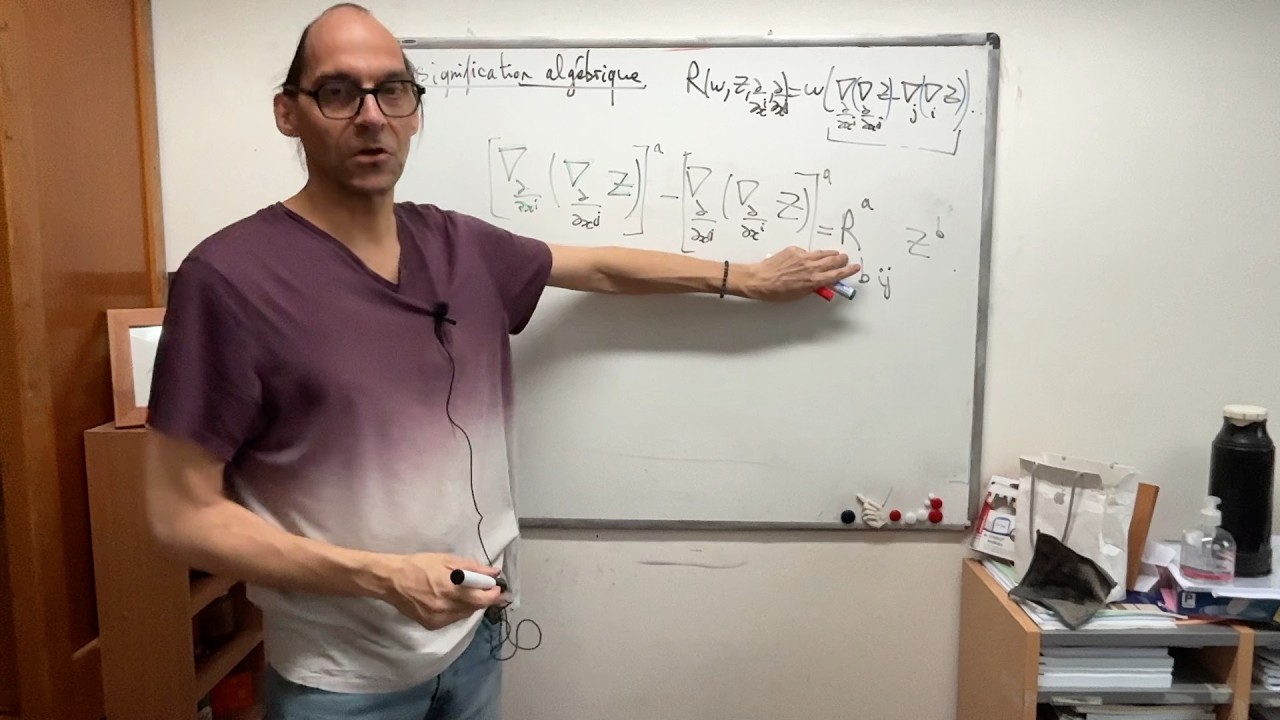
- Introduction to Riemann curvature tensor R(ω,Z,X,Y) and its definition.
- Geometric meaning of curvature: parallel transport around infinitesimal loop.
- Algebraic meaning: non-commutation of covariant derivatives.
- Components of Riemann tensor in a coordinate basis.
- Conclusion and summary of key points.
Contribution & Novelties
This lecture provides a clear and detailed exposition of the torsion and Riemann curvature tensors, emphasizing their tensor nature and geometric significance. It is particularly valuable for students learning general relativity, as it bridges abstract mathematical concepts with physical intuition. The instructor’s pedagogical approach, including explicit proofs of linearity and component calculations, enhances understanding.
Pour aller plus loin :
- Torsion tensor (Wikipedia) — Provides a concise overview of the torsion tensor and its role in differential geometry.
- Riemann curvature tensor (Wikipedia) — Detailed explanation of the curvature tensor, its symmetries, and applications.
- Connection (differential geometry) (Wikipedia) — Background on connections, including the concept of parallel transport and covariant derivatives.
109 words
Radar Profile
The radar profile shows very high scores in all dimensions, reflecting the lecture's exceptional technical depth, clarity, and reliability. The high 'niveau_technique' (10) indicates advanced mathematical content, while 'quantite_information' and 'qualite_information' (9 each) show substantial and accurate information. The 'fiabilite_globale' (9) confirms the trustworthiness of the content.