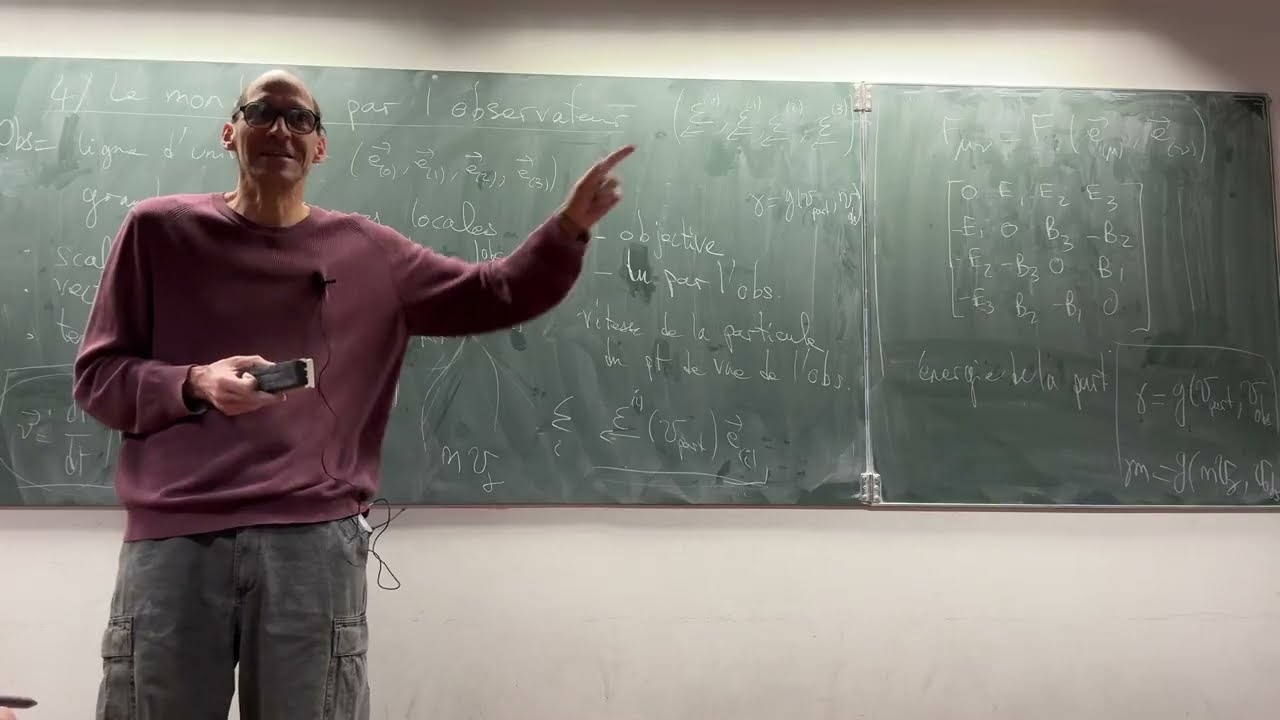
Relativité Générale (2026) – Séance 11b
Keywords
Summary
177 words
Critical Evaluation
Value of the Information & Strength of the Argument
The lecture provides a rigorous and insightful derivation of fundamental equations in general relativity from the action principle. The instructor clearly explains the conceptual framework, emphasizing the objectivity of physical quantities and the observer-dependence of their components. The argumentation is solid, building from simple examples (free particle) to more complex ones (interaction with electromagnetic field). The derivation of the Lorentz force from the minimal coupling is particularly elegant and well-explained. The lecture also addresses common misconceptions, such as the idea that special relativity cannot handle accelerated particles. The pedagogical value is high, as the instructor takes time to clarify subtle points and responds to student questions.
Scientific Rigor, Source Quality, Title Accuracy
The scientific rigor is high: the lecture is mathematically precise and conceptually sound. The instructor is a professor at a university, and the course is part of a Master’s program. No external sources are cited, but the content is based on established physics. The title accurately reflects the content, as it is a continuation of a course on general relativity. The lecture is well-structured, with clear objectives and derivations. The instructor also acknowledges when he simplifies (e.g., setting c=1) and explains the implications. The adequacy between title and content is perfect.
212 words
Title / Content Match
The title accurately reflects the content: it is the 11th session (part b) of a general relativity course, covering dynamics via the action principle.
Quality & Reliability
9/10
The lecture is given by a university professor (Etienne Parizot) as part of a Master's course, with a clear pedagogical structure. The content is mathematically rigorous, and the instructor explicitly addresses potential confusions. The video is part of a series, indicating a systematic approach. No external sources are cited, but the lecture is based on established physics (general relativity, action principle). The technical level is high, and the explanations are precise.
Key Moments
Markers derived by PSI from the transcript: the creator did not define chapters.
- Introduction and recap on four-velocity and observer dependence.
- Discussion on the objectivity of the Lorentz factor as a scalar product.
- Introduction to dynamics: action principle and Lagrangian mechanics.
- Action for a free particle and derivation of the geodesic equation.
- Additivity of actions for multiple particles and interactions.
- Action for the electromagnetic field and coupling to a particle.
- Derivation of the Lorentz force from the minimal coupling.
- Transition to the dynamics of spacetime: Einstein-Hilbert action.
- Integration on manifolds: volume form and metric determinant.
- Discussion on orientable manifolds and atlas orientation.
Contribution & Novelties
The lecture provides a clear and rigorous derivation of the dynamics of particles and fields in general relativity from the action principle. It emphasizes the conceptual importance of the action as a unifying principle. The instructor also clarifies subtle points about observer dependence and the objectivity of physical quantities. The lecture is part of a series, so it builds on previous sessions.
Pour aller plus loin :
- Einstein–Hilbert action — The action that yields Einstein’s field equations.
- Geodesics in general relativity — The path of a free particle.
- Lorentz force — The force on a charged particle in an electromagnetic field.
101 words
Radar Profile
The radar profile shows high scores across all dimensions, indicating a lecture that is both information-dense and technically rigorous. The balance between quantity and quality of information is excellent, and the technical level is appropriate for an advanced audience.