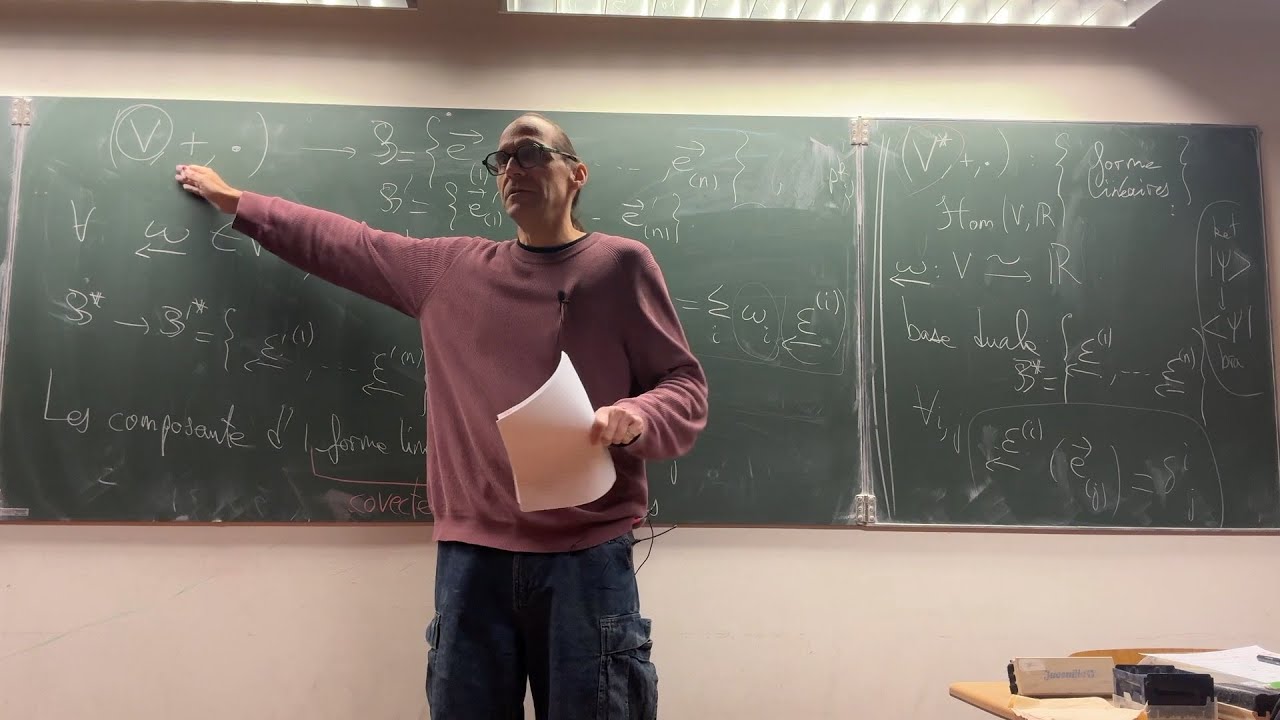
Relativité Générale (2026) – Séance 5a
Keywords
Summary
199 words
Critical Evaluation
Value of the Information & Strength of the Argument
The lecture provides high-value foundational material for understanding general relativity. The argumentation is rigorous and well-structured, building from basic definitions to more complex concepts. The professor carefully explains the geometric and algebraic motivations, such as why tangent vectors at different points cannot be compared and why the covariant derivative is needed. He also clarifies common misconceptions, such as the difference between matrices representing linear maps and bilinear forms. The use of concrete examples and warnings about notation errors enhances the pedagogical value.
Scientific Rigor, Source Quality, Title Accuracy
The scientific rigor is high, as the lecture follows standard mathematical treatments of differential geometry and general relativity. The professor references a problem sheet available online (Dropbox link) for further practice. The title accurately reflects the content, as it is a session in a general relativity course. No external sources are cited beyond the course materials, but the mathematical derivations are consistent with established literature.
162 words
Title / Content Match
The title accurately reflects the content: a session in a general relativity course, focusing on tangent spaces and multilinear algebra.
Quality & Reliability
9/10
The lecture is given by a university professor in a formal Master's course, with rigorous mathematical derivations and clear pedagogical explanations. The content aligns with standard differential geometry and general relativity literature.
Key Moments
Markers derived by PSI from the transcript: the creator did not define chapters.
- Introduction and recap of previous session: definition of differentiable curves and tangent vectors.
- Discussion on the tangent space T_pM and its basis induced by a coordinate chart.
- Explanation of contravariance: how components of vectors transform under basis changes.
- Introduction to the dual space V* and dual basis.
- Identification of V and V**; natural isomorphism between V and V* via a bilinear form.
- Discussion on 'bra' and 'ket' notation and its relation to vectors and covectors.
- Introduction to tensors of rank (r,s) and their transformation properties.
- Warning about the difference between matrices representing linear maps and bilinear forms.
- Exercises and practical advice on notation and computations.
Cited Sources
- Exercices_Feuille_2_RG_2026.pdf — Problem sheet mentioned during the lecture for practice on vector spaces, bases, and transformations.
Concurring Sources
- General Relativity — Standard reference for the physical theory that this course prepares students for.
Contribution & Novelties
This lecture provides a clear and rigorous exposition of the mathematical tools necessary for general relativity, particularly the tangent space and multilinear algebra. The professor’s emphasis on the distinction between matrices representing linear maps and bilinear forms is particularly valuable for students. The lecture also highlights the conceptual shift from comparing vectors at different points to introducing a covariant derivative.
Pour aller plus loin :
- Differential geometry — Overview of the mathematical field underlying general relativity.
- Tangent space — Detailed definition and properties of tangent spaces on manifolds.
- Tensor — General concept of tensors and their transformation laws.
- Covariant derivative — Essential concept for defining parallel transport and geodesics in general relativity.
112 words
Radar Profile
The radar profile shows high scores across all dimensions, indicating a well-balanced and comprehensive lecture. The high technical level and information quality are complemented by strong reliability, making it an excellent resource for advanced students.
💬 No comments were provided for analysis.