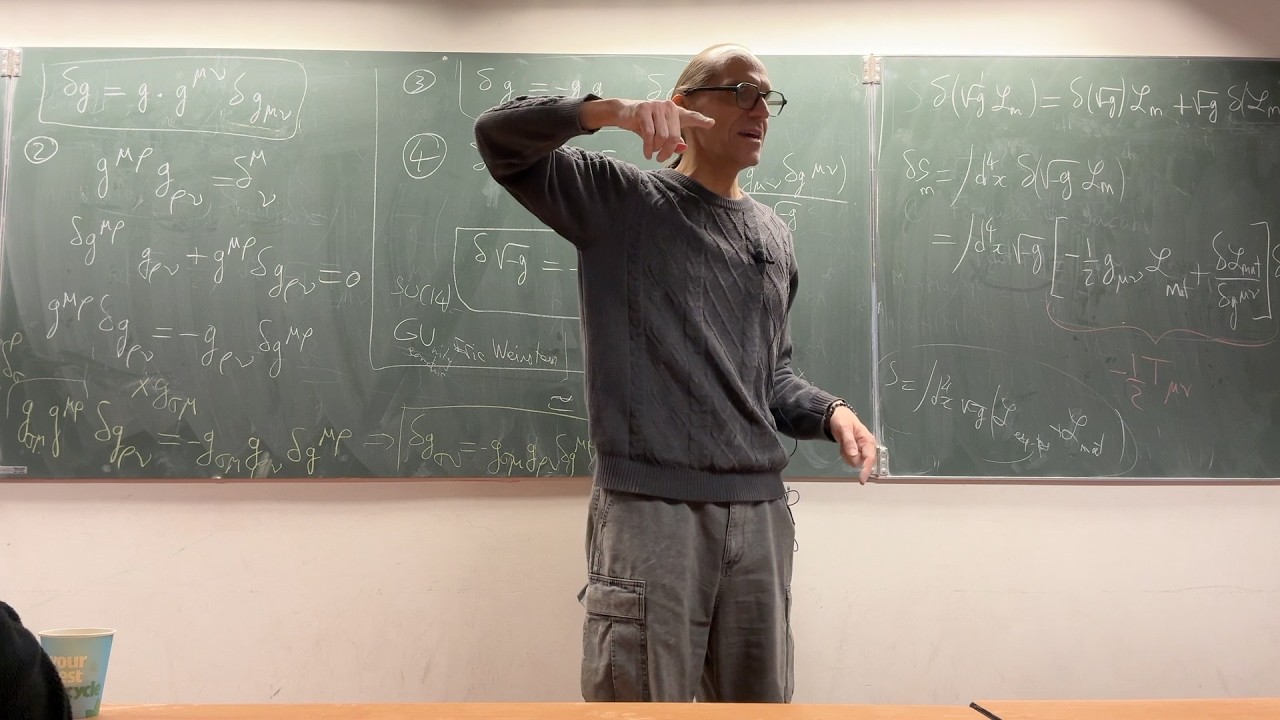
Relativité Générale (2026) – Séance 12b
Keywords
Summary
160 words
Critical Evaluation
Value of the Information & Strength of the Argument
The lecture provides a clear and detailed derivation of the Einstein field equations, a cornerstone of general relativity. The instructor carefully explains each step, including the use of the Palatini identity and the handling of boundary terms. The argumentation is solid, building on previously established concepts such as the metric, connection, and curvature. The value lies in the pedagogical clarity and the explicit demonstration of how the Einstein tensor emerges from the variational principle. The discussion of the Palatini formalism adds depth, showing an alternative perspective on the role of the connection.
Scientific Rigor, Source Quality, Title Accuracy
The scientific rigor is high, as the derivation follows standard methods found in textbooks on general relativity. The instructor does not cite specific sources during the lecture, but the content is consistent with established physics. The title accurately reflects the content, which is a continuation of a course on general relativity. The lecture is well-structured, with a clear progression from the action to the field equations. No external sources are mentioned, but the mathematical derivations are self-contained and rigorous.
186 words
Title / Content Match
The title accurately reflects the content, which is a continuation of a general relativity course focusing on the derivation of Einstein's equations.
Quality & Reliability
8/10
The lecture is a rigorous derivation of Einstein's field equations from the Einstein-Hilbert action, using standard mathematical techniques. The instructor is a university professor, and the content aligns with established physics. Minor corrections during the lecture do not undermine the overall reliability.
Key Moments
Markers derived by PSI from the transcript: the creator did not define chapters.
- Correction of the sign in the stress-energy tensor definition.
- Variation of the matter action yields the stress-energy tensor.
- Introduction to the Einstein-Hilbert action.
- Variation of the gravitational action: first term gives the Einstein tensor.
- Use of the Palatini identity to show the second term is a total divergence.
- Derivation of the Einstein field equations.
- Introduction to the Palatini formalism: connection as independent variable.
- Demonstration that the Levi-Civita connection emerges naturally.
Contribution & Novelties
This lecture provides a detailed and pedagogical derivation of the Einstein field equations, emphasizing the role of the Palatini identity and the variational principle. It also introduces the Palatini formalism, which is a more advanced topic not always covered in introductory courses. The lecture’s contribution lies in its clarity and the explicit demonstration of how the Einstein tensor arises from the action principle.
Pour aller plus loin :
- Einstein field equations — Overview of the equations and their physical significance.
- Palatini identity — Mathematical identity used in the derivation.
- Einstein–Hilbert action — The action from which the field equations are derived.
101 words
Radar Profile
The radar profile shows high scores in quality of information, technical level, and reliability, with a slightly lower score in quantity of information due to the focused scope of the lecture. This indicates a highly rigorous and specialized content, suitable for advanced students.