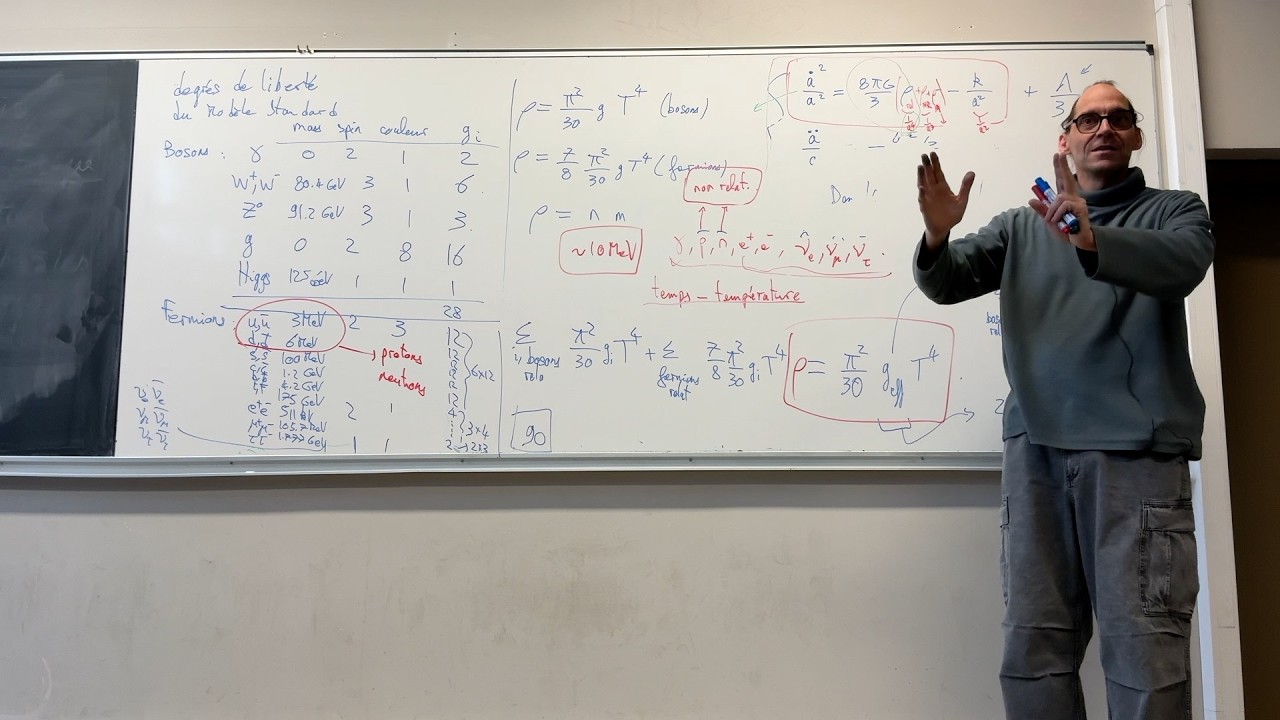
Initiation à l'Astrophysique (2026) – Séance 5
Keywords
Summary
149 words
Critical Evaluation
Value of the Information & Strength of the Argument
The lecture provides a solid, mathematically grounded introduction to the FLRW metric and Friedmann equations. The argumentation is rigorous, building from the cosmological principle to the metric and then to the dynamical equations. The lecturer carefully explains the conceptual subtleties, such as the need for a cosmic time and the role of the initial singularity in defining it. The value lies in its clarity and pedagogical approach, making advanced concepts accessible to advanced undergraduates. The argumentation is well-structured, with each step logically following from the previous one.
96 words
Title / Content Match
The title accurately reflects the content: this is the fifth session of an introductory astrophysics course, focusing on cosmology and the early universe.
Quality & Reliability
8/10
The lecture is given by a university professor (Étienne Parizot) in a formal course setting (L3, Université Paris Cité). The content is mathematically rigorous, deriving the FLRW metric and Friedmann equations from the cosmological principle. The presentation is clear and well-structured, with appropriate caveats about the limits of the theory (e.g., the initial singularity). However, no external sources are cited in the video, and the lecture is based on established textbook material.
Key Moments
Markers derived by PSI from the transcript: the creator did not define chapters.
Contribution & Novelties
This lecture provides a clear and rigorous introduction to the FLRW metric and Friedmann equations, emphasizing the conceptual foundations of cosmology. It is particularly valuable for students who need to understand the mathematical structure behind the expanding universe. The lecture does not present new research but excels in pedagogy.
Pour aller plus loin :
- Friedmann equations — Standard reference for the equations governing the expansion of the universe.
- Robertson-Walker metric — Detailed article on the metric and its properties.
- Cosmological principle — Background on the assumption of homogeneity and isotropy.
90 words
Radar Profile
The radar profile shows high scores across all dimensions, indicating a well-balanced and reliable lecture. The quantitative and qualitative information is substantial, the technical level is appropriate for advanced undergraduates, and the overall reliability is high.