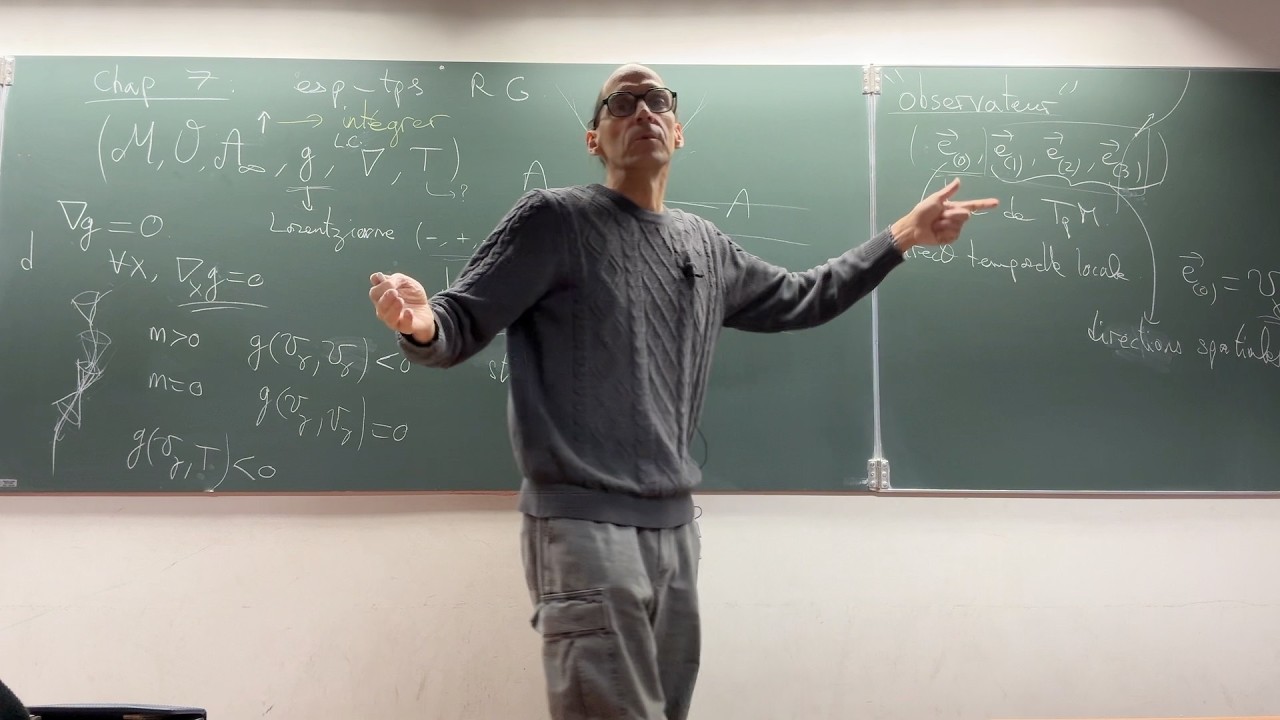
Relativité Générale (2026) – Séance 12a
Keywords
Summary
146 words
Critical Evaluation
Value of the Information & Strength of the Argument
The lecture provides a clear and rigorous derivation of Einstein’s equations from a variational principle, which is a fundamental and elegant approach. The argumentation is solid, building step by step from the action principle to the field equations, with careful attention to mathematical details. The instructor also offers physical insights, such as the interpretation of the energy-momentum tensor as the source of spacetime curvature. The value lies in its pedagogical clarity and the depth of the derivation, making it suitable for advanced students.
Scientific Rigor, Source Quality, Title Accuracy
The scientific rigor is high: the lecture is mathematically precise and consistent with standard general relativity literature. The instructor does not cite external sources explicitly, but the content aligns with established textbooks and research. The title accurately reflects the content, as it is indeed a lecture on general relativity. No comments were provided, so no analysis of public reception is possible.
159 words
Title / Content Match
The title accurately reflects the content: a lecture on general relativity, specifically session 12a, covering the derivation of Einstein's equations.
Quality & Reliability
9/10
The lecture is given by a university professor (Etienne Parizot) as part of a Master's course in fundamental physics at Université Paris Cité. The content is mathematically rigorous, follows a structured pedagogical approach, and includes detailed derivations. The presentation is consistent with established general relativity theory, and the lecturer demonstrates deep expertise. No commercial or promotional content is present.
Key Moments
Markers derived by PSI from the transcript: the creator did not define chapters.
- Introduction and recap of spacetime as a differentiable manifold with Lorentzian metric.
- Discussion of light cones and the constraints on particle velocities.
- Review of observers and the choice of orthonormal frames.
- Introduction to the content of spacetime: particles and fields.
- Discussion of the classical nature of fields and the issue of quantum gravity.
- Recap of the dynamics of free particles as geodesics.
- Introduction to the principle of stationary action and its role in deriving field equations.
- Detailed derivation of the variation of the action with respect to the metric.
- Definition of the energy-momentum tensor from the matter action.
- Conclusion and outlook for the next session.
Contribution & Novelties
This lecture provides a clear and detailed derivation of Einstein’s field equations from the variational principle, which is a cornerstone of general relativity. The instructor’s pedagogical approach makes this advanced topic accessible to graduate students. The lecture also touches on the conceptual issues of quantum gravity, offering a perspective on ongoing research.
Pour aller plus loin :
- Einstein field equations - Wikipedia — Overview of the equations and their derivation.
- Variational principle - Wikipedia — General concept of action principles in physics.
- Energy-momentum tensor - Wikipedia — Definition and role in general relativity.
93 words
Radar Profile
The radar profile shows high scores across all dimensions, indicating a lecture that is both information-dense and technically rigorous. The balance between quantitative information and qualitative explanation is strong, with a slight emphasis on technical depth.