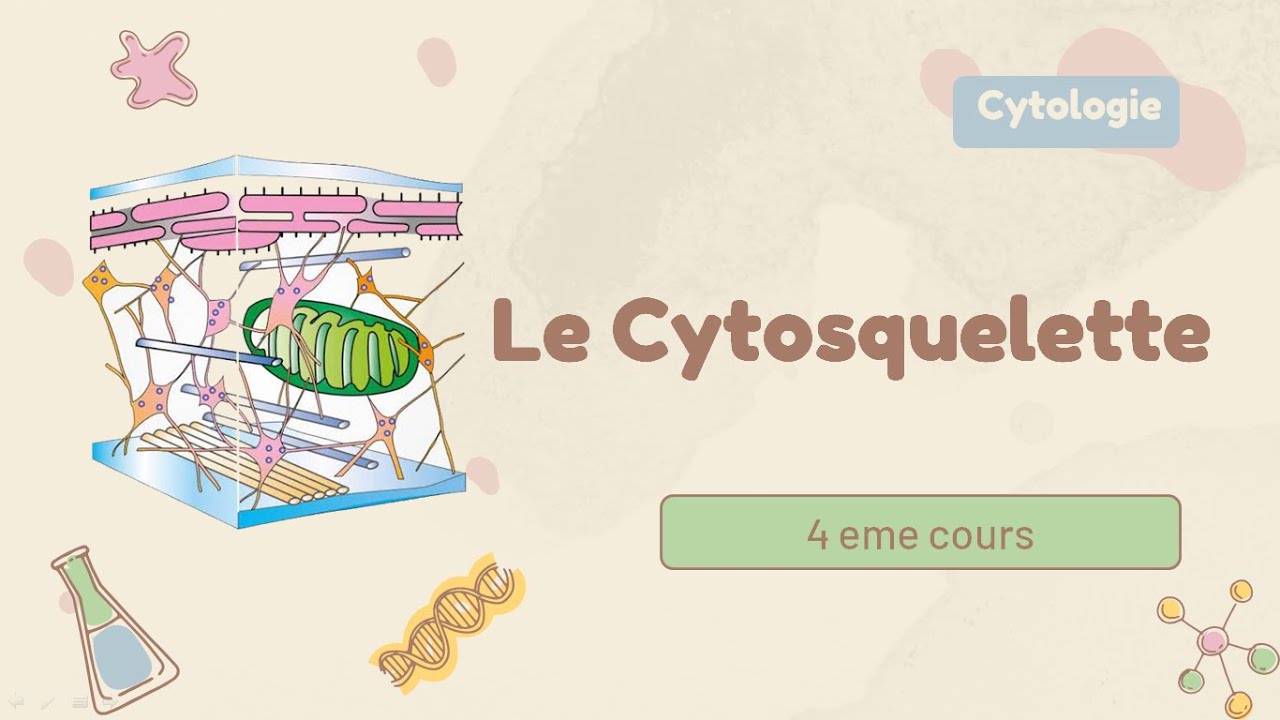
Le Cytosquelette | Cytologie - 1er année médecine
Keywords
Summary
149 words
Critical Evaluation
Value of the Information & Strength of the Argument
The video provides a solid foundational understanding of the cytoskeleton, covering key components, their structure, and functions. The information is accurate and well-organized, with clear explanations of polymerization and the roles of associated proteins. However, the argumentation is largely descriptive and lacks critical analysis or discussion of experimental evidence. The video does not delve into the molecular mechanisms in depth, nor does it address controversies or recent advances in the field. The use of diagrams and animations would have enhanced the explanation, but the verbal descriptions are generally clear. Overall, the value lies in its educational utility for beginners, but it does not offer novel insights or a critical perspective.
Scientific Rigor, Source Quality, Title Accuracy
The video cites two academic sources: a cell biology textbook by C. Favro and F. Nicolle, and an official cytology course collection from the Faculty of Medicine of Algiers. These sources are appropriate for the level of the content and lend credibility to the information presented. However, the video does not provide specific citations for individual claims, which limits the ability to verify the accuracy of each point. The title accurately reflects the content, which is a cytology lecture on the cytoskeleton. The video is well-structured and follows a logical progression, but it does not include any references to recent research or alternative viewpoints. The absence of a discussion of the limitations of current knowledge or potential controversies reduces the scientific rigor. Overall, the sources are reliable but not exhaustive, and the title-content alignment is good.
261 words
Title / Content Match
The title accurately reflects the content, which is a cytology lecture on the cytoskeleton for first-year medical students.
Quality & Reliability
7/10
The video is a structured educational tutorial covering the cytoskeleton's components, polymerization, and functions. It cites two academic sources (a cell biology textbook and an official cytology course collection) but lacks in-depth explanations of complex mechanisms and does not address recent research. The content is accurate but presented at a basic level.
Key Moments
Markers derived by PSI from the transcript: the creator did not define chapters.
- Introduction and overview of the cytoskeleton
- Generalities: definition, roles, and components
- Actin microfilaments: structure and polymerization
- Roles of actin microfilaments in cell movement
- Microtubules: structure and polymerization
- Stable and unstable microtubule structures
- Motor proteins and roles of microtubules
- Intermediate filaments: structure and families
- Roles of intermediate filaments and conclusion
Cited Sources
- Biologie cellulaire UE2 - C. Favro - F. Nicolle — Referenced as a source for the course content.
- LE CYTOLOGUE - Recueil des cours officiels du module cytologie Faculté de médecine d’Alger - Abdessalem Saoud — Referenced as a source for the course content.
Concurring Sources
- Cytoskeleton - Wikipedia — General reference that aligns with the video's content on cytoskeleton components and functions.
- Molecular Biology of the Cell (Alberts et al.) — A standard cell biology textbook that covers the cytoskeleton in detail, consistent with the video's information.
Contribution & Novelties
The video provides a clear and structured introduction to the cytoskeleton, suitable for first-year medical students. It synthesizes information from established textbooks and official course materials, offering a concise overview of the three main filament systems. The presentation is didactic, with a logical flow from generalities to specific components. However, it does not introduce novel concepts or recent research findings. The value lies in its pedagogical clarity rather than originality.
Pour aller plus loin :
- Cytoskeleton - Wikipedia — Provides a comprehensive overview of the cytoskeleton, including its components and functions.
- Actin - Wikipedia — Detailed information on actin structure, polymerization, and roles.
- Microtubule - Wikipedia — Explains microtubule dynamics, associated proteins, and functions.
- Intermediate filament - Wikipedia — Discusses the structure and types of intermediate filaments.
- Kinesin - Wikipedia — Information on kinesin motor proteins and their role in intracellular transport.
142 words
Radar Profile
The radar profile shows balanced scores across all dimensions, with slightly lower scores in technical depth and source rigor. This indicates a solid educational video that is accessible to beginners but may not satisfy advanced learners seeking in-depth molecular mechanisms or extensive citations.
💬 No comments were provided for analysis.