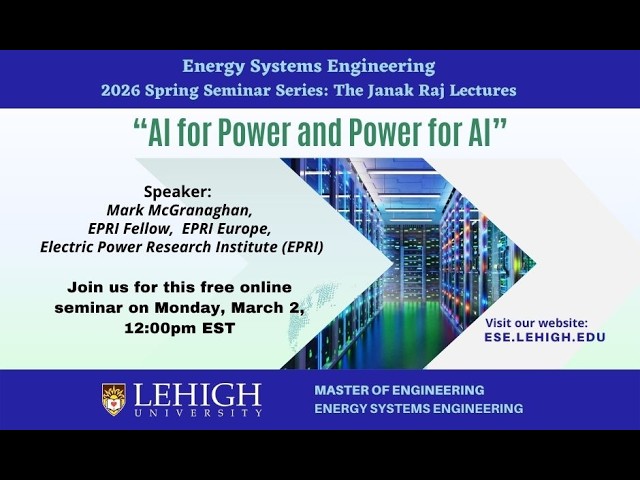
ESE Spring Seminar #5, March 2, 2026, McGranaghan: "AI for Power and Power for AI"
Keywords
Summary
185 words
Critical Evaluation
Value of the Information & Strength of the Argument
The talk provides valuable insights into the challenges and opportunities of AI for the power sector. McGranaghan effectively argues that electricity infrastructure is a primary bottleneck for AI expansion, and he supports this with specific examples and data, such as the 22% load share in Ireland and the 60% increase in capacity projections. He also presents a compelling case for the economic value of AI, outlining three waves of value creation. The argumentation is coherent and well-structured, though it relies on the speaker’s expertise and industry reports rather than original research.
Scientific Rigor, Source Quality, Title Accuracy
The speaker cites several sources, including the 2017 transformer paper, a Duke University study, and EPRI reports. These are credible and relevant. The title accurately reflects the content, which is a balanced discussion of both aspects. The talk is an expert opinion piece, and while it is not a formal study, the speaker’s authority and the use of industry data lend it credibility. No comments were provided for analysis.
175 words
Title / Content Match
The title accurately reflects the dual focus of the talk: the power requirements of AI infrastructure and the application of AI to improve power grid operations.
Quality & Reliability
8/10
The speaker is an EPRI Fellow with extensive experience in power engineering and smart grids. The talk provides a high-level overview of the challenges and opportunities of AI for the power sector, based on EPRI's research and industry insights. While not a peer-reviewed study, the information is credible and well-grounded in the speaker's expertise.
Key Moments
Markers derived by PSI from the transcript: the creator did not define chapters.
- Introduction and overview of the talk's structure.
- Discussion of the growth in AI infrastructure and electricity demand.
- Explanation of the transformer technology and its impact on computing power.
- Value proposition of AI: knowledge AI, agentic AI, and robotics.
- Comparison with past infrastructure investments (fiber, internet).
- EPRI's updated projections for grid capacity requirements.
- Importance of flexibility and the DC Flex project.
- Challenges: data center tripping and dynamic load.
- Regulatory considerations and DOE 403 rule.
Cited Sources
- Attention Is All You Need — Referenced as the 2017 paper that introduced the transformer architecture.
- EPRI Report on AI Infrastructure — Mentioned as a recent report with updated projections for grid capacity.
- Duke University Nicholas Institute Study — Cited for the potential of curtailment to release capacity.
Concurring Sources
- IEA Data Centres and Data Transmission Networks — Provides global data on data center energy use, consistent with the talk's emphasis on growing demand.
Contribution & Novelties
The talk provides a comprehensive overview of the bidirectional relationship between AI and the power sector, highlighting the urgent need for grid expansion and flexibility. It introduces EPRI’s DC Flex project and discusses regulatory developments. The speaker’s perspective from Europe adds a global dimension.
Pour aller plus loin :
- Transformer architecture — Background on the technology driving AI growth.
- Data center energy use — IEA data on data center energy consumption.
- Grid flexibility — Concept of demand response and flexibility.
80 words
Radar Profile
The radar profile shows high scores in information quality and reliability, reflecting the speaker's expertise and use of credible sources. The quantity of information is moderate, and the technical level is accessible to a broad audience. The overall balance indicates a reliable and informative presentation.