Statistical Breakthroughs and Novel Perspectives in Deep Learning Theory
Keywords
Summary
197 words
Critical Evaluation
Value of the Information & Strength of the Argument
The talk provides valuable insights into the current state of deep learning theory and proposes a novel statistical framework for image classification. The speaker effectively argues that traditional nonparametric regression settings are insufficient for image classification due to the high variability within classes, and that a structured model capturing geometric deformations is more appropriate. She supports her arguments with references to established results and her own research. The argumentation is coherent and well-structured, though the talk is more of an overview and motivation for new directions rather than a detailed technical exposition.
Scientific Rigor, Source Quality, Title Accuracy
The speaker demonstrates scientific rigor by referencing key results in the field, such as Barron’s work on approximation, Telgarsky’s result on depth, and Bartlett’s work on VC dimension. She also mentions the limitations of existing theory and motivates her own framework. The title accurately reflects the content, as the talk covers statistical breakthroughs and novel perspectives. The talk is given at the Isaac Newton Institute, a reputable institution, which adds to its credibility. However, as a keynote, it lacks detailed citations and proofs, so the rigor is moderate.
195 words
Title / Content Match
The title accurately reflects the content: the speaker discusses statistical breakthroughs and novel perspectives in deep learning theory, covering approximation, generalization, and a new framework for image classification.
Quality & Reliability
8/10
The talk is given by a professor at a recognized research institute, presenting a coherent overview of deep learning theory from a statistical perspective. The content is well-structured, references established results (e.g., Barron, Matus Telgarsky, Peter Bartlett), and introduces a novel framework for image classification. However, as a keynote talk, it is not a peer-reviewed publication and lacks detailed proofs, so a score of 8 reflects high reliability with minor caveats.
Key Moments
Markers derived by PSI from the transcript: the creator did not define chapters.
- Introduction: Speaker thanks collaborators and mentions Matus Telgarsky's quote on deep learning breakthroughs not driven by math.
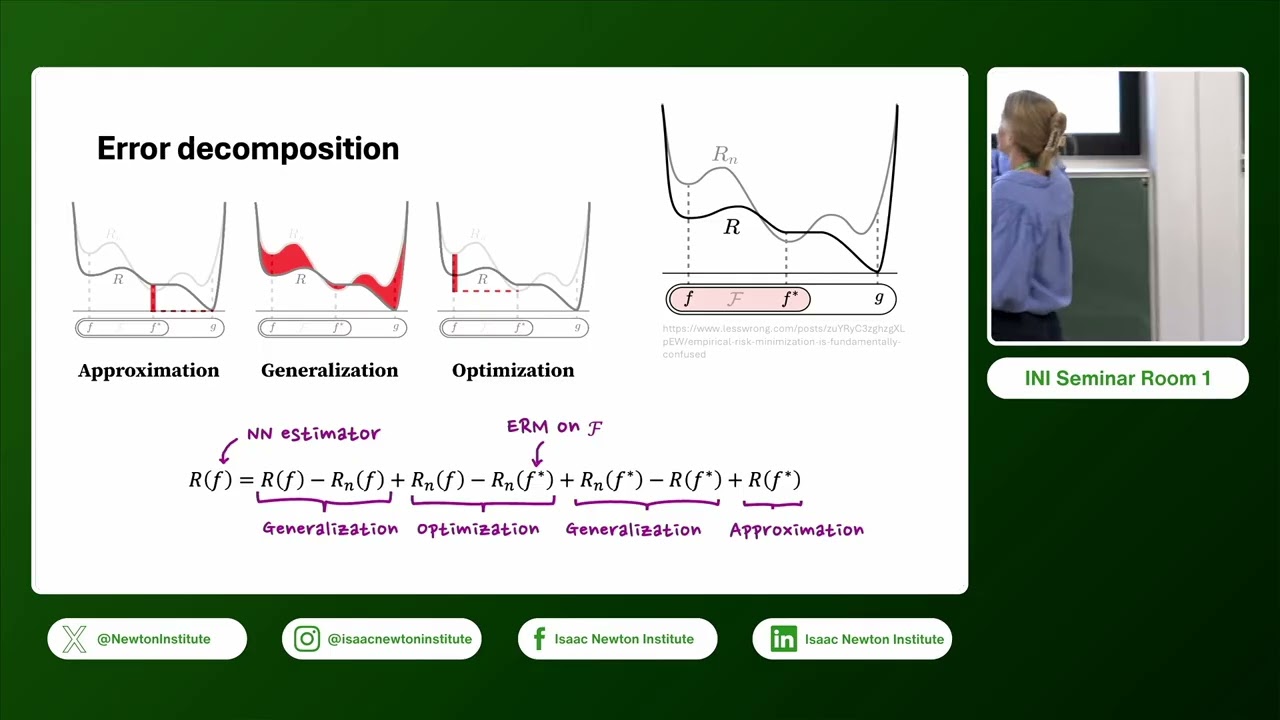
- Overview of deep learning theory: approximation, generalization, optimization.
- Discussion of universal approximation and Fourier transform approach.
- Importance of depth: Telgarsky's result on approximating x^2.
- Generalization bounds and VC dimension.
- Limitations of existing theory: nonparametric regression, feedforward networks, ignoring gradient descent.
- Motivation for new framework: images as structured objects with deformations.
- Proposed model: template function with deformations (scaling, shifts, rotations, brightness).
- Classification via inverse mapping and CNN approach.
- Theoretical results and assumptions for the new framework.
Cited Sources
- Isaac Newton Institute for Mathematical Sciences — The talk was given at the Isaac Newton Institute, and the description provides a link to the event page.
- Event page: Early Career Pioneers in Uncertainty Quantification and AI for Science — The description links to the specific seminar page for this talk.
- LinkedIn company page of Isaac Newton Institute — The description includes a link to the institute's LinkedIn page.
Concurring Sources
- Barron, A. R. (1993). Universal approximation bounds for superpositions of a sigmoidal function — Barron's work on approximation bounds is referenced in the talk as a key result.
- Telgarsky, M. (2016). Benefits of depth in neural networks — Telgarsky's result on the benefits of depth is discussed in the talk.
- Bartlett, P. L., et al. (2019). Nearly-tight VC-dimension and pseudodimension bounds for piecewise linear neural networks — Bartlett's work on VC dimension bounds is mentioned in the talk.
Dissenting Sources
- Hinton, G. (2023). The risks of AI — The speaker cites Hinton's negative views on AI development, which contrast with the optimistic view of deep learning's success.
Contribution & Novelties
The talk offers a novel perspective by proposing a statistical framework for image classification that explicitly models geometric deformations, moving beyond traditional nonparametric regression settings. This framework allows for a theoretical analysis of why convolutional neural networks are effective for image classification, as they can learn invariances to these deformations. The speaker also highlights the need for a common language across different fields in deep learning theory.
Pour aller plus loin :
- Universal approximation theorem — This theorem is foundational in approximation theory and is discussed in the talk.
- VC dimension — A key concept in generalization bounds, mentioned in the talk.
- Convolutional neural network — The architecture used in the proposed framework for image classification.
116 words
Radar Profile
The radar profile shows high scores across all dimensions, indicating a technically deep and reliable presentation. The talk is well-balanced between theoretical foundations and novel contributions, with a strong emphasis on statistical rigor.