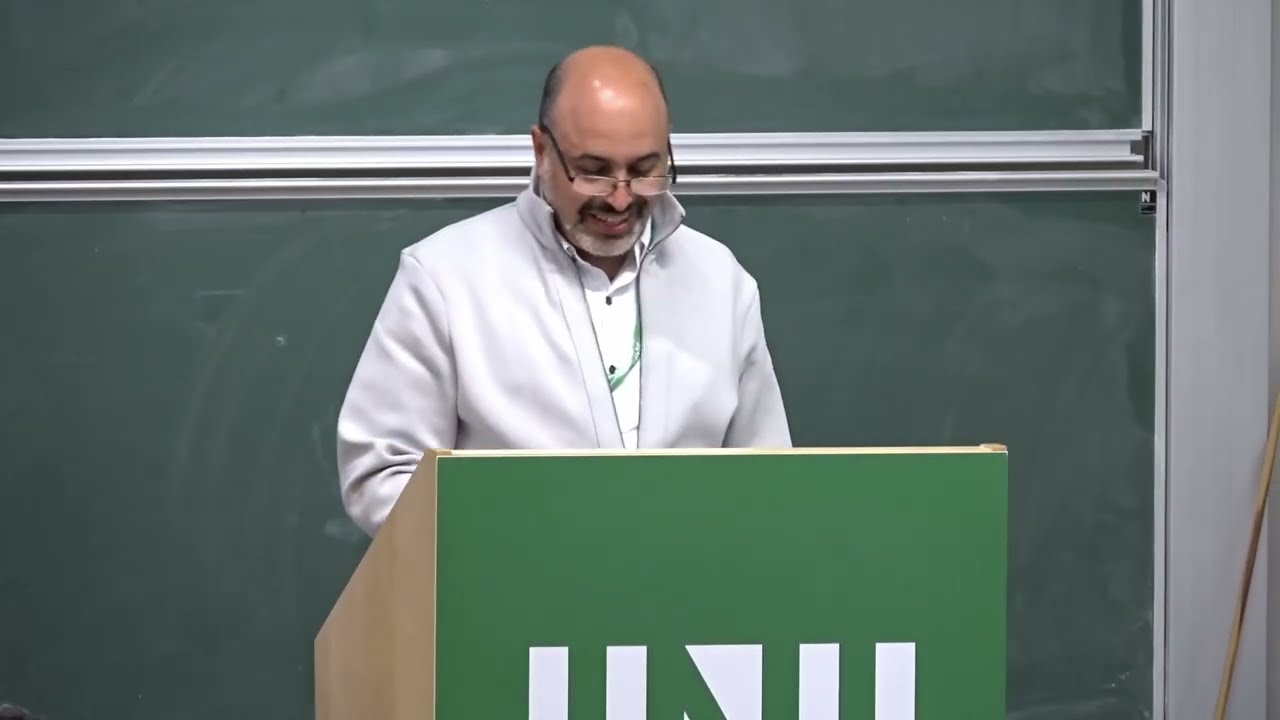
When Compressibility Replaces Smoothness: Bridging Machine Learning, Dynamical Systems and Algorithmic Information Theory via Kolmogorov and Solomonoff Kernels
Keywords
Summary
133 words
Critical Evaluation
Value of the Information & Strength of the Argument
The talk offers a novel conceptual framework by linking Kolmogorov complexity to kernel methods, providing a principled way to define ideal kernels. The argumentation is coherent, building from foundational concepts in AIT to concrete constructions like D2K embeddings. The speaker effectively motivates the need for a third pillar (AIT) in addition to dynamical systems and machine learning. However, the presentation is dense and often hand-wavy, with many results presented as preprints or conjectures, limiting the immediate practical value. The argument that compressibility can replace smoothness is intriguing but not fully developed with rigorous proofs in the talk.
Scientific Rigor, Source Quality, Title Accuracy
The talk references classical works in learning theory (e.g., Cucker and Smale) and AIT (Kolmogorov, Solomonoff, Chaitin), but specific citations are not provided in the video. The description links to the Isaac Newton Institute and the seminar page, which may contain further references. The title accurately reflects the content, and the presentation is scientifically rigorous in its use of established mathematical concepts. However, the lack of explicit citations within the talk and the reliance on preprints reduce the verifiability of the claims.
194 words
Title / Content Match
The title accurately reflects the core thesis: using Kolmogorov and Solomonoff kernels to replace smoothness with compressibility, bridging the three fields. The content directly addresses this.
Quality & Reliability
7/10
The talk presents original research at the intersection of machine learning, dynamical systems, and algorithmic information theory, grounded in established mathematical frameworks. The speaker is affiliated with Caltech and the Turing Institute, lending credibility. However, the presentation is largely conceptual, with many results described as preprints or open problems, and the technical depth is high but not fully formalized in the talk.
Key Moments
Markers derived by PSI from the transcript: the creator did not define chapters.
- Introduction and motivation: bridging machine learning, dynamical systems, and algorithmic information theory via kernel methods.
- Overview of the talk's structure and the proposed unification.
- Introduction to Kolmogorov complexity and its role in defining similarity.
- Discussion of the uncomputability of Kolmogorov complexity and the need for kernel methods.
- Introduction of Kolmogorov and Solomonoff kernels, and the D2K construction to ensure positive semi-definiteness.
- Definition of Solomonoff RKHS and Solomonoff Gaussian processes.
- Reformulation of classical learning theory spectral regimes in terms of Kolmogorov complexity.
- Application to dynamical systems: learning via sparse kernel flows and connections to Koopman operators.
- Discussion of open problems and conjectures, including links to Pollicott-Ruelle resonances.
- Conclusion and invitation for collaboration.
Cited Sources
- Isaac Newton Institute for Mathematical Sciences — Hosting institution and event organizer.
- Seminar page for OMDW01 — Event page with further details and possibly references.
Concurring Sources
- Cucker and Smale (2002) - On the mathematical foundations of learning — Classical learning theory results reformulated in the talk.
Contribution & Novelties
The talk proposes a novel theoretical framework connecting algorithmic information theory to kernel methods, offering a principled way to define ‘ideal’ kernels based on Kolmogorov complexity. This could lead to new insights in learning theory and dynamical systems analysis. The introduction of Solomonoff RKHS and Gaussian processes is a conceptual advance, though practical computability remains a challenge.
Pour aller plus loin :
- Kolmogorov complexity — Foundational concept for the talk.
- Reproducing kernel Hilbert space — Core mathematical structure used.
- Solomonoff’s theory of inductive inference — Basis for the Solomonoff kernels.
90 words
Radar Profile
The radar profile shows high scores in technical level and information quantity, reflecting the advanced mathematical content and dense presentation. Quality and reliability are moderate, due to the conceptual nature and reliance on preprints. The overall balance indicates a specialized, research-oriented talk.
💬 Sur les 0 commentaires analysés, aucune tendance n'est disponible.