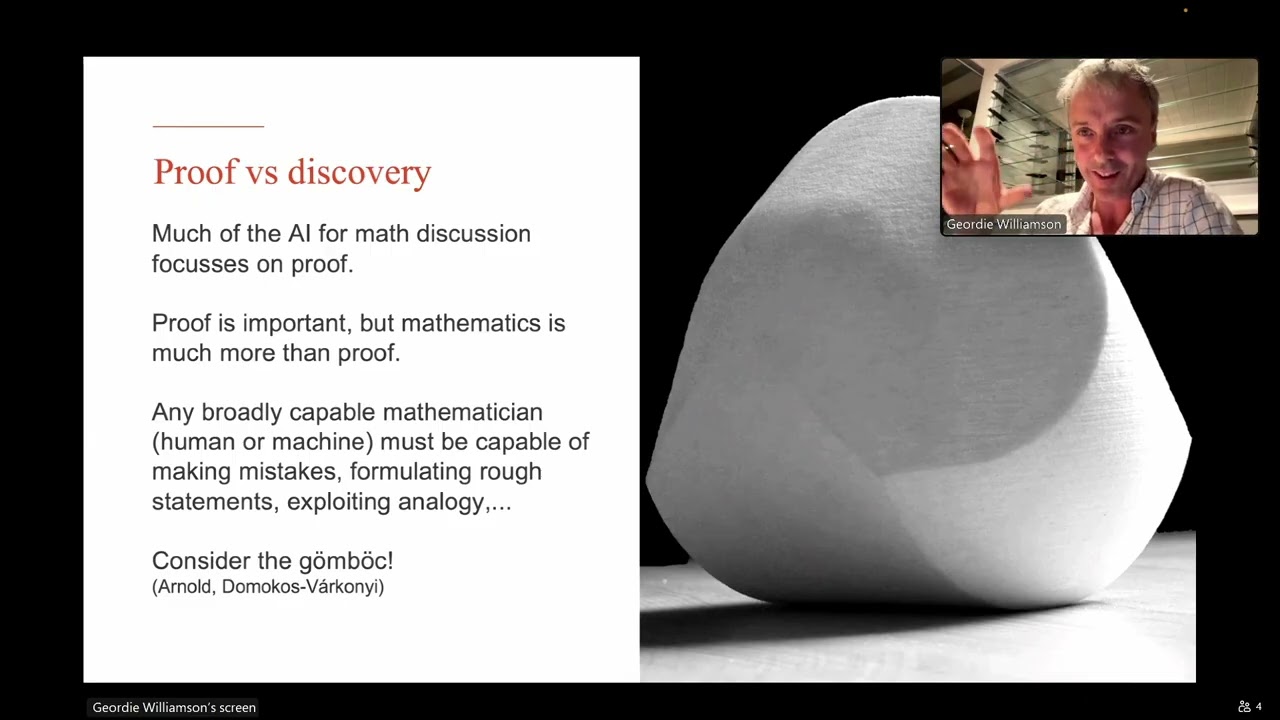
Prof. Geordie Williamson | Human-machine mathematical collaboration with modern AI
Keywords
Summary
144 words
Critical Evaluation
Value of the Information & Strength of the Argument
The talk provides valuable insights into the practical application of AI in pure mathematics, based on the speaker’s direct experience. The argumentation is solid, supported by concrete examples and published results. Williamson effectively argues that AI can assist in mathematical discovery, not just proof verification, and emphasizes the importance of interpreting neural networks to derive new mathematical insights. He also presents a balanced view, acknowledging potential limitations and alternative futures.
Scientific Rigor, Source Quality, Title Accuracy
The speaker is a credible authority, and the talk references specific research projects and publications. The sources cited are primarily his own work and collaborations with DeepMind, which are verifiable. The title accurately reflects the content. The talk is a personal perspective rather than a systematic review, but it is rigorous in its use of examples and references.
143 words
Title / Content Match
The title accurately reflects the content, which focuses on human-machine collaboration in mathematics using modern AI.
Quality & Reliability
8/10
The speaker is a renowned mathematician with direct experience in AI-assisted research, presenting concrete examples and published results. The talk is a personal perspective, not a peer-reviewed study, but it is grounded in verifiable research and collaborations with DeepMind.
Key Moments
Markers derived by PSI from the transcript: the creator did not define chapters.
- Introduction: Williamson shares his connection to INI and his advocacy for a pragmatic approach to AI.
- Historical perspective: His initial skepticism about neural networks and the influence of AlphaGo.
- Collaboration with DeepMind: The importance of interdisciplinary communication and the time it takes to build shared language.
- Core belief: The 'centaur phase' of human-machine collaboration will reshape mathematics.
- Example 1: Bruhat graphs and combinatorial invariants - using graph neural networks to predict Kazhdan-Lusztig polynomials.
- Example 2: The 'memorations' phenomenon in arithmetic geometry - using AI to discover patterns in elliptic curves.
- Example 3: Recent work with AlphaVault on Bruhat graphs.
- Comments on coding agents and their potential for mathematicians.
- Reflections on challenges and the future of mathematics with AI.
Cited Sources
- INI Seminar page — Event page for the talk
- Isaac Newton Institute — Institute website
- INI LinkedIn — Institute LinkedIn page
Concurring Sources
- Kazhdan-Lusztig polynomials — Background on the polynomials discussed in the talk
- Birch and Swinnerton-Dyer conjecture — Background on the conjecture mentioned in the talk
Contribution & Novelties
The talk offers a unique insider perspective on the practical use of AI in pure mathematics, emphasizing the importance of discovery and interpretation of neural networks. It provides concrete examples of AI-assisted mathematical research and advocates for low-resource AI approaches.
Pour aller plus loin :
- Kazhdan-Lusztig polynomial — Relevant to the discussion of Bruhat graphs and combinatorial invariance.
- Birch and Swinnerton-Dyer conjecture — Central to the ‘memorations’ example.
- AlphaGo — Influential in the speaker’s reevaluation of neural networks.
78 words
Radar Profile
The radar profile shows high scores in quantity and quality of information, reflecting the speaker's expertise and the depth of examples. The technical level is high, indicating a specialized audience. The overall reliability is strong, given the speaker's credentials and the verifiable nature of the discussed research.