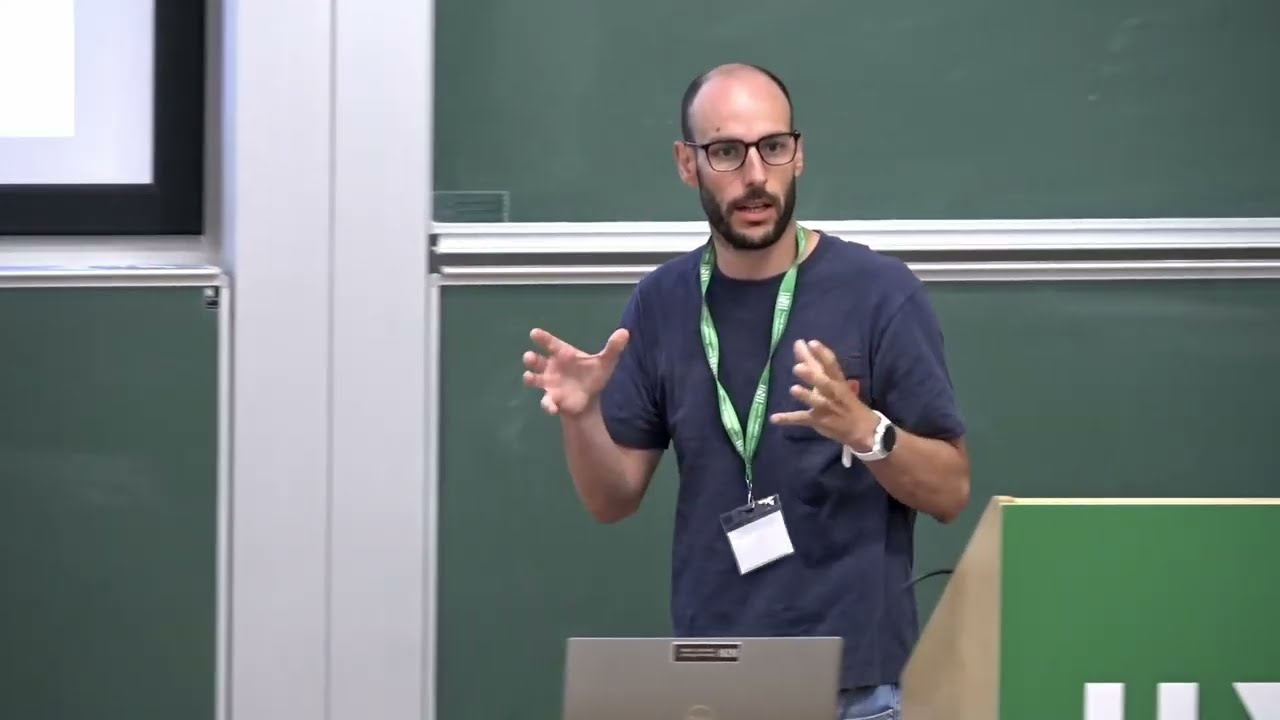
Dr. Alberto Alberello | Waves in ice-covered seas -- scattering and other mechanisms
Keywords
Summary
116 words
Critical Evaluation
Value of the Information & Strength of the Argument
The talk provides valuable insights into wave-ice interactions, particularly the role of dissipative mechanisms beyond scattering. The argumentation is solid, grounded in peer-reviewed research and comparisons with field data. The speaker clearly explains the physical processes and mathematical formulations, making a compelling case for the importance of including drag and other dissipative effects in wave-ice models. The extension to polychromatic sea states is a significant contribution, as it better represents real ocean conditions.
Scientific Rigor, Source Quality, Title Accuracy
The presentation is scientifically rigorous, referencing peer-reviewed work and comparing model predictions with satellite measurements. The speaker acknowledges limitations and uncertainties, such as the reliability of field measurements and the need for calibration. The title accurately reflects the content, focusing on scattering and other mechanisms. The talk is part of a seminar series at the Isaac Newton Institute, adding to its credibility.
150 words
Title / Content Match
The title accurately reflects the content, focusing on wave scattering and other mechanisms in ice-covered seas.
Quality & Reliability
8/10
Presentation by a domain expert at a recognized research institute, based on peer-reviewed work and comparisons with field data. However, it is a seminar talk with limited detail and no full methodological transparency.
Key Moments
Markers derived by PSI from the transcript: the creator did not define chapters.
- Introduction and context: importance of wave-sea ice coupling for climate modeling.
- Discussion of marginal ice zone and scattering regimes.
- Presentation of experiments on wave scattering by ice floes.
- Introduction of drag mechanism and its effect on attenuation.
- Comparison of model predictions with satellite observations.
- Extension to polychromatic sea states and spectral formulation.
- Discussion of attenuation exponent variability and conclusions.
Cited Sources
- Isaac Newton Institute for Mathematical Sciences — Host institution and seminar series.
- Seminar page for this talk — Details of the seminar and related event.
Concurring Sources
- Isaac Newton Institute for Mathematical Sciences — Host institution and seminar series.
Contribution & Novelties
The talk presents a novel model that incorporates ice drift velocity into wave attenuation, explaining observed increases in attenuation rates towards the ice edge. The extension to polychromatic sea states is a step towards more realistic modeling. The work is published in the Journal of Fluid Mechanics.
Pour aller plus loin :
- Wave scattering in sea ice — Overview of scattering phenomena.
- Marginal ice zone — Definition and characteristics.
- Wave attenuation in sea ice — General concept.
77 words
Radar Profile
The radar profile shows high scores in quality, technical level, and reliability, with slightly lower quantity of information due to the seminar format. The overall balance indicates a technically strong and reliable presentation.