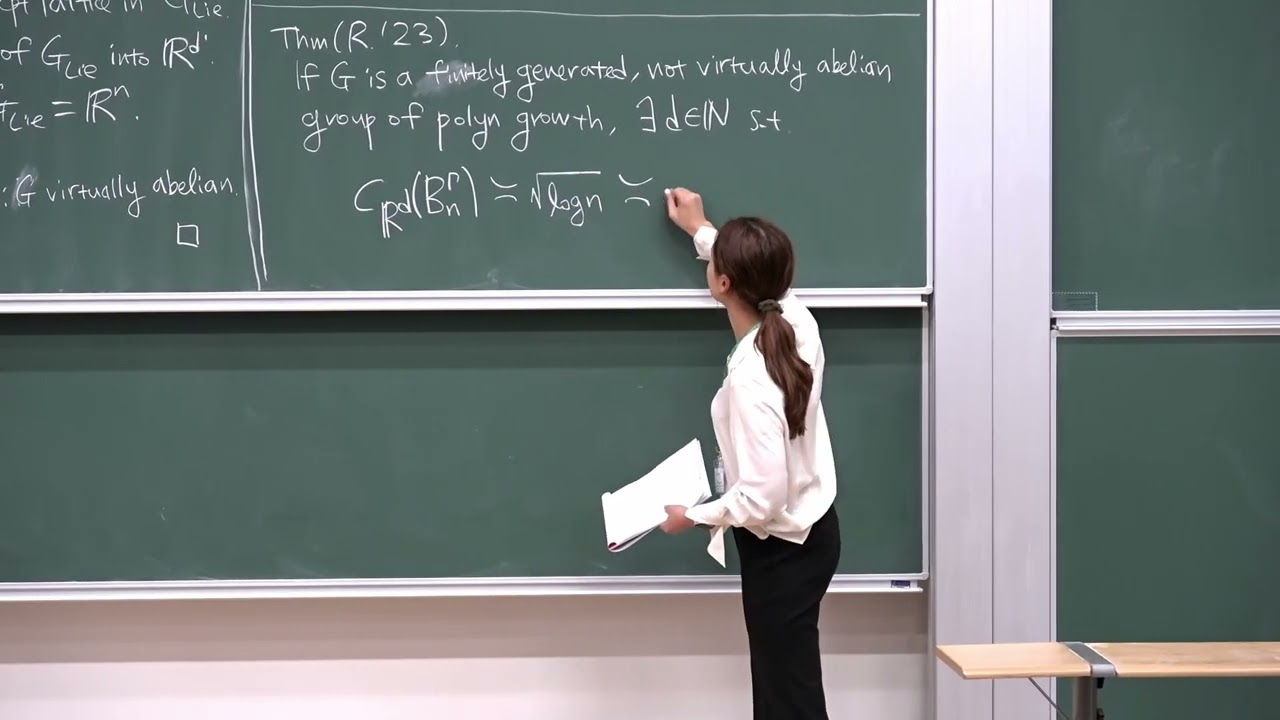
Group embeddings and coarse differentiation
Keywords
Summary
181 words
Critical Evaluation
Value of the Information & Strength of the Argument
The talk presents original research results, including a proof of sharp distortion bounds for groups of polynomial growth and a new theorem on beta numbers. The argumentation is rigorous, with clear logical steps and references to prior work. The speaker motivates the problem well and explains the significance of the results. The use of coarse differentiation as a tool is innovative and opens new avenues for proving non-embeddability results. The presentation is dense but coherent, with a clear structure.
Scientific Rigor, Source Quality, Title Accuracy
The talk is scientifically rigorous, with references to works by Assouad, Lang, and others, though some references are given by name only without full citations. The title accurately reflects the content. The talk is part of a workshop at the Isaac Newton Institute, which adds credibility. The description provides links to the institute and the specific seminar page, but no direct references to papers are given. The speaker’s own work is presented as original, and the proofs appear sound, though the transcription is imperfect and some details are missing.
183 words
Title / Content Match
The title accurately reflects the content, which focuses on embeddings of groups and the use of coarse differentiation.
Quality & Reliability
8/10
Talk by a researcher at a recognized institute (INI), presenting original results with references to prior work. The content is technical and appears rigorous, but the transcription is imperfect and some references are incomplete.
Key Moments
Markers derived by PSI from the transcript: the creator did not define chapters.
- Introduction and definition of coarse embedding and distortion.
- Statement of the characterization for virtually nilpotent groups.
- Discussion of necessary conditions for embeddability into R^d: doubling and L2 embeddability.
- Presentation of the speaker's result on distortion of groups of polynomial growth.
- Introduction of Assouad's embedding theorem and its sharpness.
- Extension to spaces with heat kernel estimates.
- Introduction of coarse differentiation and its role in proving lower bounds.
- Statement of the beta number theorem for manifolds.
- Discussion of applications and open questions.
Cited Sources
- INI Seminar page — Event page for the talk, providing context and possibly references.
- Isaac Newton Institute — Institute website, general information.
- LinkedIn page — Institute's LinkedIn page.
Concurring Sources
- Assouad's embedding theorem — The theorem is central to the talk's approach.
- Coarse geometry — General background for the topic.
Contribution & Novelties
The talk presents original results on sharp distortion bounds for groups of polynomial growth, improving on previous work. The introduction of coarse differentiation as a tool for proving lower bounds on distortion is novel. The speaker also presents a new theorem on beta numbers for manifolds with doubling and Poincaré inequalities, which may have applications to non-embeddability results.
Pour aller plus loin :
- Coarse embedding — Background on coarse embeddings.
- Assouad’s theorem — The classical embedding theorem for doubling spaces.
- Heat kernel — Background on heat kernels on manifolds.
- Poincaré inequality — Relevant to the conditions used in the talk.
100 words
Radar Profile
The radar profile shows high scores in technical level and information quality, with slightly lower but still strong scores in quantity and reliability. This indicates a dense, specialized talk with solid content, suitable for experts.