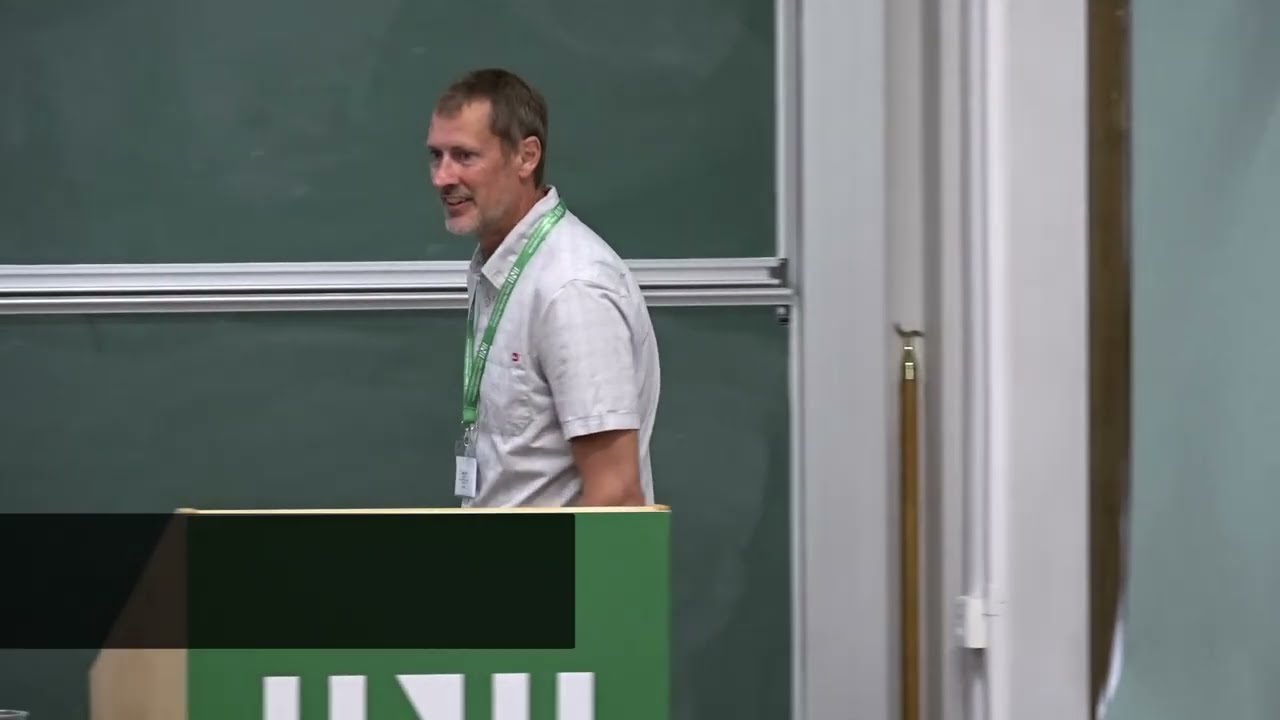
Dr. Stuart Hawkins | TMATSOLVER-EM: an easy to use software for simulating multiple scattering of electromagnetic waves
Keywords
Summary
153 words
Critical Evaluation
Value of the Information & Strength of the Argument
The talk provides valuable information about a practical software tool for electromagnetic scattering simulations. The argumentation is solid, supported by demonstrations and comparisons with theoretical results (e.g., Bloch wave dispersion curves). The speaker emphasizes ease of use and flexibility, backed by examples of rapid problem setup. However, the talk is more of a presentation of capabilities rather than a rigorous scientific validation, with limited discussion of numerical accuracy and convergence.
Scientific Rigor, Source Quality, Title Accuracy
The talk is scientifically rigorous in its methodology, referencing the T-matrix method and its mathematical foundations. The speaker mentions collaborations and prior work, but specific sources are not detailed in the description. The title accurately reflects the content. The talk is part of a workshop at the Isaac Newton Institute, which adds credibility. However, the lack of explicit citations in the description limits the ability to verify claims independently.
154 words
Title / Content Match
The title accurately reflects the content, focusing on the software and its application.
Quality & Reliability
8/10
The talk presents a software package with clear methodology and validation against known results, but lacks detailed peer-reviewed publication references in the description.
Key Moments
Markers derived by PSI from the transcript: the creator did not define chapters.
- Introduction and acknowledgments
- Motivation: Art Gower's beam challenge and development of TMATSOLVER
- Overview of TMATROM and TMATSOLVER capabilities
- Differences between 2D and 3D electromagnetic versions
- T-matrix method and computation of T-matrices
- Multiple scattering formulation and solver details
- Application to metamaterials: finite arrays and Bloch waves
- Rainbow reflection effect and conclusions
Cited Sources
- Isaac Newton Institute — Hosting institution and workshop information
- Seminar page — Details of the talk and event
Concurring Sources
- Isaac Newton Institute — Hosting institution and workshop information
Contribution & Novelties
The talk presents a novel software package that simplifies electromagnetic multiple scattering simulations, making advanced techniques accessible to a broader audience. It demonstrates the application to finite arrays and the exploitation of band gaps via graded rotations, which is a new result in 3D. The software’s compatibility with a common T-matrix database enhances interoperability.
Pour aller plus loin :
- T-matrix method — Foundational concept for the software.
- Multiple scattering theory — Theoretical background.
- Bloch wave — Key concept for periodic structures.
- Metamaterial — Application area.
85 words
Radar Profile
The radar profile shows high scores in quality and reliability, with slightly lower quantity of information due to the focused scope. The technical level is high, indicating a specialized audience.