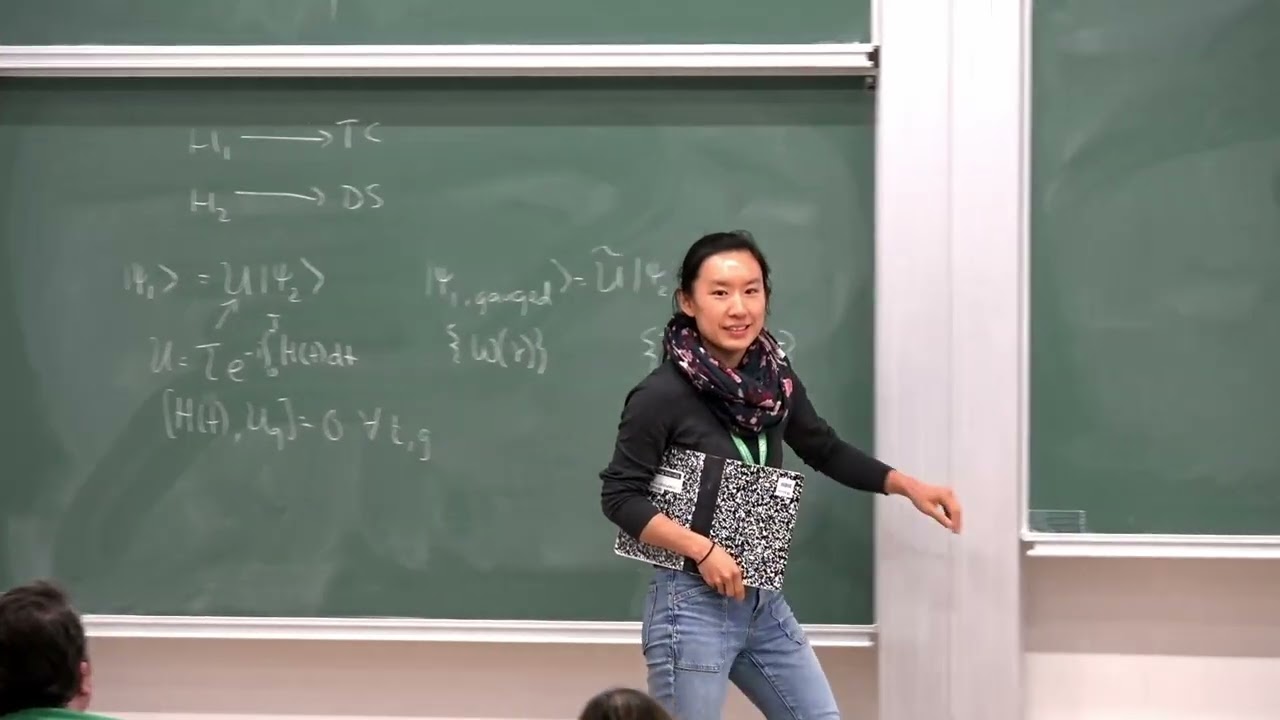
Dr. Carolyn Zhang | Boundaries, SPTs, and topological order in lattice models - Lecture 3
Keywords
Summary
192 words
Critical Evaluation
Value of the Information & Strength of the Argument
The lecture provides a high-value, in-depth explanation of string-net models and their connection to SPT phases and topological order. The argumentation is rigorous, building on previous lectures and addressing subtle points such as gauge ambiguities and the conditions for hermiticity. The speaker effectively uses examples (toric code, double semion) to illustrate abstract concepts. The discussion of non-unitary fusion categories and non-hermitian Hamiltonians adds novel insight. The argumentation is solid, though it assumes a high level of prior knowledge, making it less accessible to non-specialists.
Scientific Rigor, Source Quality, Title Accuracy
The lecture is scientifically rigorous, with clear logical progression and references to established concepts in mathematical physics. The speaker mentions specific papers (e.g., on gauge transformations) but does not provide explicit citations in the talk. The title accurately reflects the content. The description provides links to the Isaac Newton Institute and the specific seminar page, which are reliable sources for the event. No comments were provided, so no analysis of public reception is possible.
173 words
Title / Content Match
The title accurately reflects the content: a lecture on boundaries, SPTs, and topological order in lattice models.
Quality & Reliability
8/10
Lecture by a researcher at Harvard University, part of an INI programme, with technical depth and references to established mathematical physics concepts. The content is advanced and assumes prior knowledge, but is presented rigorously.
Key Moments
Markers derived by PSI from the transcript: the creator did not define chapters.
- Introduction and recap of previous lecture, addressing a question about gauge invariance.
- Discussion on distinguishing SPT phases via gauging, using toric code and double semion examples.
- Introduction to string-net models: input fusion category, string diagrams, and wave function construction.
- Detailed explanation of consistency conditions for string-net weights (F-symbols, etc.).
- Examples: toric code and double semion as string-net models with specific fusion rules.
- Conditions for hermitian commuting projector Hamiltonians; discussion of non-unitary cases.
- Connection to gapped boundaries and higher central charges as obstructions.
- Further discussion on non-hermitian Hamiltonians and PT symmetry.
- Summary and concluding remarks.
Cited Sources
- Seminar page for the event — Official page for the lecture series, providing context and possibly further resources.
- Isaac Newton Institute website — General information about the institute and its programmes.
- LinkedIn page of the Isaac Newton Institute — Professional network page for the institute.
Concurring Sources
- Levin-Wen model — The original paper introducing string-net models, which the lecture is based on.
Contribution & Novelties
The lecture provides a comprehensive and rigorous exposition of string-net models, clarifying subtle points about gauge ambiguities and the conditions for hermiticity. It connects abstract category theory to concrete lattice models, offering a valuable resource for researchers. The discussion of non-unitary fusion categories and their implications for Hamiltonians is particularly insightful.
Pour aller plus loin :
- String-net condensation — Overview of the concept.
- Topological order — Background on topological phases.
- Fusion category — Mathematical foundation for string-net models.
- Toric code — Example of a topological phase.
- Double semion model — Original paper on the double semion model.
97 words
Radar Profile
The radar profile shows high scores in technical level and information quality, indicating a dense, advanced lecture. The relatively lower score in accessibility reflects the specialized nature of the content.