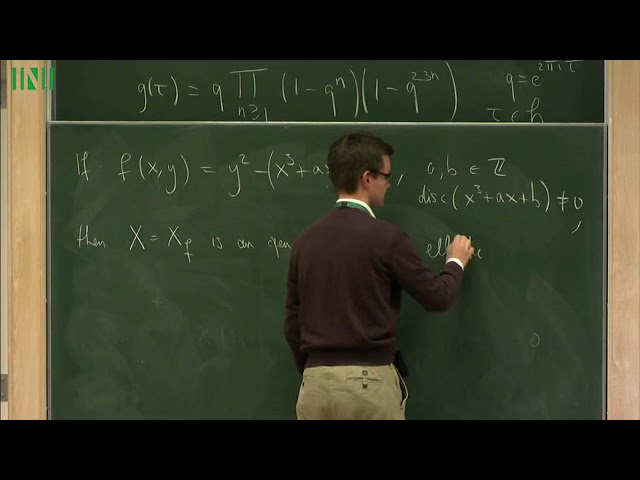
Prof. Jack Thorne | Modularity, old and new
Keywords
Summary
120 words
Critical Evaluation
Value of the Information & Strength of the Argument
The lecture provides valuable insights into the structure and significance of modularity, clearly explaining the connections between Diophantine equations, Galois representations, and modular forms. The argumentation is rigorous, building from basic definitions to advanced concepts, and is supported by references to key theorems and papers. Thorne effectively communicates the depth of the subject while maintaining clarity.
Scientific Rigor, Source Quality, Title Accuracy
The talk is scientifically rigorous, with references to the Notices of the AMS and specific works by Skinner, Diamond, Kisin, and others. The title accurately reflects the content, which covers both classical and modern aspects of modularity. The presentation is well-structured and suitable for an expert audience.
118 words
Title / Content Match
The title accurately reflects the content, which discusses the historical development and modern generalizations of modularity.
Quality & Reliability
9/10
Lecture by a leading expert in number theory, based on established results and published work, with references to the literature.
Key Moments
Markers derived by PSI from the transcript: the creator did not define chapters.
- Introduction and reference to the March 2017 Notices of the AMS.
- Definition of modularity for Diophantine equations via zeta functions.
- Example with polynomial x^3 - x - 1 and its zeta function.
- Definition of modular forms and their zeta functions.
- Introduction of elliptic curves and the modularity theorem.
- Galois representations associated to elliptic curves and their role in modularity.
- Statement of modularity lifting theorem and the '3-5 switch'.
- Discussion of the Taylor-Wiles method and its generalizations.
- Potential modularity and results over real quadratic fields.
- Conclusion and outlook on future developments.
Cited Sources
- INI Seminar Page — Event page for the lecture, part of the Fermat's Last Theorem celebration.
Concurring Sources
- Modularity theorem — Supports the discussion of the modularity theorem for elliptic curves.
- Taylor-Wiles method — Supports the explanation of the method used in the proof.
Contribution & Novelties
The lecture provides a comprehensive overview of modularity, from its classical definition to modern generalizations, highlighting the impact of Wiles’s proof. It offers a clear explanation of the Taylor-Wiles method and potential modularity, making advanced concepts accessible to a knowledgeable audience.
Pour aller plus loin :
- Modularity theorem — Provides background on the theorem connecting elliptic curves and modular forms.
- Galois representation — Explains the concept of Galois representations used in the lecture.
- Taylor-Wiles method — Details the method used in the proof of Fermat’s Last Theorem.
87 words
Radar Profile
The radar profile shows high scores in all dimensions, indicating a technically deep and reliable lecture with substantial information content.