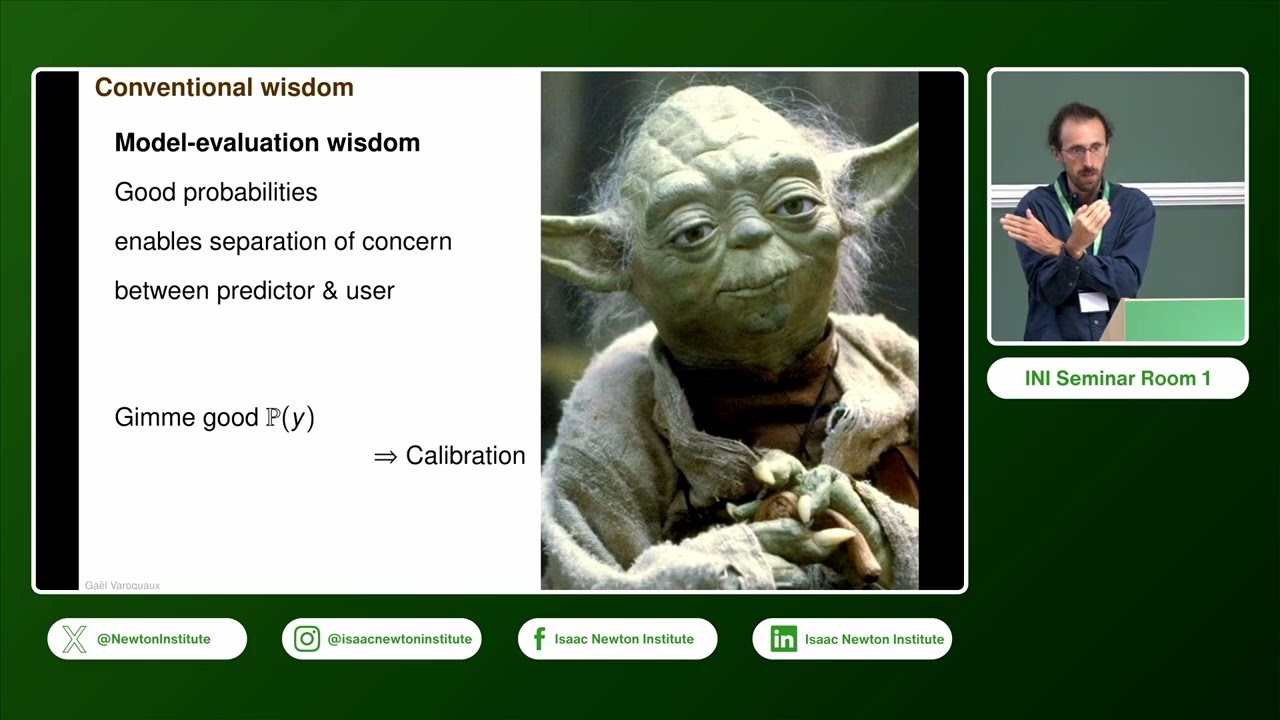
Dr. Gaël Varoquaux | Keynote: Judging uncertainty from black-box classifiers
Keywords
Summary
134 words
Critical Evaluation
Value of the Information & Strength of the Argument
The talk provides valuable insights into the limitations of calibration as a measure of uncertainty, highlighting the often-overlooked grouping loss. The argumentation is solid, building on formal definitions and proper scoring rules. The speaker clearly explains the mathematical framework and the estimation procedure, making a compelling case for the importance of considering subgroup-level uncertainty. However, the talk is more of a research overview than a detailed methodological exposition, and some claims rely on the speaker’s experience rather than extensive empirical validation.
Scientific Rigor, Source Quality, Title Accuracy
The talk demonstrates scientific rigor through precise definitions and references to established concepts like proper scoring rules and the law of total variance. The speaker acknowledges the limitations of his approach, such as the lower bound nature of the estimate. The title accurately reflects the content, focusing on judging uncertainty from black-box classifiers. The talk is based on the speaker’s research and does not cite specific external sources, but the concepts are well-established in the field.
172 words
Title / Content Match
The title accurately reflects the content: the talk focuses on judging uncertainty from black-box classifiers, discussing calibration and grouping loss.
Quality & Reliability
8/10
The talk is given by a leading expert in machine learning (co-founder of scikit-learn) at a prestigious institute (Isaac Newton Institute). The content is rigorous, with formal definitions and references to proper scoring rules and calibration literature. However, it is a keynote talk, not a peer-reviewed paper, and some claims are based on the speaker's experience rather than exhaustive evidence.
Key Moments
Markers derived by PSI from the transcript: the creator did not define chapters.
- Introduction and career background of Gaël Varoquaux.
- Discussion on the limitations of LLMs in providing uncertainty.
- Introduction to calibration and its definition.
- Explanation of calibration error and its limitations.
- Decomposition of expected loss into aleatoric and epistemic components.
- Introduction of grouping loss and its estimation using law of total variance.
- Use of decision trees to estimate grouping loss.
- Application to vision and language models, showing heterogeneity.
- Discussion on the practical implications and future directions.
Cited Sources
- Event page: Early Career Pioneers in Uncertainty Quantification and AI for Science — The talk was part of this workshop.
- Isaac Newton Institute website — General information about the institute.
- LinkedIn page of Isaac Newton Institute — Social media presence of the institute.
Concurring Sources
- On Calibration of Modern Neural Networks — This paper discusses calibration of neural networks, a topic central to the talk.
- A Unified Approach to Interpreting Model Predictions — Related to understanding model predictions and uncertainty.
Dissenting Sources
- Predictive Uncertainty Quantification via Distance-Aware Uncertainty — This paper proposes a different approach to uncertainty quantification, focusing on distance-aware methods, which contrasts with the calibration-based approach discussed.
Contribution & Novelties
The talk presents a novel decomposition of epistemic loss into calibration and grouping loss, and proposes a practical method to estimate grouping loss using decision trees and the law of total variance. This provides a more nuanced view of uncertainty in black-box classifiers, going beyond simple calibration curves.
Pour aller plus loin :
- Proper scoring rules — The talk relies on proper scoring rules to measure divergence.
- Law of total variance — The estimation method is based on this principle.
- Conformal prediction — Mentioned as a related but less practical approach for classifiers.
93 words
Radar Profile
The radar profile shows high scores in quality of information and technical level, reflecting the expert-level content. The quantity of information is also high, but the overall score is slightly lower due to the talk's focus on a specific research contribution rather than a broad overview.
💬 Sur les 0 commentaires analysés, aucune tendance n'est disponible.