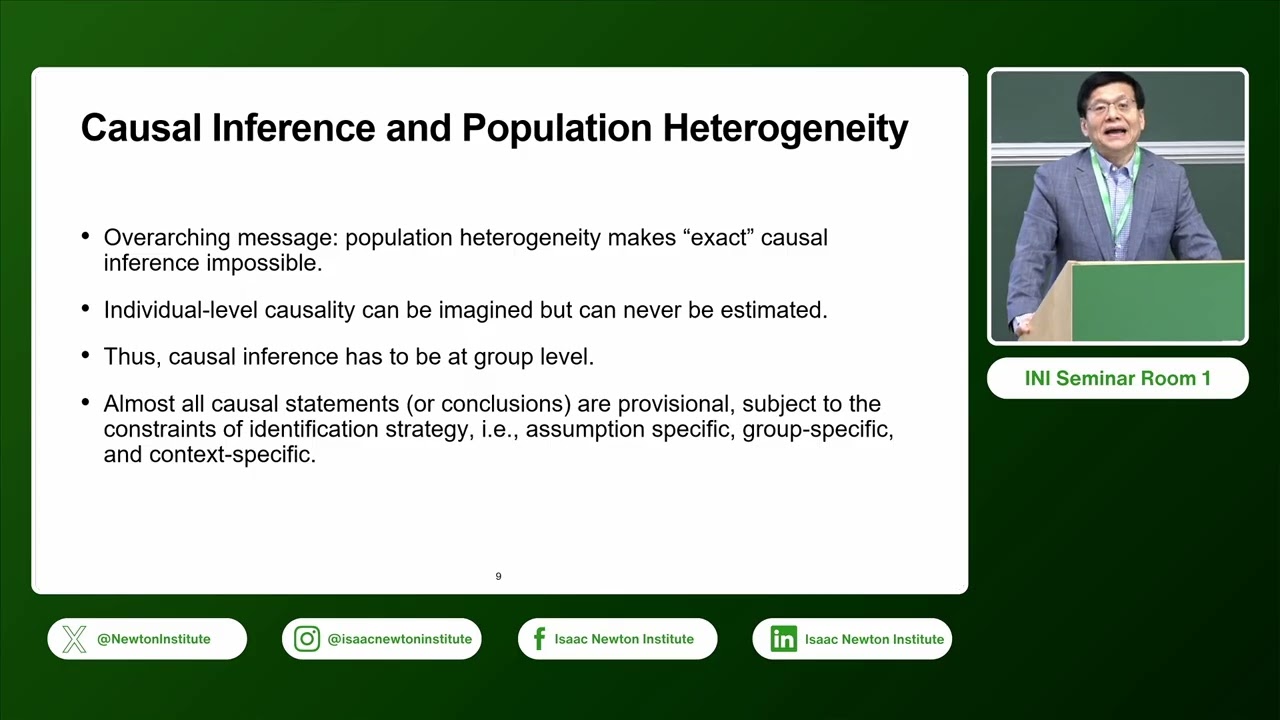
Population Heterogeneity, Causal Inference, and AI-Generated Data for Social Science
Keywords
Summary
163 words
Critical Evaluation
Value of the Information & Strength of the Argument
The talk provides valuable insights into the philosophical foundations of social science and the limitations of causal inference. The argumentation is strong, drawing on historical figures like Plato, Galton, and Duncan, and clearly distinguishes between typological and population thinking. The proposal to benchmark AI-generated data using statistical realism is innovative and well-motivated. The empirical results, though briefly presented, support the claim that current AI models fail to reproduce key statistical properties of real data. The speaker acknowledges limitations and suggests future work, making the argument balanced and credible.
97 words
Title / Content Match
The title accurately reflects the content, which covers population heterogeneity, causal inference, and AI-generated data.
Quality & Reliability
8/10
The talk is delivered by a leading sociologist and demographer (Princeton University) with extensive methodological expertise. It presents a coherent philosophical framework and empirical results from a benchmark study, but as a seminar talk it lacks full methodological detail and peer-review context.
Key Moments
Markers derived by PSI from the transcript: the creator did not define chapters.
- Introduction to the talk and speaker's background.
- Discussion of typological vs. population thinking.
- Implications of population thinking for statistics and regression.
- Causal inference and the impossibility of individual-level causal effects.
- Introduction to AI-generated data and the need for benchmarks.
- Description of the Social Science Data Bench framework.
- Results: AI fails to reproduce univariate distributions and sequences.
- Surprising finding: newer AI models do not improve statistical realism.
- Illustrative examples of distribution collapse and overestimated associations.
- Takeaways and future directions.
Cited Sources
- Isaac Newton Institute Seminar Page — Event page for the seminar, likely containing abstract and further details.
- Isaac Newton Institute Website — General information about the institute and its research programmes.
- Isaac Newton Institute LinkedIn — Social media presence of the institute.
Concurring Sources
- Isaac Newton Institute Seminar Page — Official event page, consistent with the talk's content.
Contribution & Novelties
The talk contributes a novel framework for evaluating AI-generated data in social science, emphasizing statistical realism at the population level rather than individual-level fidelity. It highlights the fundamental limitations of current AI models in reproducing distributional properties, which is a crucial caution for researchers. The distinction between typological and population thinking provides a philosophical grounding for why AI-generated data may fail. The empirical benchmark across multiple datasets and AI models is a valuable resource.
Pour aller plus loin :
- Causal Inference in Statistics — Overview of causal inference concepts.
- Population Thinking — Philosophical concept discussed in the talk.
- Statistical Realism — Philosophical perspective on statistical modeling.
- AI-generated data in social science — Related research on AI and social science data.
120 words
Radar Profile
The radar profile shows high scores in information quantity, quality, and technical level, with a slightly lower but still strong reliability score. This indicates a well-balanced, informative, and technically sound presentation, though the reliability is slightly tempered by the lack of detailed source citations within the talk itself.