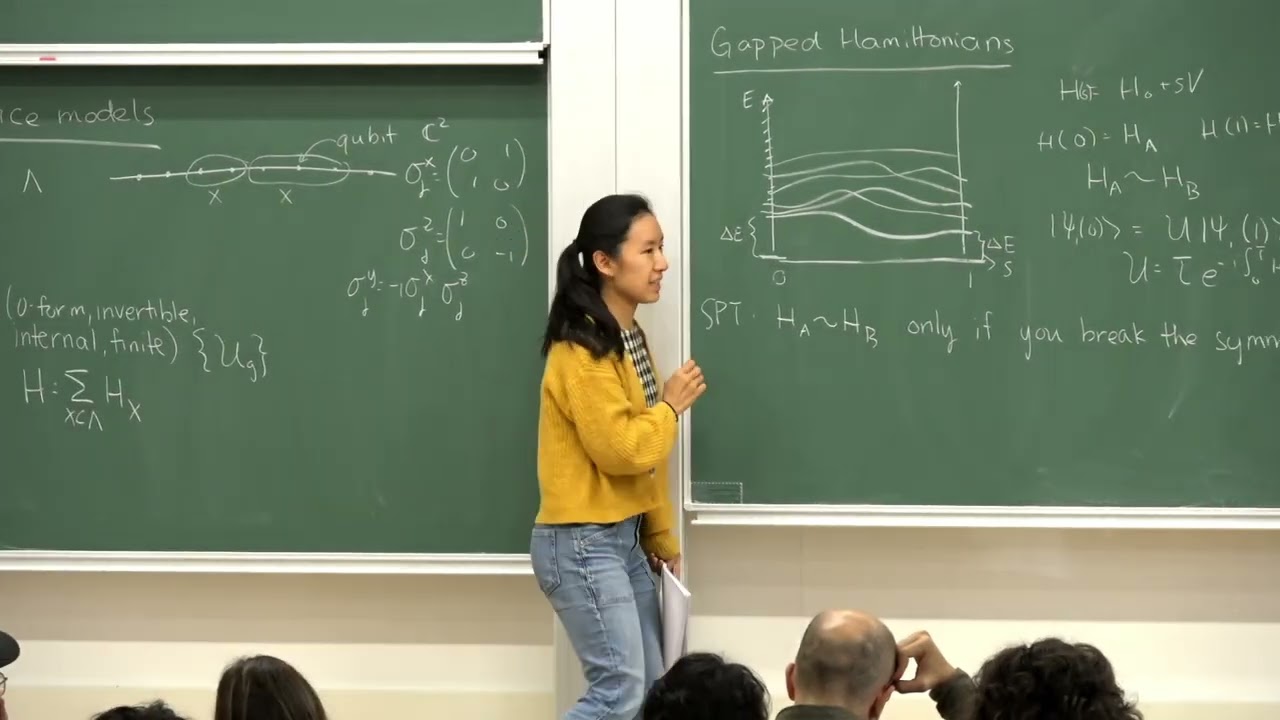
Boundaries, SPTs, and topological order in lattice models - Lecture 1
Keywords
Summary
194 words
Critical Evaluation
Value of the Information & Strength of the Argument
The lecture provides a clear and rigorous introduction to SPT phases, using explicit lattice models that are fully solvable. The argumentation is solid: the definitions of phases and SPT phases are precise, and the example is worked out in detail, showing how boundary modes and projective representations distinguish different phases. The logical flow is well-structured, moving from general concepts to concrete calculations. The value lies in its pedagogical clarity and the concrete demonstration of abstract ideas, making it accessible to a broad audience while maintaining technical depth.
Scientific Rigor, Source Quality, Title Accuracy
The lecture is scientifically rigorous, with careful definitions and derivations. The speaker is a researcher at Harvard University, and the talk is part of a program at the Isaac Newton Institute, which adds credibility. The content is based on established concepts in condensed matter physics, though no specific external sources are cited in the talk itself. The title accurately reflects the content, focusing on boundaries, SPTs, and topological order in lattice models. The lecture is well-structured and the mathematical arguments are sound.
184 words
Title / Content Match
The title accurately reflects the content: the lecture introduces symmetry-protected topological phases in lattice models, focusing on boundaries and bulk properties.
Quality & Reliability
9/10
Lecture by a recognized researcher at a prestigious institute, with rigorous mathematical derivations and clear definitions. The content is well-structured and technically sound, though it is a pedagogical presentation rather than a peer-reviewed publication.
Key Moments
Markers derived by PSI from the transcript: the creator did not define chapters.
- Introduction and overview of the lecture series.
- Definition of lattice models and local degrees of freedom.
- Introduction of symmetries and gapped Hamiltonians.
- Definition of phases of matter and SPT phases.
- Construction of the Z2 × Z2 symmetric spin chain example.
- Analysis of ground states and boundary degeneracy.
- Derivation of effective boundary symmetry operators.
- Demonstration of projective representation and anomaly.
- Discussion of implications for SPT classification.
Cited Sources
- Isaac Newton Institute for Mathematical Sciences — Organizing institution of the lecture series.
- Event page for the lecture — Details of the seminar series.
- Isaac Newton Institute LinkedIn — Social media presence of the institute.
Concurring Sources
- Symmetry-protected topological phases — Seminal paper by Chen, Gu, and Wen on SPT phases.
Contribution & Novelties
This lecture provides a clear and accessible introduction to SPT phases using explicit lattice models, emphasizing the role of boundary modes and projective representations. It bridges abstract concepts with concrete calculations, making it valuable for students and researchers new to the field. The lecture also sets the stage for more advanced topics in subsequent lectures, such as gauging SPTs and string-net models.
Pour aller plus loin :
- Symmetry-protected topological order — Overview of SPT phases.
- Projective representation — Mathematical background on projective representations.
- Topological order — Introduction to topological order.
- Quantum spin chain — Context for the lattice models discussed.
100 words
Radar Profile
The radar profile shows high scores across all dimensions, indicating a well-balanced and high-quality lecture. The technical level is high, but the presentation is clear and accessible, making it suitable for a broad audience. The lecture is both informative and rigorous, with strong quantitative and qualitative content.