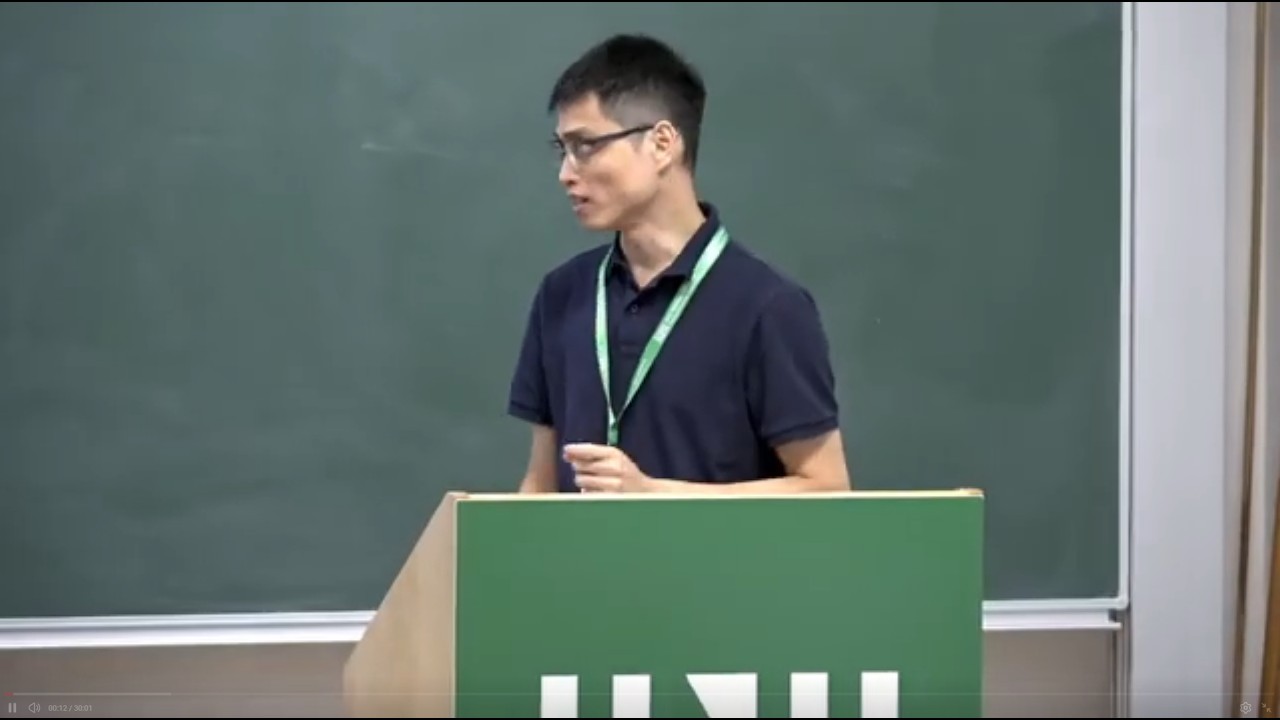
Dr. Zhenjian Lu | Nondeterminism in Meta-Complexity
Keywords
Summary
203 words
Critical Evaluation
Value of the Information & Strength of the Argument
The talk presents original research results with clear logical progression, connecting meta-complexity to fundamental questions in average-case complexity. The argumentation is rigorous, with the speaker explicitly noting simplifications and informal statements, which enhances credibility. The value lies in providing new NP-hardness results for nondeterministic time-bounded Kolmogorov complexity and outlining a potential route to stronger worst-case to average-case reductions for NP. The speaker also engages with audience questions, clarifying technical points and acknowledging limitations, which strengthens the overall argument.
Scientific Rigor, Source Quality, Title Accuracy
The presentation is scientifically rigorous, with the speaker referencing prior work (e.g., by Hirahara, Banoff, Triison, and others) and clearly stating the scope of new results. The institutional context (Isaac Newton Institute) and the formal seminar format support reliability. The title accurately reflects the content, focusing on nondeterminism in meta-complexity. The speaker’s caveats about informal notation and simplifications are appropriate for a technical audience. No comments were provided for analysis.
163 words
Title / Content Match
The title accurately reflects the content, which focuses on nondeterminism in meta-complexity and its applications to average-case complexity.
Quality & Reliability
8/10
Presentation of original research results in a formal setting, with explicit caveats about informal statements and references to prior work. The technical content is dense and assumes expert knowledge, but the speaker is transparent about simplifications and the institutional context (Isaac Newton Institute) lends credibility.
Key Moments
Markers derived by PSI from the transcript: the creator did not define chapters.
- Introduction and disclaimer about informal statements.
- Definition of average-case complexity and the classes average-BPP and heuristic-BPP.
- Discussion of worst-case to average-case reductions for NP and the barrier result.
- Introduction of time-bounded Kolmogorov complexity and the MKTP problem.
- Definition of the gap version GapMKTP and its worst-case to average-case reduction.
- Introduction of nondeterministic time-bounded Kolmogorov complexity (NKTP) and the main NP-hardness result.
- Discussion of the complexity of GapMNKTP and its placement in Sigma_2.
- Potential breakthrough: if GapMNKTP with PH oracle is easy on average, then NP is in BPP.
- Equivalence of gap and non-gap versions in the average-case setting.
- Audience questions and clarifications about the scope of the results.
Cited Sources
- Isaac Newton Institute for Mathematical Sciences — Institutional website providing context about the seminar and the institute.
- Seminar page: Frontiers in complexity lower bounds — Official page for the seminar where this talk was presented.
Concurring Sources
- Isaac Newton Institute for Mathematical Sciences — Institutional context supporting the reliability of the presentation.
Contribution & Novelties
The talk presents original results on nondeterministic time-bounded Kolmogorov complexity, showing NP-hardness for the plain version and exploring the complexity of the gap version. It offers a potential route to stronger worst-case to average-case reductions for NP, contingent on eliminating the gap in the worst case. The equivalence of gap and non-gap versions in the average-case setting is a notable contribution.
Pour aller plus loin :
- Kolmogorov complexity — Foundational concept for the talk.
- Average-case complexity — Central topic of the talk.
- Polynomial hierarchy — Relevant to the PH oracle discussion.
91 words
Radar Profile
The profile shows high technical level and good information quality, with slightly lower quantity due to the short duration. The balance suggests a dense, expert-level presentation with strong reliability.