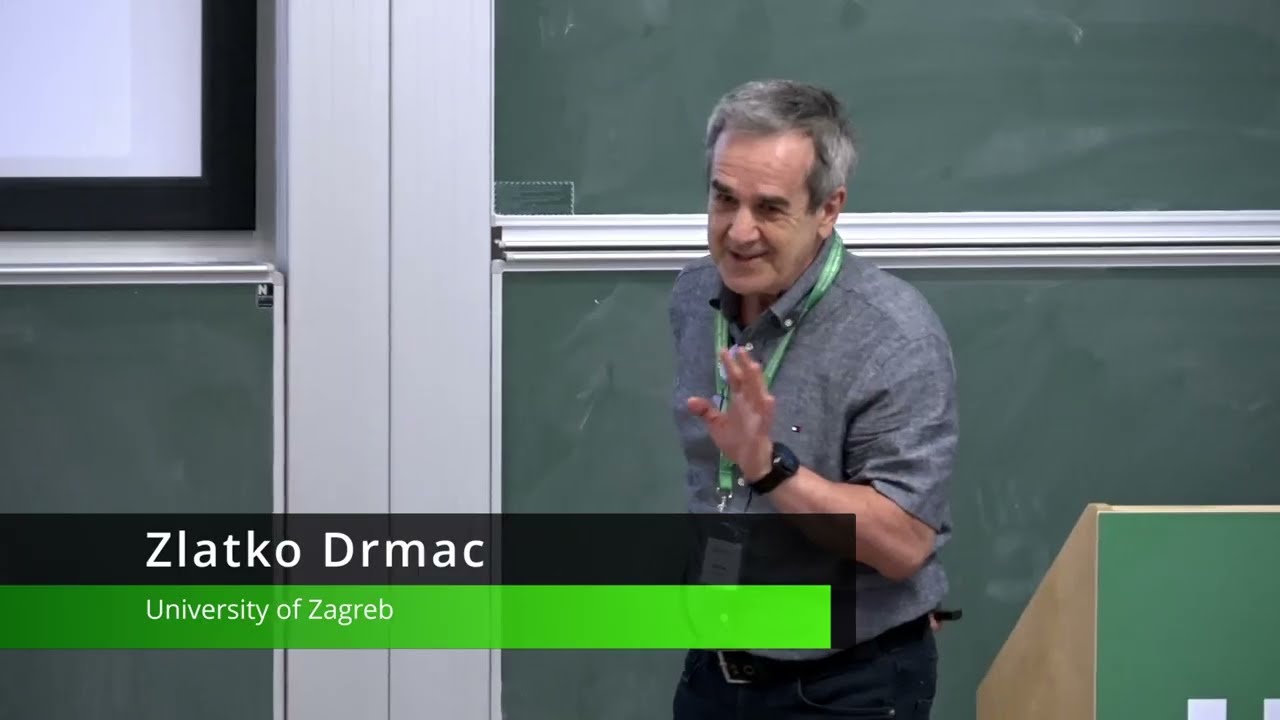
Prof. Zlatko Drmac | Residuals and mixed backward shadowing stability of the EDMD/KMD
Keywords
Summary
187 words
Critical Evaluation
Value of the Information & Strength of the Argument
The talk presents a novel and valuable theoretical framework for understanding the reliability of EDMD/KMD. The argumentation is rigorous and builds on established concepts from numerical analysis (backward error) and dynamical systems (shadowing). The speaker clearly motivates the problem, introduces the concept of a composite backward error, and then extends it to a ‘mixed’ stability that connects the operator perturbation to perturbations in the initial condition. The reasoning is well-structured and demonstrates a deep understanding of both numerical linear algebra and dynamical systems theory.
Scientific Rigor, Source Quality, Title Accuracy
The presentation is scientifically rigorous, with a clear mathematical derivation of the main results. The speaker references the work of Palmer on shadowing theory, which is a standard reference in the field. The title accurately reflects the content, focusing on residuals and the new concept of mixed backward shadowing stability. The talk is part of a scientific workshop at the Isaac Newton Institute, which adds to its credibility. The description provides links to the institute and the specific seminar page, which are relevant sources.
183 words
Title / Content Match
The title accurately reflects the content, which focuses on residuals and a novel concept of mixed backward shadowing stability for EDMD/KMD.
Quality & Reliability
8/10
Presentation of new theoretical results by a recognized expert in numerical analysis, with rigorous mathematical reasoning and references to established shadowing theory. The talk is recent and technical, but the lack of published peer-reviewed details at this stage slightly limits verifiability.
Key Moments
Markers derived by PSI from the transcript: the creator did not define chapters.
- Introduction and motivation for a numerical analysis perspective on EDMD.
- Review of Koopman operator and EDMD formulation.
- Discussion of issues with spectral pollution and spurious eigenvalues.
- Introduction of backward error analysis and the concept of a composite perturbation ΔK.
- Construction of ΔK that makes selected eigenpairs exact.
- Extension to mixed backward shadowing stability, linking ΔK to perturbations in the initial condition.
- Introduction to shadowing theory and its application to justify EDMD/KMD predictions.
- Technical details on the shadowing lemma and the role of the derivative's right inverse.
- Discussion of the implications for sensitive systems and the meaning of the shadowing trajectory.
- Summary and conclusion of the presented framework.
Cited Sources
- Isaac Newton Institute for Mathematical Sciences — Host institution and general information.
- Seminar page for OMDW01 — Event page with details about the workshop and talk.
Concurring Sources
- Shadowing lemma — The talk builds on this classical result to justify the existence of a true trajectory near the computed pseudo-trajectory.
Contribution & Novelties
The talk introduces a novel concept of ‘mixed backward shadowing stability’ for EDMD/KMD, which provides a rigorous justification for using approximate eigenpairs by showing they correspond to a true trajectory of the system with a slightly perturbed initial condition. This goes beyond simple residual checks and connects the numerical analysis of the operator approximation to the dynamical systems theory of shadowing.
Pour aller plus loin :
- Extended Dynamic Mode Decomposition — Provides background on the EDMD method.
- Shadowing lemma — Core concept used in the talk to justify the stability of pseudo-trajectories.
- Koopman operator — The operator theory underlying EDMD/KMD.
- Backward error analysis — The numerical analysis principle used to interpret the residuals.
113 words
Radar Profile
The radar profile shows a highly technical and information-dense talk, with very high scores in information quantity, quality, and technical level. The reliability score is also high, reflecting the rigorous mathematical approach and the speaker's expertise. The profile is consistent with a specialized research seminar.