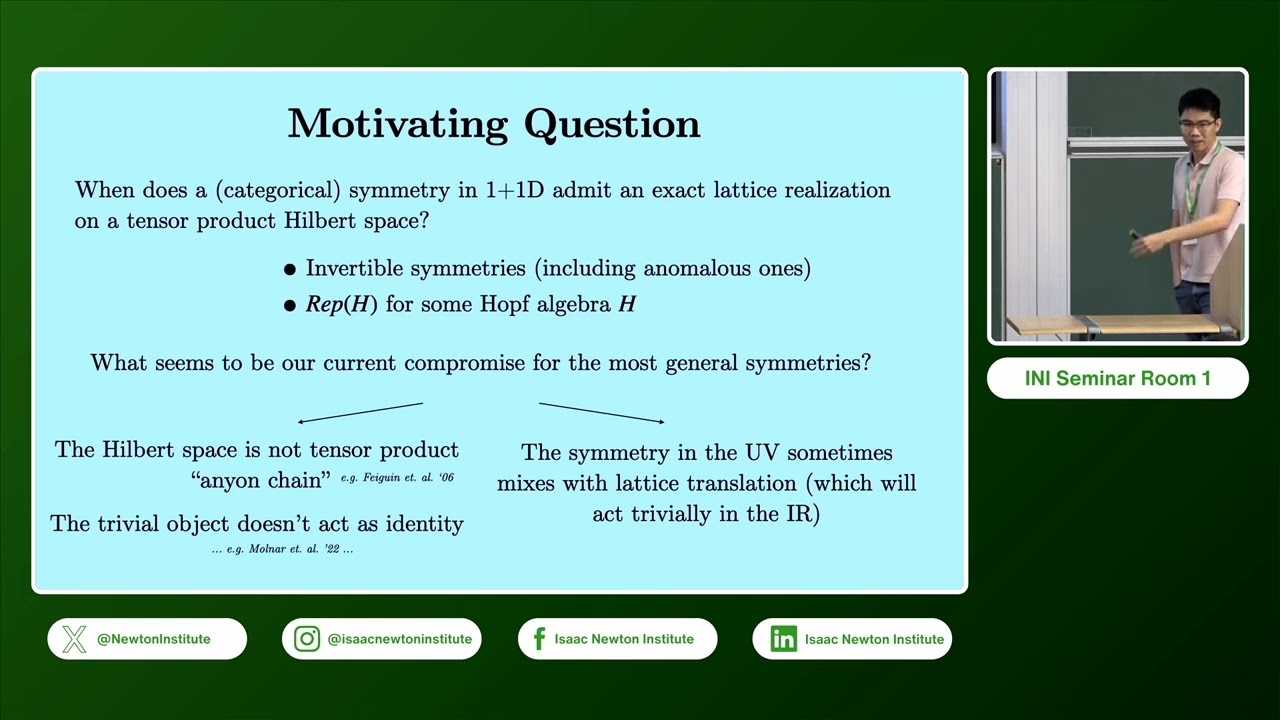
Non-invertible self-duality symmetries on a tensor product Hilbert space
Keywords
Summary
147 words
Critical Evaluation
Value of the Information & Strength of the Argument
The talk provides a valuable overview of recent developments in the construction of non-invertible symmetries on tensor product Hilbert spaces. The speaker clearly explains the motivation and the mathematical tools, particularly ZX calculus, which is not commonly used in condensed matter physics. The argumentation is solid, building from simple examples to more complex generalizations. The speaker addresses potential concerns and questions from the audience, demonstrating a deep understanding of the subject. The presentation is well-structured, with a clear outline and logical progression.
Scientific Rigor, Source Quality, Title Accuracy
The talk is scientifically rigorous, with references to published work and ongoing collaborations. The speaker mentions joint work with Ray Garla and Shuhong Xiao, as well as ongoing work with Oracle Chadi and Tachuanlu. The title accurately reflects the content, focusing on non-invertible self-duality symmetries on tensor product Hilbert spaces. The presentation is technical and assumes a background in quantum field theory and condensed matter physics. The speaker does not provide explicit citations to external sources during the talk, but the content is based on established research in the field.
187 words
Title / Content Match
The title accurately describes the content: the speaker discusses non-invertible self-duality symmetries in the context of tensor product Hilbert spaces.
Quality & Reliability
8/10
Talk by a researcher at a recognized institution (Stony Brook University) presented at the Isaac Newton Institute. The content is technical and appears rigorous, with references to published work and ongoing research. However, as a seminar, it is not peer-reviewed and may contain speculative elements.
Key Moments
Markers derived by PSI from the transcript: the creator did not define chapters.
- Introduction and overview of the talk
- Discussion of duality transformations and self-duality symmetries
- Introduction to ZX calculus and its applications
- Construction of cluster state and its symmetries
- Connection to Kramers-Wannier duality and non-invertible symmetries
- Generalization to non-abelian symmetries and gauging
- Discussion of ongoing work and open questions
Cited Sources
- Isaac Newton Institute Seminar Page — Event page for the seminar, providing details and possibly slides.
- Isaac Newton Institute Website — General information about the institute and its programs.
Concurring Sources
- Isaac Newton Institute Seminar Page — The seminar page provides official information about the talk, confirming the speaker and topic.
External References
Contribution & Novelties
The talk presents a novel approach to constructing non-invertible symmetries on tensor product Hilbert spaces by combining gauging of non-invertible symmetries with ZX calculus. This provides explicit lattice realizations of symmetries that were previously only studied at the abstract level. The speaker also highlights the subtlety of mixing with lattice translations, which is an important consideration for exact lattice realizations.
Pour aller plus loin :
- ZX-calculus — Graphical language for quantum processes, central to the talk.
- Kramers–Wannier duality — The duality transformation discussed in the context of the Ising model.
- Fusion category — Mathematical structure underlying non-invertible symmetries.
98 words
Radar Profile
The radar profile shows high scores in technical level and information quality, indicating a specialized and rigorous presentation. The lower score in quantity of information reflects the focused scope of the talk, while the high reliability score is consistent with the speaker's expertise and institutional backing.