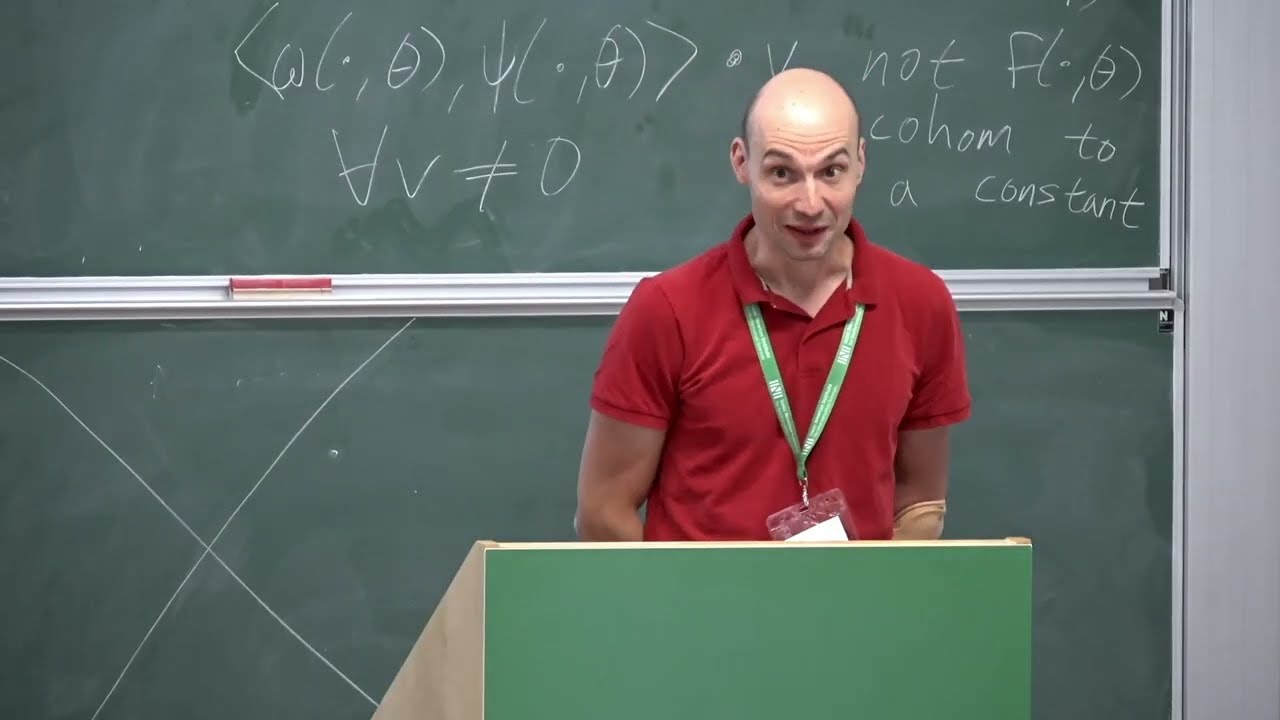
Takens meets Koopman: Linear least squares prediction of nonlinear time series
Keywords
Summary
231 words
Critical Evaluation
Value of the Information & Strength of the Argument
The talk provides significant value by establishing rigorous mathematical conditions under which a simple, classical prediction method (linear least squares) is asymptotically optimal for nonlinear dynamical systems. This bridges the gap between Takens’ geometric embedding theory and Koopman operator spectral theory, offering a new perspective on predictability. The argumentation is solid, built on formal definitions, theorems, and proofs. The speaker carefully distinguishes between strong and weak predictiveness and uses topological genericity and prevalence to quantify the ‘size’ of the set of predictable systems. The inclusion of numerical examples (torus rotation, von Neumann-Kakutani, Lorenz 63) effectively illustrates the theoretical findings and their practical implications. The comparison with Takens’ theorem at the end provides a clear synthesis of the contributions.
Scientific Rigor, Source Quality, Title Accuracy
The scientific rigor is high, as the talk is based on original research, likely to be published in peer-reviewed journals. The speaker cites foundational works (Takens, Wiener, Koopman) and uses standard mathematical tools (ergodic theory, spectral theory). The venue, the Isaac Newton Institute, is a world-leading research center, lending credibility. The title accurately reflects the content, which is a mathematical analysis of linear prediction in the context of Takens and Koopman. The talk is an original study, not a review, and the speaker clearly states the joint work with collaborators. The description provides a link to the seminar page for further details, but no direct references to specific papers are given in the description.
247 words
Title / Content Match
The title accurately reflects the content, which bridges Takens' embedding theorem and Koopman operator theory to analyze linear prediction of nonlinear time series.
Quality & Reliability
8/10
The talk presents original mathematical results with rigorous proofs, set within a well-established theoretical framework (Koopman operator theory, ergodic theory). The speaker is a professor at a university, and the venue is the Isaac Newton Institute, a prestigious research institution. The content is highly technical and internally consistent, with clear definitions and theorems. However, as a seminar talk, it lacks the full detail of a peer-reviewed publication, and some claims are presented without complete proofs.
Key Moments
Markers derived by PSI from the transcript: the creator did not define chapters.
- Introduction to the prediction problem in dynamical systems and the data-driven approach.
- Discussion of Takens' embedding theorem and its implications for predictability.
- Introduction of the linear least-squares filter (Wiener filter) and its connection to the Koopman operator.
- Definition of strong and weak predictiveness and the role of cyclic vectors.
- Presentation of the first main result: generic measure-preserving transformations have a generic set of strongly predictive observables.
- Introduction of prevalence as a measure-theoretic notion of largeness and the second main result.
- Use of the spectral theorem to characterize weak predictiveness via the Szegő-Kolmogorov theorem.
- Discussion of rank-one systems and their cyclic vectors.
- Numerical examples: torus rotation, von Neumann-Kakutani transformation, and Lorenz 63 system.
- Comparison with Takens' theorem and summary of the results.
Cited Sources
- Isaac Newton Institute for Mathematical Sciences — The institute hosting the seminar and providing the platform for the talk.
- Seminar page for the talk — The official page for this specific seminar, likely containing abstract and further details.
Concurring Sources
- Koopman operator — The talk's framework is based on Koopman operator theory, which is a well-established area of research.
- Takens' theorem — The talk builds upon Takens' embedding theorem, a foundational result in dynamical systems.
Dissenting Sources
- Lorenz 63 system — The talk shows that the Lorenz 63 system is not weakly predictive, which contrasts with the generic results. This is a specific counterexample to the general predictability property.
Contribution & Novelties
The talk provides a novel theoretical framework for understanding when linear prediction methods are effective for nonlinear time series. It rigorously establishes that for a generic class of measure-preserving dynamical systems and observables, the Wiener filter is asymptotically optimal. This is a significant contribution because it justifies the use of simple linear models in a wide range of applications, even when the underlying dynamics are nonlinear. The connection between Takens’ embedding and Koopman operator theory is a new synthesis that opens avenues for further research.
Pour aller plus loin :
- Koopman operator — The central operator used in the talk to linearize nonlinear dynamics.
- Takens’ theorem — The classical embedding theorem that motivates the delay-coordinate approach.
- Wiener filter — The linear prediction method analyzed in the talk.
- Ergodic theory — The mathematical framework for studying measure-preserving transformations.
- Spectral theorem — Used to characterize weak predictiveness via spectral measures.
148 words
Radar Profile
The radar profile shows high scores in information quality, technical level, and reliability, reflecting the rigorous mathematical nature of the talk. The quantity of information is also high, but the technical level is the most prominent, indicating a specialized audience. The overall profile is consistent with a high-level research seminar.