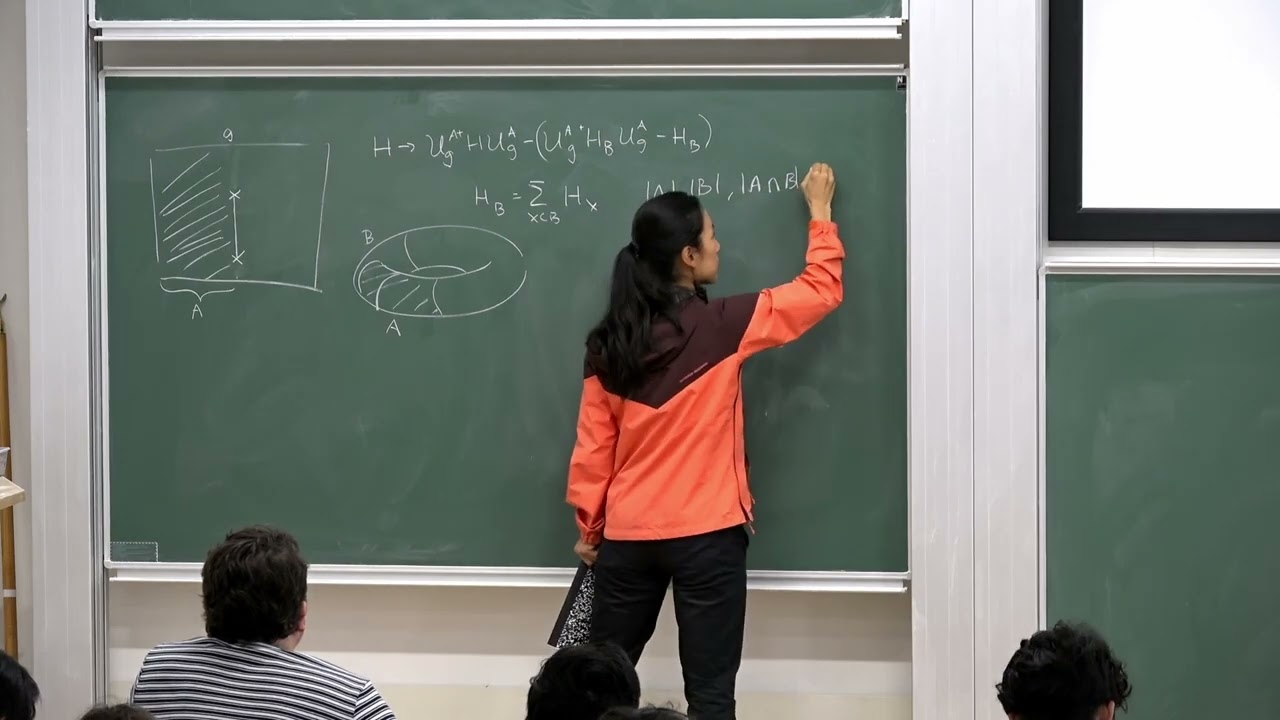
Boundaries, SPTs, and topological order in lattice models - Lecture 2
Keywords
Summary
162 words
Critical Evaluation
Value of the Information & Strength of the Argument
The lecture provides deep insights into the relationship between SPT phases, symmetry defects, and topological order. The argumentation is rigorous, building on previous results and using mathematical frameworks like G-crossed braided tensor categories. The speaker carefully explains the construction of flux insertion operators and the derivation of braiding properties, making the content valuable for researchers in the field. The use of explicit lattice models and the connection to gauging are particularly valuable, as they bridge abstract concepts with concrete realizations.
Scientific Rigor, Source Quality, Title Accuracy
The lecture is scientifically rigorous, with clear definitions and logical progression. The speaker cites relevant literature, including the work of Bais and others, and refers to her own paper for details. The title accurately reflects the content, which is focused on boundaries, SPTs, and topological order. The presentation is well-structured, and the speaker addresses audience questions, demonstrating a thorough understanding of the subject.
158 words
Title / Content Match
The title accurately reflects the content, which focuses on boundaries, symmetry-protected topological phases, and topological order in lattice models.
Quality & Reliability
9/10
The lecture is delivered by a researcher from Harvard University, part of a formal program at the Isaac Newton Institute. The content is technical, precise, and based on established mathematical physics frameworks. The speaker engages with audience questions, demonstrating depth and rigor.
Key Moments
Markers derived by PSI from the transcript: the creator did not define chapters.
- Introduction and recap of previous lecture on SPTs and boundary anomalies.
- Discussion of symmetry defects and symmetry fluxes in 2D lattice models.
- Construction of flux insertion operators and their relation to boundary representations.
- Introduction of G-crossed braided tensor categories and the heptagon equation.
- Derivation of the gauge-invariant quantity relating three-cocycles to braiding.
- Procedure for braiding symmetry fluxes and explicit calculation for Z2 SPT.
- Discussion of gauging and mapping to anyons and topological order.
- Explicit lattice gauging and construction of string-net models.
- Summary and outlook for future lectures.
Cited Sources
- Isaac Newton Institute Seminar Page — Event page for the lecture series, providing context and program details.
- Isaac Newton Institute Website — General information about the institute and its research programs.
- Isaac Newton Institute LinkedIn — Social media presence of the institute.
Concurring Sources
- Bais, F. A. et al. (2009) - 'Topological symmetry sectors and topological charges' — Referenced in the lecture for the heptagon equation and symmetry flux braiding.
Contribution & Novelties
The lecture provides a detailed and rigorous exposition of how symmetry fluxes in SPT phases can be braided and how their properties relate to topological order after gauging. It offers a concrete lattice-level construction of flux insertion operators and demonstrates the connection between three-cocycles and braiding phases. The explicit gauging procedure leading to string-net models is a valuable contribution.
Pour aller plus loin :
- G-crossed braided tensor categories — Relevant mathematical framework for symmetry defects.
- Symmetry-protected topological order — Overview of SPT phases.
- String-net models — Concrete models realizing topological order.
91 words
Radar Profile
The radar profile shows very high scores in all dimensions, indicating a highly technical, rigorous, and information-dense lecture. The content is specialized and likely intended for an expert audience.