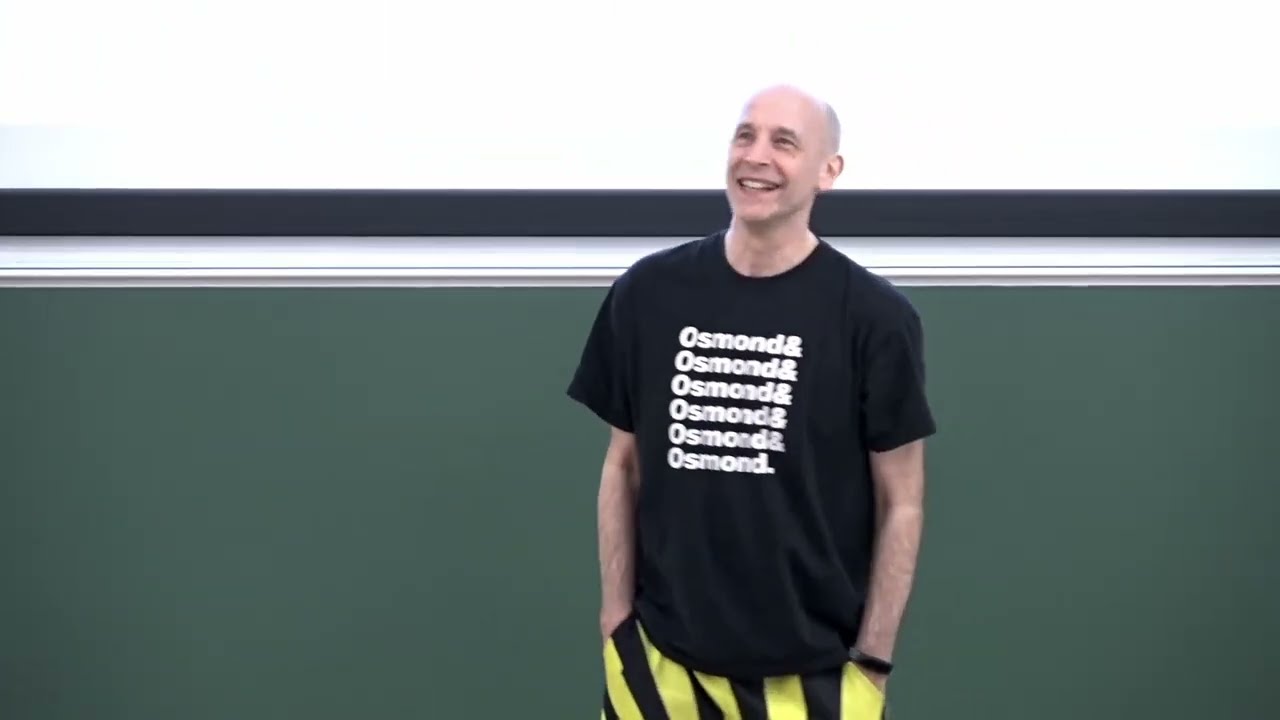
Prof. Kevin Buzzard | Formalizing mathematics today
Keywords
Summary
156 words
Critical Evaluation
Value of the Information & Strength of the Argument
The talk provides valuable insights into the current state and future of formalization, backed by concrete examples and personal experience. Buzzard’s argumentation is clear and well-structured, distinguishing between formalization and AI, and addressing both the achievements and the concerns within the community. He effectively uses the sphere packing case to illustrate the potential and limitations of auto-formalization, and he engages with the critical perspective of Patrick Massot, providing a balanced view. The talk is persuasive in arguing that formalization offers more than just proof checking, but it also acknowledges the challenges ahead.
Scientific Rigor, Source Quality, Title Accuracy
Buzzard demonstrates scientific rigor by referencing specific works, such as Hales’s proof of the Kepler conjecture and Viazovska’s work on sphere packing, and by citing the essay by Massot. The sources are credible and directly relevant. The title accurately reflects the content, which is a survey of formalization today. The talk is well-organized and the claims are supported by examples. The only minor weakness is that some statements are forward-looking and based on personal opinion, but this is clearly indicated.
187 words
Title / Content Match
The title accurately reflects the content, which surveys the current state of formalizing mathematics, with a focus on recent AI-driven developments.
Quality & Reliability
8/10
Talk by a leading expert in formalization, with concrete examples and references to recent developments. Some claims are forward-looking and based on personal opinion, but the factual content is reliable and well-contextualized.
Key Moments
Markers derived by PSI from the transcript: the creator did not define chapters.
- Introduction to the talk and the role of AI in formalization.
- Definition of formalization and proof assistants.
- Discussion on the history of formalization and the role of computer scientists.
- Introduction to the sphere packing problem and its history.
- Hales's proof of the Kepler conjecture and its formal verification.
- Viazovska's work on sphere packing in dimensions 8 and 24.
- Harry Haron's formalization project and the collaborative nature of formalization.
- Math Inc.'s auto-formalization of the sphere packing results.
- Patrick Massot's reaction and the debate on the impact of AI.
- Discussion on the broader benefits of formalization beyond correctness.
Cited Sources
- Why Formalize Mathematics? — Essay by Patrick Massot referenced by Buzzard, outlining reasons for formalization.
- Newton Institute Seminar Page — Official page for the seminar, providing context and possibly slides.
- Isaac Newton Institute — Host institution for the talk.
Concurring Sources
- Formalizing 100 theorems — A list of formalized theorems, showing the progress in the field.
Dissenting Sources
- Patrick Massot's comment — Massot expressed concerns that AI companies might 'destroy' the field, a view that contrasts with Buzzard's more optimistic outlook.
External References
Contribution & Novelties
The talk provides an up-to-date overview of the state of formalization, highlighting the recent milestone of auto-formalization of a Fields Medal-winning proof. It offers a balanced perspective on the benefits and challenges, and it emphasizes the importance of formalization beyond mere correctness, such as knowledge management and explainability. The talk also gives insight into the collaborative nature of formalization projects and the potential impact of AI on the field.
Pour aller plus loin :
- Lean theorem prover — Official website of the Lean proof assistant.
- Kepler conjecture — Background on the sphere packing problem in 3D.
- E8 lattice — The lattice central to Viazovska’s proof in 8 dimensions.
108 words
Radar Profile
The radar profile shows high scores in quantity and quality of information, with a slightly lower but still solid score in technical level and reliability. This indicates a well-informed and reliable talk, though it may require some background knowledge to fully appreciate.
💬 No comments were provided for analysis.